

Every supplier stamps “commercial-grade” or “hotel quality” on their stainless steel. But once the spec sheet hits your desk, most of those claims start to wobble. The label promises one thing. The metal delivers another.
I’ve spent years sourcing and inspecting catering stainless for hotels, and the gap between marketing and reality is wide. A buffet chafer that looks flawless in the catalog can pit, rust, and warp inside a single season — if the grade is wrong or the gauge is too thin. By the time it happens, the order is paid for, and the replacement cost lands on you.
Commercial-grade catering stainless comes down to measurable specifications: 304 (18-8) steel as the baseline grade, the right gauge thickness for each product type (16–18 gauge for structural items, 18–22 for chafers and pans), fully welded and sealed seams with rolled or reinforced edges, NSF/ANSI 2 and FDA-compliant food-contact material, and corrosion resistance that delivers a long service life under repeated commercial washing. Grade, gauge, and weld quality decide far more than surface shine ever will.
The same pattern shows up again and again at the buyer level: properties pay a 5-star price and receive a 2-star metal, simply because nobody asked for a mill certificate. What follows is every specification that actually matters — the real numbers, the verifiable standards, and the exact language to drop into your RFQ.
Here’s what you’ll walk away with:
- The grade, gauge, and construction specs that separate real commercial stainless from look-alikes
- Verifiable certification references you can check yourself in two minutes
- A spec checklist and a “specification gap” comparison you can hand to any supplier before you commit
Let’s get into it.
Does Steel Grade Actually Define “Commercial-Grade” Quality?
Grade is the single most important spec buyers misread — and the easiest one for a supplier to fudge.
Most catering stainless steel falls into three grades: 304, 201, and 430. On a showroom table, they look nearly identical. Put them under heat, acid, and chlorine sanitizers, and they behave like three completely different materials.
You’ll also run into labels like “18-8” and “18-10.” These describe chromium and nickel content. “18-8” means roughly 18% chromium and 8% nickel, which is just another way of saying 304. “18-10” is a marketing-friendly cousin in the same family. When you see 18-8, think 304.
Here’s the trap. Because 304 costs more, some suppliers ship 201 and call it 304. The two look identical, but 201 swaps out expensive nickel for cheaper manganese. That swap saves the factory money and costs you durability. In a wet, salty, high-chlorine kitchen, 201 pits and rusts far sooner.
For reference, 304 has long been the industry default for food-contact and buffet equipment across the commercial foodservice market. It’s the grade to match when you write your spec.
304 vs 201 vs 430: What the Numbers Mean
| Grade | Chromium % | Nickel % | Magnetic? | Corrosion Resistance | Real-World Behavior | Best Use |
|---|---|---|---|---|---|---|
| 304 (18-8) | ~18% | ~8% | No | Excellent | Handles acidic foods, sanitizers, and years of washing without pitting | Guest-contact catering, buffet, food pans, chafers |
| 201 | ~16–18% | ~3.5–5.5% | Slightly | Fair | Surface rust and pitting appear within months in wet duty | Low-contact decorative trim only |
| 430 | ~16–18% | ~0% | Yes | Moderate | Holds up dry, but rusts in standing water and chlorine | Dry or low-acid, non-critical items |
The short version: 304 is the commercial benchmark. 201 belongs on decorative trim, never on anything that touches food or water all day. And 430 has its niche for dry, low-acid uses, but it won’t survive heavy wet duty the way 304 does.
One detail worth flagging: U.S. FDA guidance for food-contact stainless calls for a minimum of 16% chromium. All three grades above clearly show that bar — but chromium alone doesn’t tell the durability story. Nickel content is what gives 304 its superior corrosion resistance, and that’s exactly what cheaper grades cut.
How to Verify the Grade You Actually Receive
Don’t take the word “304” on faith. Build verification into the order itself.
- Request mill test certificates (MTCs) for your specific lot, not a generic company-wide claim. A real MTC lists the actual chemical composition, batch by batch.
- Use the magnet test as a quick screen, not proof. True 304 is non-magnetic, while 430 is magnetic. But cold-working can leave 304 slightly magnetic at corners and edges, so this only catches the obvious problems.
- Order XRF testing for large purchases. A handheld X-ray fluorescence gun reads the alloy in seconds and confirms nickel content. Well worth it before a full buffet rollout.
In practice: When we onboard a new factory, we ask for the mill certificate and run an XRF check on a random sample from the same lot. A real share of “304” suppliers can’t match the paperwork to the metal. RFQ language that works: “304 / 18-8 stainless, mill certificate required per lot, subject to XRF verification on arrival.” A supplier who agrees without flinching is usually the one telling the truth.
With grade locked in, the next number suppliers love to hide is thickness.
Why Gauge and Thickness Matter More Than Buyers Think
Two pieces can both be genuine 304 and still perform worlds apart. The difference is gauge — how thick the steel actually is.
Here’s what trips people up: in the gauge system, a lower number means thicker steel. So 18-gauge is thicker and stronger than 22-gauge. It feels backward, but that’s the convention.
Thickness drives durability. Thin steel dents on impact, warps under repeated heat, and bends at the handles and edges where stress concentrates. A thin chafing dish can buckle over a flame within months, long before its finish wears out.
That’s why some suppliers happily quote the grade but go quiet on gauge. They’re hoping you won’t ask. Always ask.
Recommended Gauge Ranges by Product Type
| Product Type | Recommended Gauge | Typical Thickness | Failure Mode If Too Thin | Procurement Implication |
|---|---|---|---|---|
| Chafing dishes & food pans | 18–22 gauge | 0.8–1.2 mm | Warps over flame, dents in storage | Specify minimum gauge in writing; reject under-spec samples |
| Trays & platters | 20–24 gauge | 0.6–0.9 mm | Flexes and bows under loaded weight | Test with a full load before bulk order |
| Buffet frames & stands | 16–18 gauge | 1.2–1.5 mm | Sags and racks under sustained load | Treat as structural — never accept display-grade metal |
| Serving utensils | 16–18 gauge | 1.2–1.5 mm | Bends permanently under the serving force | Heavier gauge pays back in replacement savings |
Notice that structural and high-stress items demand the thickest steel. Don’t let a supplier slide display-grade metal under a loaded buffet frame — that’s where collapses and warranty disputes begin.
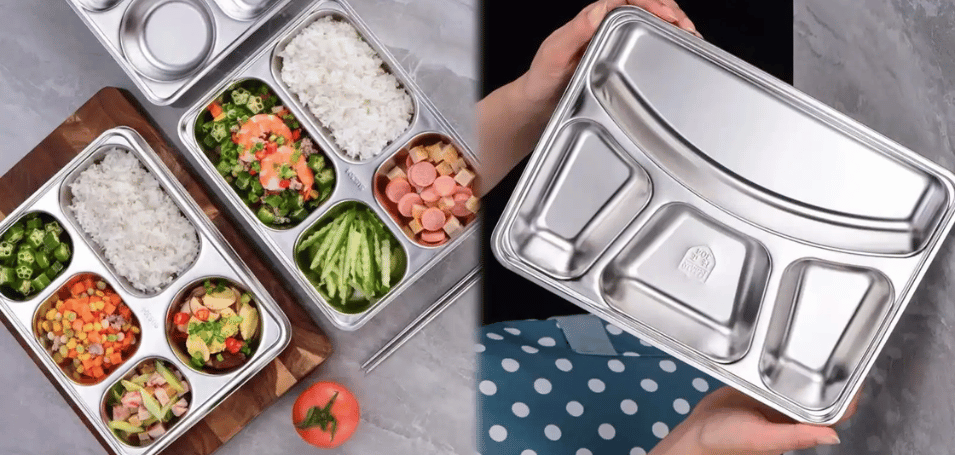
The Weight Test as a Quick Field Check
When samples arrive, pick them up. For the same size and shape, the heavier piece usually means thicker, better steel.
Use it carefully, though. Weight alone can mislead — a denser but lower-grade piece can feel heavy, too. So pair the weight check with grade verification, and never lean on weight by itself.
In practice: Keep one approved sample of each item as a physical “control.” When a new shipment lands, weigh a random piece against your control on a kitchen scale. A drop of 10% or more usually means the factory quietly switched to a thinner gauge between orders. It happens more than you’d think.
Once grade and gauge check out, the next decision is one buyers treat as cosmetic when it’s really operational: finish.
Mirror Polish vs Brushed: Which Finish Should You Specify?
Finish shapes’ appearance, daily cleaning, and how scratches show over the years. This isn’t a quality ranking — it’s a presentation-versus-maintenance trade-off.
Mirror polish gives you that high-shine, premium buffet look. Brushed (or satin) trades some sparkle for far easier upkeep. Both can be excellent 304. The right call comes down to where the piece lives in your operation.
The Head-to-Head Comparison
| Factor | Mirror Polish | Brushed / Satin |
|---|---|---|
| Look | High shine, premium, guest-facing | Muted, modern, understated |
| Scratch visibility | Shows scratches and fingerprints fast | Hides scratches and smudges well |
| Cleaning effort | Higher — needs frequent polishing | Lower — wipes clean in seconds |
| Labor cost over time | Higher — adds polishing rounds to service | Lower — minimal daily upkeep |
| Best use case | Front-of-house buffet, banquet display | High-volume, back-of-house, heavy handling |
Matching Finish to the Setting
Match the finish to the zone, not to a blanket preference.
- Front-of-house buffet and banquet display: Go mirror polish. The shine reads as luxury and lifts the entire spread — exactly what a 5-star banquet floor expects.
- High-volume, heavy-handling items: Go brushed. It hides the inevitable wear of a busy kitchen and trims polishing labor from every shift.
- Mixed operations: Standardize finish by zone. That keeps replacement and cleaning costs predictable, rather than chasing a perfect match across mismatched pieces.
In practice: Luxury properties often run mirror-polish chafers out front and brushed pans in the back for the very same menu. It looks intentional and saves hours of polishing labor each week. The mistake we see is buying mirror polish everywhere, then watching housekeeping fight to keep back-of-house pieces fingerprint-free.
A flawless finish on bad construction still fails, though. So let’s look at where cheap stainless actually breaks first.
How Weld and Edge Quality Separate Real Commercial-Grade
This is where low-cost products come apart, even when the grade is correct. Welds and edges are the hidden durability markers most buyers never inspect — and the first place trouble shows up.
What to Look for in Welds
You want smooth, fully sealed seams. Run a finger along a joint: it should feel continuous, not rough, pitted, or gapped.
Poor welds do two bad things. They trap food and bacteria in tiny crevices, which is a sanitation and audit liability. And they crack under the thermal stress of hot food meeting hot washing, cycle after cycle.
Watch for spot welds and folded seams on items that should be fully welded. On a chafer or a food pan, those shortcuts are a red flag. Fully welded construction costs more for a reason — it lasts, and it passes inspection.
Edge and Rim Finishing
Check the edges and rims next. You want rolled or reinforced edges, not thin folded ones.
Thin, folded edges cut hands, bend out of shape, and trap debris inside the fold. Rolled edges add strength and remove the sharp hazard in one move. This matters for both safety and longevity.
Before you order, ask the supplier for close-up photos or physical samples of the welds and rims. A confident maker shares them without hesitation. Hesitation is its own answer.
Construction quality protects your investment. Certification protects your guests — and protects you in an audit.
Food-Contact Safety and Certifications Buyers Should Require
Certifications verify what marketing can’t. They also protect the property when a health inspector arrives. Treat them as non-negotiables for anything that touches food.
A useful anchor here: the U.S. FDA recognizes NSF/ANSI 2 as the American National Standard for the sanitary design and construction of food equipment. So this isn’t a marketing badge — it’s the standard regulators actually point to.
Certifications That Matter
| Certification | What It Verifies | Who Needs It |
|---|---|---|
| NSF/ANSI 2 | Materials, design, fabrication, construction, and performance for food handling and processing equipment | All hotels — baseline for food-contact gear |
| FDA-compliant material | The steel meets FDA food-contact requirements (including a minimum 16% chromium for food-contact stainless) | All guest-contact catering items |
| EU food-contact compliance | Conformity with EU Regulation (EC) No 1935/2004; in Germany, the LFGB sets national food-contact rules | Buyers sourcing for or shipping to Europe |
NSF/ANSI 2 is the practical baseline for commercial food equipment. FDA-compliant material confirms the steel itself is food-safe. And if you’re buying for European properties, conformity with EU Regulation (EC) No 1935/2004 — and, in Germany, the LFGB — sets a higher documentation bar than many factory defaults.
How to Verify a Certification Claim
A logo on a brochure isn’t proof. Do the two-minute check.
- Request the certificate number and look it up in the certifying body’s public database.
- Confirm it covers the exact SKUs you’re buying, not just the company name. A company-level certificate doesn’t always extend to every product line.
- Treat slow answers as a red flag. A supplier who can’t produce documentation quickly may not have it.
In practice: One question separates real suppliers from resellers in a single move: “Can you send me the NSF certificate numbers for these specific SKUs, and confirm the certificate covers this exact model?” Genuine manufacturers answer within the day. Resellers go quiet or send a generic company logo — which tells you they don’t control their own product line.
Safe and certified is the floor. Now let’s talk about how long the steel should actually last.
How Long Should Commercial Stainless Actually Survive?
Commercial dishwashing is brutal compared to home use. High heat, aggressive detergents, chlorine sanitizers, and constant cycling — day after day. This is where lower grades quietly fail.
What Commercial Dishwashing Does to Stainless
Every cycle puts your stainless steel under real stress:
- High temperatures. Under the FDA Food Code (Section 4-703.11), hot-water mechanical warewashing requires utensil surfaces to reach 71°C (160°F) for sanitation. Your stainless meets that heat over and over.
- Chlorine-based sanitizers that attack weaker, low-nickel alloys
- Mineral buildup from hard water that dulls and spots the surface
- Repeated thermal shock from hot wash to cool rinse
This is exactly why grade matters so much. Quality 304 shrugs off this routine for years, delivering a long service life with minimal corrosion in a well-run kitchen. 201 and 430 start showing rust spots, pitting, and a dull, tired surface within months in a wet, high-chlorine setting.
Proper drying and correct detergent dosing extend the life of good metal. But no maintenance routine rescues the wrong grade.
Lifespan and Corrosion Expectations by Grade
| Grade | Corrosion Resistance | Realistic Commercial Service Life | What You'll See Over Time |
|---|---|---|---|
| 304 (18-8) | Excellent | Long service life under repeated commercial washing, minimal corrosion | Retains shine and integrity with routine care |
| 201 | Fair | Visible pitting within months in wet, high-chlorine use | Rust freckles, pitting, dull patches |
| 430 | Moderate | Acceptable in dry/low-acid use; degrades faster in wet duty | Surface rust where water pools |
The takeaway is simple: pay for 304 on anything that gets washed hard, and it pays for itself over years of service rather than a recurring replacement line in your budget.
With durability understood, the last spec decision is matching all of this to your property’s positioning.
Matching Stainless Steel Specs to Your Hotel Tier
The right spec depends on positioning and use intensity, not just budget. Spec by zone and application rather than slapping one blanket standard across the whole property.
Specification Guide by Property Tier
| Tier | Recommended Grade | Gauge | Finish | Certification Level |
|---|---|---|---|---|
| Economy / select-service | 304 for guest-contact; selective 430 for dry/decorative | Mid gauge | Brushed (low maintenance) | NSF/FDA on food-contact items |
| Mid-range / full-service | 304 standard across catering | Mid-to-heavy gauge | Brushed back-of-house, mirror front-of-house | NSF-certified throughout |
| Luxury / 5-star | 304 throughout | Heavier gauge | Mirror polish front-of-house | Full NSF/FDA documentation, fully welded |
A few notes worth holding onto:
- Economy/select-service: 304 still belongs on guest-contact items. You can use 430 selectively for dry, low-acid, or decorative parts to control cost — but never as a wet-duty shortcut.
- Mid-range/full-service: Make 304 your standard across catering and buffet items, with NSF certification and a solid mid-to-heavy gauge. This is the tier where guests start noticing wear, so don’t cut here.
- Luxury/5-star: 304 everywhere, heavier gauge, mirror polish out front, fully welded construction, and complete certification paperwork on file.
Spec to the tier and the zone, and you stop overpaying in some areas while under-building in others.
The Specification Gap: Commercial-Grade vs. “Catering-Quality” Labels
The phrase “catering quality” or “commercial-grade” on a product listing has no regulated definition. Anyone can print it. Genuine commercial-grade stainless differs in measurable, verifiable ways — and the gap shows up clearly on the spec sheet.
Genuine commercial-grade stainless specifications include:
- Grade stated and verified (304 / 18-8) with a mill certificate per lot
- Gauge/thickness listed for every product type
- Construction noted: fully welded, sealed seams
- Edge finishing specified (rolled or reinforced)
- Finish type by zone (mirror or brushed)
- NSF/ANSI 2 and FDA-compliant material with verifiable certificate numbers
- Corrosion and wash-durability data
- Dimensional and load-test results for structural items
Cheap “catering-quality” labels typically include:
- A grade claim (“stainless steel” or “304”) with no certificate
- Thin marketing language (“commercial,” “heavy-duty”) and nothing measurable
- Country of origin
- Care instructions
That’s the whole list. No verifiable grade. No gauge. No weld spec. No certification numbers. No durability data. When a quote appears suspiciously short, the missing lines are the warning.
The Buyer’s Spec Checklist
Paste this straight into your next RFQ or quality check. Each line closes a common loophole.
- Grade confirmed: 304 / 18-8 stainless, mill certificate required per lot
- Gauge stated: thickness specified for each product type
- Finish specified by zone: mirror (front-of-house) vs brushed (back-of-house)
- Construction: fully welded, sealed seams, and rolled/reinforced edges required
- Certification: NSF/ANSI 2 and FDA-compliant material (add EU 1935/2004 / LFGB for Europe) with verifiable numbers
- Durability: corrosion and wash-durability data requested
- Samples: physical sample approval required before bulk order, with one retained as a control
If a supplier satisfies every line above, you’re dealing with genuine commercial-grade. If they dodge even two or three, keep looking.
Frequently Asked Questions
Is 201 stainless steel safe for use in hotel catering?
For limited, low-contact, decorative use, 201 can be acceptable. For anything that touches food or is subject to repeated washing, it’s the wrong choice. 201 has far less nickel, so it corrodes and pits faster in wet, salty, high-chlorine kitchens. Stick with 304 for guest-contact catering items.
How can I tell the difference between 304 and 201 without lab testing?
Use a few quick screens together. True 304 is non-magnetic, so a strongly magnetic piece raises a flag. 304 also tends to feel heavier and cost more, so a suspiciously cheap “304” deal is a warning sign. None of these is proof, though — for large orders, confirm with XRF testing or a mill certificate tied to your lot.
Does a higher gauge number mean stronger steel?
No — it’s the opposite. A higher gauge number means thinner steel. So 22-gauge is thinner and weaker than 18-gauge. When you want durability for chafers or buffet frames, ask for a lower gauge number.
Is mirror polish worth the extra maintenance?
For front-of-house buffet and banquet display, yes. The shine reads as premium and lifts the whole presentation. For heavy back-of-house items, brushed is the smarter pick — it hides scratches and cuts polishing labor every shift. Match the finish to where the piece actually works.
What certification should I require at a minimum?
NSF/ANSI 2-plus and FDA-compliant materials are the practical baseline for guest-contact catering items. Add EU 1935/2004 (and LFGB for Germany) if you’re sourcing European properties. Always ask for verifiable certificate numbers tied to your exact SKUs, not a generic company logo.
Why does my “stainless steel” equipment still rust?
Usually one of four reasons: the grade is too low (201 or 430 in wet duty), the welds are poor and trapping moisture, heavy chlorine exposure from sanitizers, or improper drying that leaves standing water. Fix the grade and the handling, and the rust problem usually disappears.
Conclusion: Spec It Right Before the Order Ships
“Commercial-grade” means measurable specs, not marketing language. Know the numbers, inspect the samples, and require the documentation before you commit a dollar.
The essentials are straightforward: 304 (18-8) grade as your baseline, the right gauge for each product type, fully welded seams with reinforced edges, NSF/ANSI 2 and FDA-compliant material, and proven corrosion resistance under commercial washing. Get those right, and the finish becomes a styling choice rather than a gamble.
If you’re sourcing catering stainless and want to test these specs against real product samples, ask your supplier for the full set: a mill certificate per lot, NSF and FDA documentation tied to your exact SKUs, gauge confirmation, and a washed sample you can run through your own dishwasher before the bulk order ships. The suppliers who can produce all of that are the ones worth a long-term relationship. The ones who can’t have just told you everything you need to know.
So here’s your next step: spec by application and tier, request physical samples and certificates up front, and verify the grade before the container leaves the factory. Do that, and your catering stainless steel stops being a recurring replacement cost and starts being equipment that earns its place for years.
Sources and Methodology
This guide focuses on the measurable, verifiable specifications that define commercial-grade stainless steel for hotel and catering use. Material grades, certifications, and food-safety standards were cross-checked against official standards bodies and regulatory sources. Where specific brand grades or exact durability figures could not be independently verified, the language was kept conservative and tied to recognized industry standards rather than unconfirmed claims.
Primary sources reviewed:
- NSF/ANSI 2 – Food Equipment Standard — defines minimum food protection and sanitation requirements for the materials, design, fabrication, construction, and performance of food handling and processing equipment. NSF Food Equipment Standards
- U.S. FDA – List of American National Standards for Food Equipment — confirms FDA recognition of NSF/ANSI 2 as the standard for sanitary design and construction of commercial food equipment. FDA fact sheet (PDF)
- U.S. FDA food-contact material requirements — food-contact stainless steel must have a minimum chromium content of 16%.
- FDA Food Code, Section 4-703.11 — hot-water mechanical warewashing requires utensil surfaces to reach 71°C (160°F) for sanitation.
- EU Regulation (EC) No 1935/2004 — the framework regulation on materials and articles intended to come into contact with food. In Germany, the LFGB (Lebensmittel-, Bedarfs- und Futtermittelgesetzbuch) sets national regulations for food contact.
Grade definitions for 304 (18-8), 201, and 430 reflect widely published stainless steel composition ranges. Recommended gauge ranges and tier-based specifications reflect common commercial foodservice procurement practice and should be confirmed against supplier mill certificates and your own sample testing before any bulk order.