
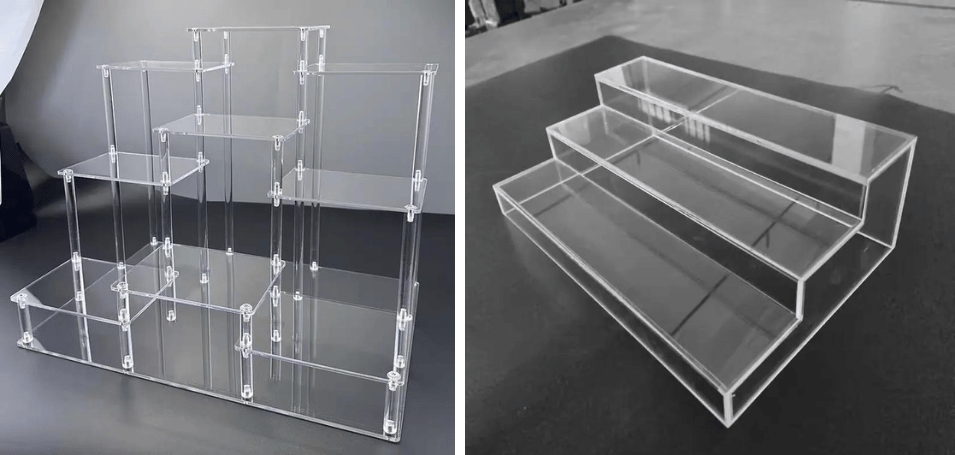
Every supplier calls their display stands “crystal clear,” “premium acrylic,” or “commercial-grade.” But when the quotes arrive, most buyers compare two things: price and how clear the stand looks in a product photo. The specs that actually predict whether a stand yellows, cracks under a tray of pastries, or hazes over after a month of cleaning rarely make it onto the listing.
A premium commercial acrylic display stand is defined by measurable specifications: cast (not extruded) acrylic for clarity and crack resistance, adequate panel thickness rated for the intended load, verified UV stabilization against yellowing, polished flame- or diamond-finished edges free of chips and crazing, food-contact certification where it touches food (FDA, EU 1935/2004, LFGB), and surface treatment for scratch and cleaning durability. Acrylic type, thickness, and edge quality matter far more than initial shine alone.
We supply acrylic display stands and serving equipment to hotels, buffet operations, dessert and bakery displays, and catering companies across multiple regions. We see the gap between what gets marketed and what durable, safe procurement actually requires. It is wide. Below are all the specifications that matter — with the practical numbers and the questions to ask.
Cast or Extruded — Which Acrylic Should Define Your Display Stand?
The acrylic type is the single biggest spec choice you make. It drives clarity, strength, crack resistance, and cost. Get it right, and your displays stay clear and intact for years. Get it wrong, and you’ll watch the edges chip and the panels craze after a few months of buffet service.
The acrylic type should be selected based on how the stand will be handled and loaded, not by the word “acrylic” on a label. Cast acrylic offers superior optical clarity and resists cracking during fabrication and under load, making it the right choice for heavy, frequently handled displays. Extruded acrylic is cheaper and more uniform in thickness but more brittle at the edges, making it well-suited to light, flat, low-stress pieces. The manufacturing method predicts performance far more reliably than the appearance of a fresh piece.
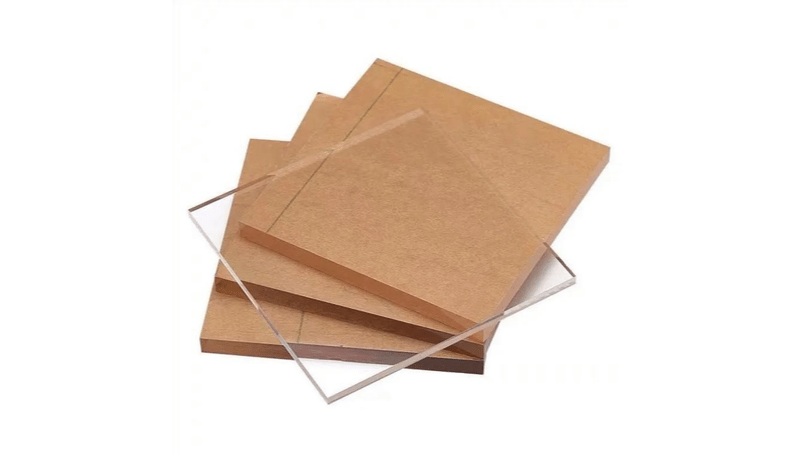
Here’s the catch. “Acrylic” on a product listing tells you almost nothing on its own. “Crystal clear” is a marketing phrase, not a spec. The same word covers both a premium cast panel that machines cleanly and a brittle extruded sheet that chips when you drill it.
Cast vs. Extruded Acrylic
| Factor | Cast Acrylic | Extruded Acrylic |
|---|---|---|
| Clarity | Superior optical clarity | Slight haze or distortion possible |
| Strength / crack resistance | Resists cracking and chipping under load | More brittle, especially at edges |
| Thickness consistency | Slight variation | Very uniform |
| Machinability | Cuts, drills, and polishes cleanly | Can chip and melt during fabrication |
| Cost | Premium | Cheaper |
| Best use | Heavy, high-clarity, frequently handled display | Light, flat, low-stress pieces |
How to Read “Premium Acrylic” Claims
The terms “PMMA,” “plexiglass,” and “acrylic” all describe the same material family. None of them tells you the grade or the manufacturing method. A supplier can call brittle extruded stock “premium plexiglass” and be technically accurate while selling you the weaker product.
There’s a quick visual cue. Genuine quality cast acrylic often shows a faint blue tint along a cut edge. A green or yellow edge tint frequently signals cheaper stock. It’s not foolproof, but it’s a useful first screen when a sample lands on your desk.
Buyer tip: Request confirmation of cast vs. extruded and the material spec in writing. “High-quality acrylic” is not a spec. “Cast PMMA, 8mm” is.
What Thickness and Load-Bearing Standards Should Buyers Check?
Your real cost isn’t the unit price. It’s the unit price plus everything that bows, cracks, or gets pulled from rotation. Panel thickness determines whether a stand can hold its load without flexing — and underspec panels sag, bow, and eventually crack in service.
Thickness must match both the load and the span. A small dessert riser and a multi-tier buffet display have completely different needs. Thin panels flex under weight, and repeated flexing on under-thick acrylic leads to stress cracking, known as crazing, over time. The right thickness is the one rated for the actual load and shape — not simply the thickest panel available.
Flexing isn’t just a cosmetic problem. Every time an under-thick shelf bows under a tray, it stores stress. Over weeks of service, that stress shows up as a web of fine cracks that no cleaning will remove.
Thickness Guidance by Product Type
| Product Type | Typical Thickness Range | Why It Matters |
|---|---|---|
| Small risers / sign holders | Thinner panels (e.g., 3–5mm) | Light loads tolerate less material |
| Dessert and cake stands | Mid-thickness (e.g., 5–8mm) | Supports plated weight without flex |
| Multi-tier buffet displays | Thicker panels + reinforced joints | Carries stacked food weight safely |
| Large shelving / tiered towers | Thickest panels + structural bracing | Handles span and keeps the unit stable |
Why Thicker Isn’t Always Better
There’s a trade-off most buyers miss. Over-spec the thickness everywhere, and you pay for material you don’t need, plus heavier pieces that staff handle through every shift. Under-spec it and you watch shelves bow under load.
Common mistake → fix: Picking one thickness for an entire range, either too heavy across the board or too thin where it counts. Instead, match thickness to each piece’s real load and span. A sign holder doesn’t need buffet-tier material.
Buyer tip: Request the actual panel thickness in millimeters and the rated or tested load for the specific shape and span you’re buying.
How Do You Verify UV and Yellowing Resistance?
Yellowing is the leading reason commercial display stands get replaced early. Cheap acrylic clouds turn yellow under light, and there’s no fixing it once it starts. A yellowed stand makes even fresh food look tired.
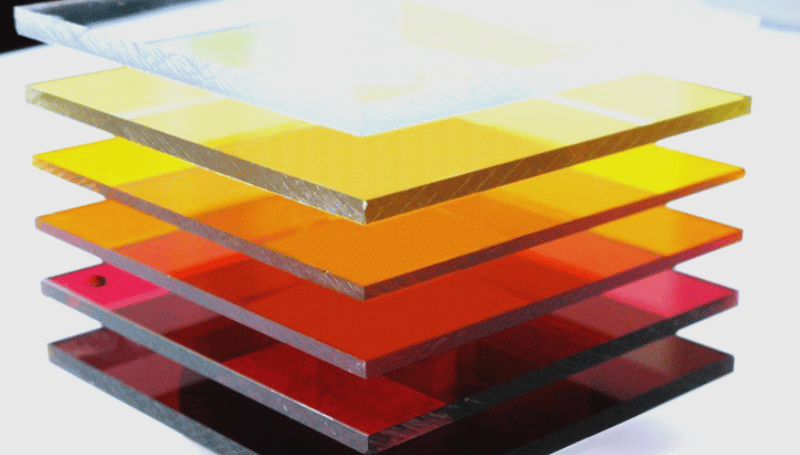
UV resistance is a formulation issue, not a finish you can see out of the box. Premium cast acrylic with UV stabilizers holds its clarity for years under display lighting and sunlight. Budget stock without stabilizers can yellow within months when exposed to sunlight or bright display lamps, or during outdoor and poolside use. The cause is UV exposure breaking down non-stabilized acrylic, and the damage is usually irreversible.
What Drives Yellowing in Acrylic
Three factors accelerate it: direct UV from windows and skylights, close proximity to display lighting, and heat. Non-stabilized acrylic absorbs that energy and breaks down at the molecular level.
The result is rarely uniform. Yellowing tends to be uneven, which means a partial replacement leaves you with a mismatched display — one clear stand next to one that’s gone amber.
Buyer tip: For window-lit, brightly lit, or outdoor displays, specify UV-stabilized cast acrylic from the start.
How to Test and Verify
Recognized weathering and accelerated UV-resistance test methods exist, and reputable manufacturers run them. If your display sits in sunlight or under strong lamps, it’s worth requesting this data before you commit.
There’s also a fast field check. Compare a sample against a reference piece of known quality under bright light. Look for any tint, haze, or cloudiness straight out of the box — quality cast acrylic should read as truly colorless.
Buyer tip: Request UV-stability or accelerated-weathering test data for sunlit or outdoor installations, and ask whether the supplier offers a warranty against yellowing.
What Separates Quality Edge Finishing From a Cheap Cut?
Edges are the first thing a buyer judges up close, and the first place a cheap stand gives itself away. They affect appearance, safety, and durability all at once — a poorly finished edge looks unfinished, cuts hands, and cracks under stress.
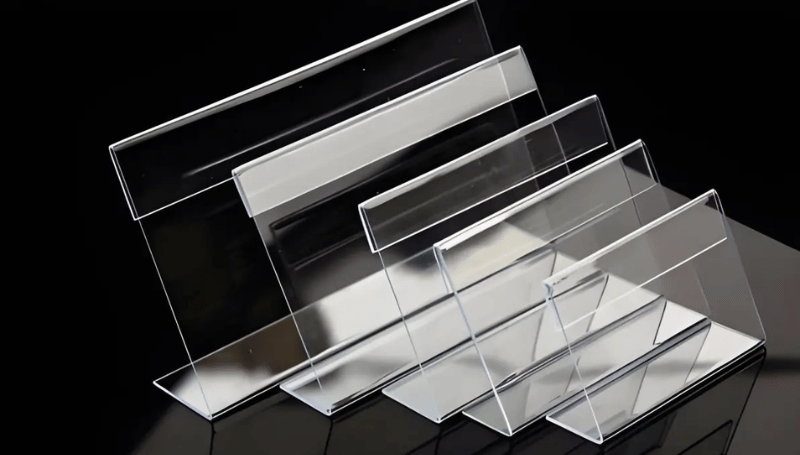
Quality edge finishing is clean, consistent, and matched to its purpose. Diamond-polished edges give a clear, glass-like finish for premium presentation. Flame-polished edges are glossy and quick but can introduce internal stress if overdone. Sanded or matte edges are functional and lower-cost. Raw saw-cut edges are sharp, unfinished, and a clear red flag against any “premium” claim. Consistent edge work signals controlled manufacturing.
Edge Finishes and What They Mean
| Edge Finish | Description | Appearance | Best Use / Note |
|---|---|---|---|
| Diamond-polished | Machine-polished to a clear, glass-like edge | Premium, optically clear | Front-of-house, high-end display |
| Flame-polished | Quick gloss from controlled heat | Glossy but can stress the edge | Mid-range; risk of internal stress if overdone |
| Sanded / matte | Mechanically smoothed, non-reflective | Functional, frosted look | Back-of-house, budget pieces |
| Saw-cut (raw) | Unfinished cut edge | Sharp, cloudy, marked | Lowest quality — a red flag for “premium.” |
Spotting Edge Defects
Hold a sample under strong light and look closely at the edges and corners. The warning signs stand out once you know them: chips, visible saw marks, cloudy or burnt edges, crazing (those fine stress cracks), and sharp unfinished corners.
Common mistake → fix: Judging a stand by the shine of its flat face while ignoring the edges, where quality and safety actually show. Instead, inspect every edge and corner.
Buyer tip: Run a finger along the edges and corners under strong light, and request the specified edge finish — for example, diamond-polished — in writing.
What Food-Contact Safety Certifications Should Procurement Require?
When a stand touches food — risers, trays, tiered dessert displays — food-contact safety is not negotiable, and it’s fully verifiable. Certifications exist for two reasons: to protect your guests and to keep you compliant in your operating market.
Any food-contact acrylic should carry certification valid for your market: FDA compliance for the United States, EU Regulation 1935/2004 for Europe, or LFGB for the stricter German benchmark. Not all acrylic is food-grade — standard display acrylic is not automatically food-safe. A supplier must meet the standards of your market, not just the standards of where the product is made.
Certifications That Matter
| Certification | What It Verifies | Region / Best For |
|---|---|---|
| FDA | Food-contact material compliance for the US | United States operations |
| EU 1935/2004 | General food-contact safety framework | European Union operations |
| LFGB | Stricter migration and safety testing | Germany: premium global benchmark |
| ISO 9001 | Supplier quality management system | Supplier vetting baseline |
Food-Grade vs. Standard Acrylic
Here’s the gap buyers underestimate. Standard display acrylic is formulated for clarity and strength, not for sitting under food. Under acidic or oily foods, unverified material carries a migration risk — substances leaching from the acrylic into what your guests eat.
Food-grade acrylic is made and tested for exactly this contact. The only way to know which one you’re getting is documentation tied to the specific product.
Buyer tip: For any direct food-contact stand, request the food-contact certificate and material confirmation for the specific SKU — and verify the certificate numbers yourself.
Does the Stand Survive Scratching, Cleaning, and Commercial Use?
Acrylic scratches more easily than glass. That’s its main weakness, and commercial cleaning destroys poorly specified stands fast. Surface durability is where “premium” claims most often fall apart.
Acrylic is inherently softer than glass, so scratch resistance and the right cleaning protocol together decide how long a stand stays presentable. High-frequency commercial wiping, stacking, and handling wear it far faster than occasional home use. Hard coatings or abrasion-resistant treatments extend life, while abrasive pads and the wrong cleaners cause hazing and crazing. Out-of-the-box clarity tells you nothing about how a stand looks after 200 wipe-downs.
Scratch Resistance and Surface Treatment
Because the base material is soft, a scratch-resistant or hard coating makes a real difference to lifespan. Without it, every stack and every wipe leaves micro-scratches that build into a permanent haze.
The cleaning method matters just as much. Abrasive pads and ammonia-based cleaners are the fastest way to ruin an acrylic surface, causing it to fog within weeks.
Buyer tip: Ask whether the surface carries a scratch-resistant coating, and request the recommended cleaning protocol in writing.
Cleaning and Chemical Compatibility
This is where good stands die from bad habits. Many common cleaners — ammonia, alcohol-based sprays, harsh solvents — cause crazing and clouding in acrylic. The fine cracks they create are permanent.
Common mistake → fix: Cleaning acrylic like glass with standard window cleaner, which leads to fogging and cracks. Instead, train staff to use acrylic-safe cleaners and only soft microfiber cloths.
Buyer tip: Confirm chemical compatibility and that pieces tolerate the cleaning agents your staff actually use day to day.
How Do You Spot Marketing Language vs. Real Specifications?
“Premium acrylic” and “commercial-grade” have no regulated meaning. Anyone can print them. Your job as a buyer is to map every quality claim to a number, a test, or a certificate before you sign a bulk order.
Genuine premium acrylic stands come with documentation: confirmation of cast vs. extruded, a stated panel thickness and rated load, UV-stability test data, a defined edge finish, and food-contact certificate numbers where relevant. Retail “premium” listings typically offer only a material name, a shine, and care instructions. The specification gap is how you tell them apart.
Common Marketing Claims and What to Request Instead
| Marketing Claim | What to Request Instead |
|---|---|
| “Premium / crystal-clear acrylic” | Cast vs. extruded confirmation + material spec |
| “Strong / heavy-duty” | Panel thickness (mm) + rated load for the shape |
| “Won’t yellow / UV-resistant” | UV-stability / accelerated-weathering test data |
| “Food safe” | FDA / EU 1935/2004 certificate numbers |
| “Scratch-resistant” | Coating confirmation + recommended cleaning protocol |
Why You Should Evaluate Tested Samples
Factory-fresh samples are built to impress. That’s their whole purpose. What you actually want to see is how a piece performs after stress — real loading, real lighting, and real cleaning.
Common mistake → fix: Approving an order on out-of-the-box clarity alone. Instead, request samples and the full spec sheet, and run them through your own lighting, loading, and cleaning routine before making a bulk purchase.
Buyer tip: Ask for samples and run them under your actual display lamps with your actual cleaner. Quality stock holds its clarity; weak acrylic starts hazing and crazing fast.
How Should Operation Type Shape Your Purchasing Decisions?
There’s no single “best” acrylic display stand. A dessert counter and an outdoor buffet have the same quality standard but should never carry the same specifications. The right choice aligns with your service model, environment, and presentation goals.
Operation type drives acrylic choice, thickness, finish, and food-contact priority. Buffet and banquet displays need load-bearing strength and multi-tier stability. Dessert and bakery counters prioritize clarity, food-contact certification, and easy cleaning. Hotel breakfast service demands durability under repeated handling. Retail merchandising needs UV resistance under store lighting more than food-contact safety. Match the spec to the operation to protect both presentation and total cost.
Operation-Type Specification Guide
| Operation Type | Priority Specs | Recommended Build | Presentation Note |
|---|---|---|---|
| Buffet / banquet display | Load-bearing, multi-tier stability, food-contact safety | Thicker cast acrylic, reinforced joints | Sturdy, high-traffic ready |
| Dessert / bakery display | High clarity, food-contact certification, easy cleaning | Cast acrylic, diamond-polished edges | Showcase-quality, food-first |
| Hotel breakfast / brunch | Durability, repeated handling | Cast acrylic with scratch-resistant surface | Holds up shift after shift |
| Retail / merchandising | Clarity and UV resistance under store lighting | UV-stabilized acrylic | Stays clear under display lamps |
Positioning-Based Trade-offs
Think in terms of cost per use, not unit price. A diamond-polished cast dessert stand costs more upfront but earns it back on a pastry counter, where clarity drives sales. A reinforced multi-tier buffet display costs more but survives the load and handling that would crack lighter stock.
For any high-volume operation, two practical factors decide long-term cost: stacking and storage efficiency, and reorder availability. A discontinued range forces you to replace an entire display rather than a single damaged piece — and mismatched stands look careless on a buffet line.
Buyer tip: Confirm long-term SKU availability before you standardize on a range, and check that pieces nest or stack efficiently for your storage space.
The Acrylic Display Stand Procurement Checklist
A premium acrylic display stand is defined by measurable specs — not marketing language. Know the type. Test the samples. Verify the certifications.
Bring this checklist to your next supplier conversation and ask for documentation against every line:
- Confirm cast vs. extruded acrylic and the material spec
- Verify panel thickness (mm) and rated load matched to the application
- Request UV-stability / weathering data for lit or outdoor use
- Confirm the edge finish (e.g., diamond-polished) and inspect for chips and crazing
- Collect food-contact certificate numbers (FDA / EU 1935/2004 / LFGB) for food-touching pieces and verify them
- Confirm scratch-resistant treatment and the cleaning protocol
- Evaluate tested samples under your own lighting, load, and cleaning — not factory-fresh pieces
- Match acrylic type, thickness, and finish to your operation type
- Confirm reorder availability and stacking/storage efficiency for the SKU
Any display stand worth buying comes with this documentation, not just a sales pitch. If a supplier can answer each line quickly, you’re talking to someone who understands their product. If they can’t, dig deeper before you commit.
If you’re sourcing acrylic risers, dessert stands, tiered buffet displays, or bakery showcases and want to compare these specifications against real products, contact our team for a quote. We’ll send you tested samples and the full specification sheet — including food-contact certificates — so you can verify exactly what your guests will see and what your staff will handle, before you place a bulk order.