
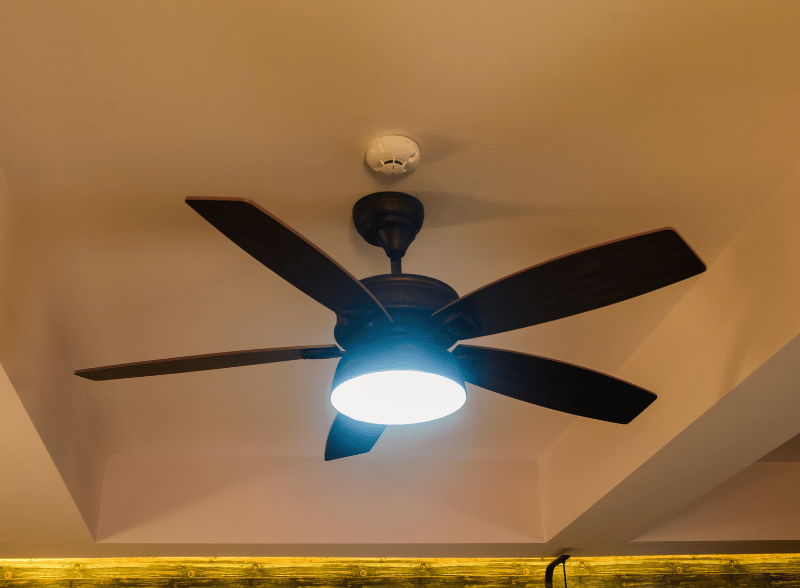
It’s 2 AM in one of your premium suites. A guest who paid top rate for a quiet, restful night is staring at the ceiling instead of sleeping. The fan above the bed wobbles slightly on every rotation. It ticks. It hums — a low, persistent drone that no one notices at check-in but everyone notices at 2 AM. When the guest reaches for the remote to dim the light, the LED flickers and buzzes instead of fading. And in the morning, there’s a faint film of rust dust on the white duvet, shed from a finish that never stood a chance against the coastal air.
That’s the paradox of the ceiling fan with light. It’s meant to deliver comfort and atmosphere. Chosen badly, it quietly manufactures noise complaints, uneven lighting, inflated energy bills, and a steady stream of maintenance tickets.
Now multiply that across 200 rooms. The wrong fan isn’t one bad night — it’s a pattern of one-star reviews mentioning “noisy fan,” a utility bill that runs higher than it should every single month, and a replacement cycle that arrives years too early. For a procurement team, fan selection is a compounding decision.
This guide breaks down how ceiling fans with light have evolved, what actually defines a superior unit, and how the right choice protects guest comfort, your utility budget, and your design vision — backed by numbers you can verify.
A superior hotel ceiling fan with light is defined by measurable performance, not appearance alone: a quiet, efficient DC motor running under 35 dBA, strong airflow rated in CFM, integrated LED lighting with proper dimming and color temperature, low energy draw, a moisture or wet rating matched to the location, and a corrosion-resistant finish built for the environment. Motor type, noise level, airflow, and lighting quality matter far more than blade span or price alone.
We partner with hotels, resorts, and villa projects on in-room and outdoor comfort solutions. We see the gap between what gets marketed and what a durable, guest-pleasing fixture actually delivers. Here’s everything that matters.
The Evolution of In-Room Comfort — From Noisy Blades to Silent Airflow
To understand what makes a modern fan good, you have to understand what made the old ones a problem.
For decades, ceiling fans ran on AC motors — essentially scaled-down versions of industrial motors. They were heavier, ran hotter, and drew far more power than they needed to. Worse for hospitality, they were loud. As bearings wore and balance drifted, that quiet new fan became the humming, wobbling, ticking unit your night-shift staff fielded complaints about. Speed control was crude, usually three clunky steps, and the light kit was almost always an afterthought bolted to the bottom.
Hotels lived with a bad trade-off: you got airflow and ambiance, but they came bundled with noise, vibration, and energy cost.
The shift came with the DC motor. A modern DC-motor fan draws a fraction of the power, runs dramatically quieter, starts and stops smoothly, and offers fine speed control across many steps. Alongside it came integrated LED lighting — designed as part of the fixture rather than tacked on — with built-in dimming and adjustable color temperature.
There was a parallel design shift, too. The fan stopped being a utilitarian box on the ceiling and became a styled fixture that completes a room’s look.
Less power. Less noise. Less vibration. More control. The DC motor changed what a ceiling fan can be in a guest room.
Knowing what separates a modern unit from a dated one is the first step to specifying the right one. So let’s break down the specs.
Deconstructing the Modern Marvel — What Defines a Superior Hotel Ceiling Fan With Light?
Choosing the right fan is a strategic decision. It shapes guest experience, operating cost, and the look of every room it hangs in. And it comes down to a suite of specifications working together — not blade span, and definitely not price alone.
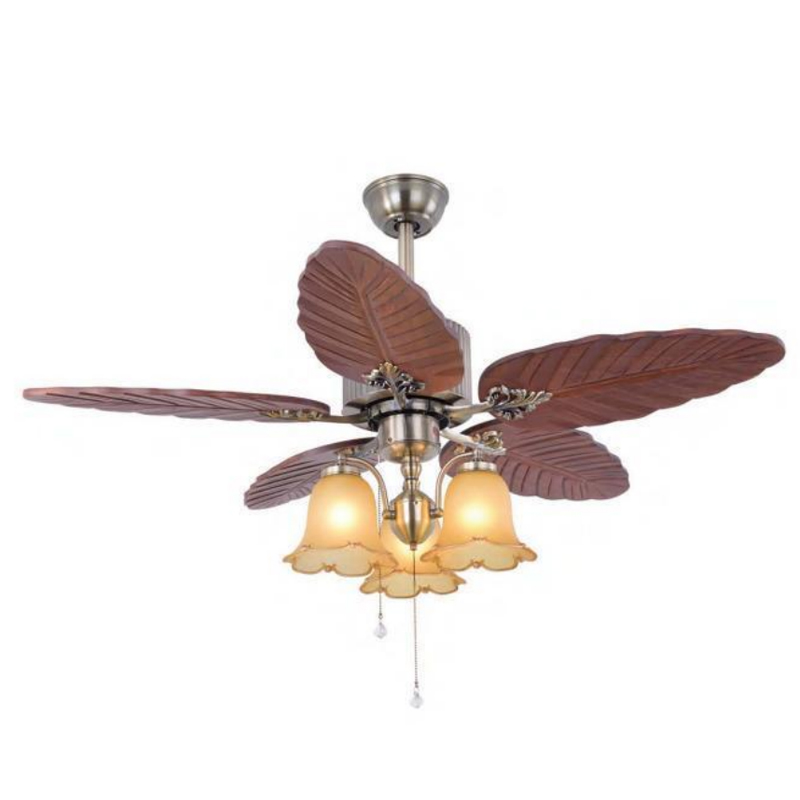
Here’s the rule to carry into every supplier conversation: every claim — “quiet,” “energy-saving,” “premium” — should map to a number or a rating. If it can’t, treat it as marketing language. The nine areas below are your spec checklist for any RFQ.
1. DC vs. AC Motor — The Foundation of Performance
The motor is the single biggest predictor of noise, energy use, and lifespan. A DC motor draws far less power — often 60–70% less than an equivalent AC unit — runs cooler and quieter, starts and stops smoothly, and gives you more speed steps for precise comfort control.
AC’s only real advantage is a lower upfront cost. That rarely wins once you factor in energy use and replacement over the fixture’s life.
Buyer tip: Confirm DC brushless motor construction in writing, and ask for rated wattage at each speed — not just “energy efficient.”
2. Noise Level (dBA) — The Silent Sleep Protector
Noise is the number-one fan-related complaint in guest rooms, and it’s the one that ends up in reviews. A quality unit runs well under 35 dBA — effectively inaudible against the ambient noise of a room. Cheaper fans start quietly and get louder as they age and wear.
Buyer tip: Request a tested decibel rating, not a “whisper-quiet” phrase. Numbers don’t wobble; marketing does.
3. Airflow (CFM) and Blade Design — Comfort You Can Feel
A fan can be perfectly silent and still fail if it doesn’t move enough air. Airflow is measured in CFM (cubic feet per minute), and the real goal is high CFM at low noise and low power draw. Blade count, pitch, span, and material all drive that number.
Buyer tip: Ask for the CFM rating and CFM-per-watt efficiency. Together they tell you whether a fan actually cools or just spins.
4. Integrated Lighting Quality
The “with light” half matters as much as the fan. Look at how the LED is integrated, the lumen output, how evenly the light spreads, and how well glare is controlled. There’s a real difference between a true integrated LED fixture and a cheap light kit clipped onto a fan body.
Buyer tip: Uneven or glaring light undercuts the entire room ambiance. Inspect the light distribution on a sample, not just the spec sheet.
5. Dimming and Color Temperature
Adjustable color temperature — warm to neutral, measured in Kelvin — and smooth dimming let a single fixture shift from bright, functional light to relaxed evening ambiance. The catch is compatibility: dimming has to play nicely with your room control systems and any remote or app interface.
Buyer tip: Confirm flicker-free dimming across the full range and the Kelvin range on offer. A buzzing, flickering dim is worse than no dimming at all.
6. Energy Efficiency — A CFO’s Best Friend
A low-wattage DC motor plus efficient LED lighting, running daily across hundreds of rooms, adds up to meaningful annual utility savings. This is also where the fixture earns its place in your sustainability story, contributing to green certifications and ESG reporting.
Buyer tip: Ask for rated motor wattage at each speed and the lighting wattage separately, so you can model the real annual cost.
7. Moisture and Outdoor Rating
Fans carry a rating that tells you where they belong: dry-rated for interior rooms, damp-rated for covered terraces and breezeways, and wet-rated for fully exposed areas. Put the wrong rating in the wrong place, and it fails fast.
Buyer tip: Match the rating to the exact install location, not a generic “outdoor” label. A covered terrace and an exposed poolside need different units.
8. Finish and Corrosion Resistance
Coastal, poolside, and humid environments destroy under-specified finishes — rust, pitting, and discoloration set in within a season. What protects a fan is finish quality, a sealed motor, and corrosion-resistant hardware throughout.
Buyer tip: For beachfront and tropical projects, specify corrosion-resistant construction explicitly. Don’t assume “outdoor” means salt-air ready.
9. Customization and Brand Fit
A modern fan is a design element. Finish, blade material, and color, light styling, and control options can all be tailored to a room’s interior and your brand identity. That’s what turns a generic appliance into part of your design language.
Buyer tip: Ask which elements can be customized and the minimum order quantity for custom finishes before you commit to a range.
Spec Snapshot — What to Request vs. Common Claims
| Marketing Claim | What to Request Instead |
|---|---|
| “Whisper-quiet” | Tested noise level in dBA |
| “Powerful airflow” | CFM rating + CFM-per-watt |
| “Energy-saving” | Motor wattage per speed + LED wattage |
| “Outdoor-ready” | Damp- or wet-rated certification |
| “Premium finish” | Corrosion-resistance spec for the environment |
| “Dimmable LED” | Flicker-free dimming range + Kelvin range |
Beyond Cooling — How the Right Fan Drives Comfort, Savings, and Design Harmony
A superior ceiling fan with light pays off on three fronts at once: guest experience, operating cost, and how the room looks and feels. Get the spec right and all three move in your favor.
Guest Comfort and Sleep Quality
Silent operation plus steady, even airflow is what guests actually feel — a room that stays comfortable through the night without a sound to remind them the fan is there. That directly shapes reviews and repeat stays. The lighting carries its own weight: adjustable warmth and smooth dimming let guests set their own mood, from reading bright to winding down.
Energy Savings That Compound
Here’s the math that matters to your CFO. A DC fan paired with LED lighting draws a fraction of the current that legacy AC units draw. Across full occupancy and long daily run hours, that gap compounds into substantial annual savings — not a rounding error, but a line item. And the lower draw supports green certifications and makes it easier to back up ESG reporting with real figures.
Design Harmony and Brand Consistency
A coordinated finish and considered styling make the fan part of the room’s design story rather than an afterthought hanging from the ceiling. Specifying consistent fixtures across room types gives your property a cohesive, intentional feel — the kind guests register without quite knowing why.
Technical Deep Dive — The Anatomy of a Hospitality-Grade Ceiling Fan With Light
Specs are easier to judge when you can see what each one does for you. Here’s a representative snapshot for a flagship hospitality model, framed around what the engineering means in practice.
| Specification | Example Value | What It Means For You |
|---|---|---|
| Motor Type | DC brushless | Quiet, efficient, long-lasting operation |
| Power Consumption (motor) | ~25–35W at high speed | Drastically lower energy cost vs. AC units |
| Noise Level | < 35 dBA | Virtually inaudible for undisturbed sleep |
| Airflow | High CFM at low draw | Strong cooling without the noise penalty |
| Lighting | Integrated LED, dimmable | Even glare-free light with mood control |
| Color Temperature | Adjustable (warm–neutral Kelvin) | One fixture, bright function to soft ambiance |
| Speed Settings | Multiple steps + remote/app | Precise guest comfort control |
| Rating | Damp/wet options | Matched to interior, terrace, or coastal use |
| Finish | Corrosion-resistant | Built to survive humidity and salt air |
| Customization | Finish, blades, controls | Tailored to your brand and interior |
Exact figures vary by model and configuration. Always request the spec sheet for the specific unit and confirm it against your actual install location.
How Should Operation and Location Shape Your Choice?
There’s no single “best” fan. The right specification depends on where it hangs and how the space is used. A fan that’s perfect over a guest bed is the wrong call over an exposed poolside deck.
| Location / Scenario | Priority Specs | Recommended Build |
|---|---|---|
| Guest rooms/suites | Ultra-low noise, dimmable warm light, and efficiency | DC motor, integrated LED, dry-rated |
| Villas / high-ceiling spaces | Strong airflow, correct downrod sizing, and presence | High CFM, larger span, styled finish |
| Outdoor terraces / covered dining | Moisture resistance, durable finish | Damp-rated, corrosion-resistant |
| Lobbies / public areas | Design impact, even lighting, quiet | Statement finish, high-output LED |
| Beachfront/poolside resorts | Salt-air corrosion resistance, wet rating | Wet-rated, sealed motor, marine-grade finish |
Buyer tip: Confirm downrod length and ceiling-height compatibility for each space, and match the moisture rating to the exact install point — not a building-wide assumption. One spec rarely fits a whole property.
More Than a Fan — A Complete Comfort and Lighting Solution
Sourcing the right fixture is only the first step. The properties that get this right don’t buy fans piecemeal off a catalog — they plan a coordinated program with a partner who supports the whole project.
Here’s how that partnership works:
- Consultation: We work with your design and engineering teams to match specs to each space and climate, room by room.
- Customization: We tailor finish, blades, lighting, and controls to your brand identity, so the fixture reads as part of your design language.
- Specification support: We provide tested data — dBA, CFM, wattage, ratings, and certifications — that you can verify before committing.
- Logistics and installation guidance: We coordinate global manufacturing, shipping, and install-ready delivery across the project, on schedule.
A coordinated fixture program beats scattered ordering every time — in consistency, total cost, and the headaches you avoid down the line.
Give Your Guests Silent Comfort and a Better Stay
The ceiling fan with light has finished its transformation. It’s no longer a noisy, energy-hungry liability lurking on your guest satisfaction surveys. Done right, it’s a silent, efficient, design-forward asset — one that protects sleep, trims your utility bill, and quietly elevates the room.
What separates a fan worth buying from one you’ll regret is simple: motor type, noise level, airflow, lighting quality, ratings, and finish — every one verified with a number.
Bring this checklist to your next supplier conversation:
- Confirm DC vs. AC motor and rated wattage
- Verify noise level (dBA) and airflow (CFM)
- Check integrated LED quality, dimming, and color temperature
- Match the moisture/outdoor rating to the exact location
- Specify corrosion-resistant finish for coastal and humid sites
- Confirm customization options for brand fit
- Request the full spec sheet and verify ratings before any bulk order
Any fixture worth buying comes with this documentation, not just a sales pitch. If a supplier answers each line quickly, you’re talking to someone who knows their product. If they can’t, dig deeper before you commit.
If you’re specifying ceiling fans with light for guest rooms, villas, terraces, lobbies, or beachfront spaces, get in touch for full specification sheets, samples, and a project consultation. We’ll help you match the right unit — motor, airflow, lighting, rating, and finish — to every space in your property, so you know exactly what your guests will experience before you place a bulk order.