
Every tableware supplier claims “premium,” “hotel-grade,” or “commercial quality.” But when the quotes arrive, most buyers compare on price and how the plate looks in a photo. The specs that actually predict breakage, food safety, and replacement cost rarely make it onto the listing.
High-quality hotel tableware is defined by measurable specifications: a fully vitrified body with under 0.5% water absorption, chip-resistant rolled or reinforced edges, glaze hardness rated for thousands of commercial dishwasher cycles, thermal shock resistance suited to your back-of-house workflow, and verified food-contact certifications (FDA, EU 1935/2004, LFGB). Material type, body density, and edge engineering matter far more than weight or brand name alone.
We supply tableware and catering equipment to hotels, restaurants, and catering operators across multiple regions. We see the gap between what gets marketed and what durable, safe procurement actually requires. It is wide. Below are all the specifications that matter — with the practical numbers and the questions to ask.
Which Material Should Define Your Hotel Tableware?
Material is the single biggest spec choice you make. It drives durability, cost, guest perception, and how often you reorder. Get it right, and your replacement budget stays flat for years. Get it wrong, and you refill broken stock every quarter.
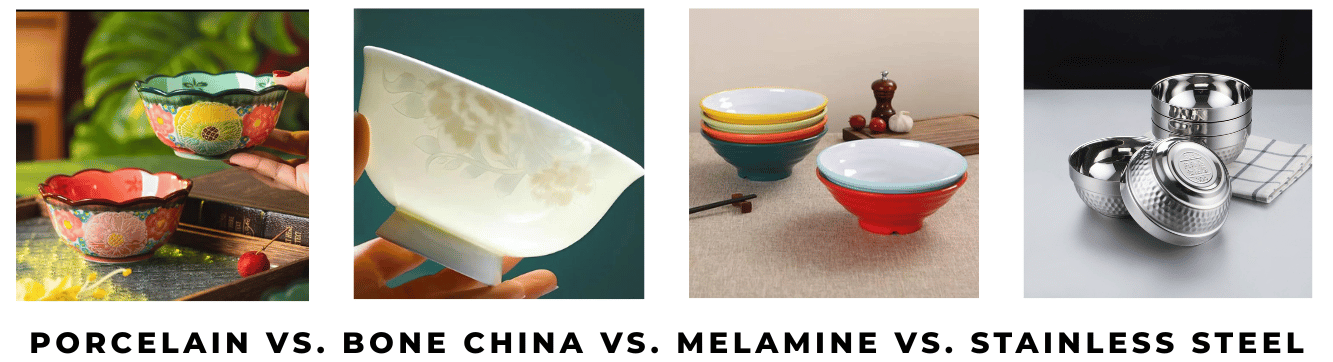
Hotel tableware material should be selected based on body composition and intended service, not on the name on the label. Fully vitrified porcelain suits most full-service dining. Bone china is used in fine dining, where translucency and prestige matter. Melamine is suitable for buffet, poolside, and outdoor use. Stainless steel is the buffet and catering workhorse. The firing temperature and vitrification level predict durability more reliably than the marketing term used.
The words “porcelain” and “china” are used loosely on product listings. Two plates, both called “porcelain,” can fire at very different temperatures and absorb very different amounts of water. That difference is what cracks, chips, and stains in your dish room — long before the pattern ever fades.
Porcelain vs. Bone China vs. Melamine vs. Stainless Steel
| Material | Composition / Firing | Durability & Chip Resistance | Best Use Case | Relative Cost | Guest Perception |
|---|---|---|---|---|---|
| Porcelain | High-fired, vitrified clay body | Strong all-rounder; excellent when fully vitrified | Full-service restaurants, all-day dining | Mid | Clean, professional, classic |
| Bone China | Bone ash content for strength and translucency | Surprisingly strong for its thin, light feel | Fine dining, luxury room service | High | Refined, premium, delicate |
| Melamine | Molded thermoset resin | Shatter-resistant, won't chip on drop | Buffet, poolside, outdoor, catering | Low–Mid | Casual; not for true fine dining |
| Stainless Steel | 18/10 or 18/0 grade steel | Effectively unbreakable | Buffet stations, chafers, catering | Mid | Modern, industrial, hygienic |
A quick note on stainless grade. 18/10 (18% chromium, 10% nickel) resists corrosion and holds its shine far better than 18/0, which contains no nickel and dulls or spots more quickly with heavy washing. For high-traffic buffet lines and chafing displays, the nickel content is worth the premium. This is exactly the distinction between entry-level pieces and professional Stainless Steel Catering Supplies.
How to Read Body Composition Claims
Vitrification is the real density indicator. When a clay body is fired hot enough, it fuses into a glass-like, non-porous structure. The measure of this is the water absorption percentage — how much water the body absorbs. Lower is better.
- Fully vitrified: under 0.5% absorption — the commercial benchmark
- Standard porcelain: 0.5%–3% absorption
- Earthenware / non-vitrified: 3%+ absorption — porous, stains, cracks under heat
A high-alumina or fully vitrified body resists chipping and crazing far better than standard porcelain at the same wall thickness. It also won’t absorb moisture, so it stays hygienic and won’t develop hairline cracks from repeated thermal cycling.
Buyer tip: Request the water absorption test data, not just the material name. A supplier who can hand you a number understands their product. One who only repeats “premium porcelain” may be reselling without knowing what they sell.
What Durability Standards Should Buyers Actually Check?
Your real tableware cost is not the unit price. It is the unit price plus the cost of everything you replace. Hospitality breakage rates of 10–20% per year are common, and most of that loss starts at the edges. The right durability specs cut that number significantly.
Durable hotel tableware rests on three measurable pillars: edge and chip resistance, mechanical impact and flexural strength, and glaze hardness. These specs — not plate weight — determine how many service cycles a piece survives. Lowering your annual breakage rate by even a few percentage points often outweighs the higher purchase price in the first year.
Treat the three pillars below as the questions you put directly into your RFQ.
Edge and Chip Resistance
The rim takes the most abuse — in stacking, in bus tubs, in the dish machine. Rolled edges and reinforced rims are engineered specifically to resist the chips that pull a plate out of rotation. A chipped plate is a discarded plate; guests won’t accept it.
Standardized chip-resistance test methods exist, and reputable manufacturers run them. Ask for the results.
Buyer tip: Ask whether the edges are reinforced or rolled, and request chip-test data for the specific shape you’re buying.
Impact and Flexural Strength
Mechanical strength tells you how a piece handles drops, knocks, and stacking pressure. Here is the counterintuitive part: thicker is not automatically stronger.
Common mistake → fix: Buyers often choose the heaviest plate, assuming weight equals toughness. In reality, a fully vitrified body at moderate thickness outperforms a heavy but under-fired one. Specify vitrification and flexural strength, not grams.
Relevant test references include mechanical and flexural strength — request them by name when comparing suppliers.
Glaze Quality and Surface Wear
The glaze is what guests touch and see. Poor glaze shows knife scratches, metal marking, and dulling within weeks. Quality glaze resists scratching, keeps its finish through thousands of washes, and stays bright under banquet lighting.
Glaze is also a safety marker. Lead- and cadmium-free glaze protects both your guests and your compliance position. This matters across all your patterns, including decorative ranges like Retro Tableware, where richer colors historically relied on heavier metal pigments.
Buyer tip: Request the glaze hardness rating and metal-marking resistance data, and confirm the glaze is lead- and cadmium-free in writing.
Does the Tableware Survive Commercial Dishwashing and Heat?
This is where “hotel-look” retail pieces fall apart. A plate that survives your home dishwasher faces a completely different environment in a commercial dish room.
Hotel tableware must withstand high-temperature commercial warewashing with aggressive detergents over thousands of cycles, as well as the thermal demands of your specific workflow — warming drawers, microwave reheating, or freezer-to-oven service. Under-glaze decoration survives commercial washing; on-glaze decoration often does not. Verify rated cycles and thermal shock data, not a generic “dishwasher safe” claim.
Commercial warewashers run hotter, faster, and with stronger chemicals than any domestic unit. Decoration, glaze, and body all face that punishment dozens of times a week.
Dishwasher Cycle Ratings
“Dishwasher safe” is a marketing phrase, not a specification. What you want is a rated commercial wash-cycle count at a stated water temperature and detergent exposure.
Decoration durability splits along one line:
- Under-glaze decoration: the pattern sits beneath the protective glaze layer — it survives commercial washing for the life of the plate
- On-glaze decoration: the pattern sits on top — it fades, scratches, and wears off under repeated commercial cycles
Buyer tip: Request a tested commercial-wash cycle rating and confirm whether decoration is under-glaze or on-glaze before you commit.
Thermal Shock and Heat Resistance
Thermal shock is the stress caused by a rapid temperature change — pulling a plate from a warming drawer onto a cold pass, or moving a dish from freezer to oven. Poorly fired bodies crack. Fully vitrified bodies handle a wide temperature differential.
Material limits matter here, too. Melamine is not microwave-safe and softens under high heat. Stainless steel conducts heat and gets dangerously hot in ovens or chafers without proper handling.
Buyer tip: Request the thermal shock test temperature differential, and match it to your real back-of-house process.
What Food-Safety Certifications Should Procurement Require?
Food-contact safety is not negotiable, and it is fully verifiable. Never accept “food safe” without documentation. Certifications exist for two reasons: to protect your guests and to keep you compliant in your operating region.
At minimum, hotel tableware should carry food-contact certification valid for your market: FDA compliance for the United States, EU Regulation 1935/2004 for Europe, or LFGB for the strictest German benchmark. California operations must also meet Proposition 65 lead and cadmium limits. A supplier must meet the standards of your market — not just the standards of where the product is made.
Certifications That Matter
| Certification | What It Verifies | Region / Best For |
|---|---|---|
| FDA | Food-contact material compliance for the US market | United States operations |
| EU 1935/2004 | General food-contact safety framework | European Union operations |
| LFGB | Stricter migration and safety testing | Germany: premium global benchmark |
| California Prop 65 | Lead and cadmium exposure limits | California and risk-averse buyers |
| ISO 9001 | Supplier quality management system | Supplier vetting baseline |
Lead and Cadmium Migration Limits
The glaze and decoration are the main points of migration risk — not the clay body itself. When heat, acid, or repeated washing wears decorative surfaces, metals can leach into food. This is why under-glaze decoration is safer: the protective glaze seals the pigment away from any food contact.
Buyer tip: Ask for the specific SKU’s migration test report and the certificate numbers. Then verify them yourself. Any supplier making the claim should hand over a number you can look up.
How Do You Spot Marketing Language vs. Real Specifications?
“Hotel quality” has no regulated meaning. Anyone can print it. Your job as a buyer is to map every quality claim to a number, a test, or a certificate before you sign a bulk order.
Hotel-grade tableware comes with documented specifications: water absorption percentage, chip resistance and flexural strength results, glaze hardness, rated commercial wash cycles, thermal shock data, and food safety certificate numbers. Retail “hotel-quality” labels typically list only the material name, decoration, and care instructions. The specification gap is what lets you tell them apart.
Common Marketing Claims and What to Request Instead
| Marketing Claim | What to Request Instead |
|---|---|
| "Premium / hotel-grade" | Water absorption % and chip-test data |
| "Super durable / break-resistant." | Impact and flexural strength results |
| "Food safe" | FDA / LFGB / EU 1935/2004 certificate numbers |
| "Dishwasher safe" | Rated commercial wash cycles + decoration type |
| "Won't fade." | Confirmation of under-glaze decoration |
Why You Should Evaluate Tested Samples
Factory-fresh samples look perfect. That is the point of them. What you actually want to see is how a piece performs after stress — repeated washing, edge knocks, thermal cycling.
Common mistake → fix: Approving an order on appearance and weight alone. Instead, request samples and the full spec sheet, and put those samples through your own dish room before making a bulk purchase.
Buyer tip: Ask for samples that have been through commercial wash cycles, not just unboxed pieces. Authentic quality holds up; weak glaze and on-glaze decoration start showing wear fast.
How Should Hotel Positioning and Service Type Shape Your Choice?
There is no single “best” tableware. A fine-dining restaurant and a poolside buffet have the same quality standard but should never carry the same spec. The right choice aligns with your service model, breakage environment, and brand positioning.
Service type drives material, durability priority, and decoration level. Fine dining favors bone china and refined under-glaze patterns. Full-service dining suits fully vitrified porcelain. Buffet and banquet operations need high chip resistance and stacking efficiency. Catering, outdoor, and poolside service calls for shatter-resistant melamine or stainless steel. Match the spec to the operation to optimize both guest experience and total cost.
Service-Type Specification Guide
| Operation Type | Recommended Material | Priority Specs | Decoration / Aesthetic |
|---|---|---|---|
| Fine dining / luxury | Bone china or premium porcelain | Translucency, refined feel, edge quality | Under-glaze, subtle patterns |
| Full-service restaurant | Fully vitrified porcelain | Durability + presentation balance | Under-glaze, brand-consistent |
| Buffet / banquet | Reinforced porcelain or stainless steel | Chip resistance, stacking efficiency | Simple, durable, uniform |
| Catering / outdoor / poolside | Melamine or stainless steel | Shatter resistance, portability | Casual, practical |
This is also where your display pieces matter. Buffet and banquet presentation often depends on more than plates — a Dessert Stand for the sweet station, a tiered Fruit Plate for the breakfast spread, and Buffet Ornaments to anchor the visual layout — all share the same durability and food-safety logic as your dinnerware. Specify them to the same standard.
Positioning-Based Trade-offs
Think in terms of cost per use, not unit price. A bone china plate costs more upfront but earns its place in a fine-dining room where guest perception drives the bill. A reinforced porcelain plate wins in a high-volume buffet where chip resistance protects your margin.
For any high-volume operation, two practical factors decide long-term cost: stacking and storage efficiency, and reorder availability. A discontinued pattern forces you to replace an entire service rather than a few broken pieces.
Buyer tip: Confirm long-term SKU availability before you standardize on a pattern. Pattern matching on reorders is where many operations get stuck.
The Hotel Tableware Procurement Checklist
Hotel-quality tableware is defined by measurable specs — not marketing language. Know the numbers. Test the samples. Verify the certifications.
Bring this checklist to your next supplier conversation and ask for documentation against every line:
- Confirm material and water absorption % (under 0.5% for fully vitrified)
- Request edge chip-resistance and impact/flexural strength data
- Verify glaze hardness and lead/cadmium-free status
- Require rated commercial dishwasher cycles and thermal shock data
- Collect food-safety certificate numbers (FDA / EU 1935/2004 / LFGB) and verify them
- Confirm decoration is under-glaze, not on-glaze
- Evaluate tested samples, not factory-fresh pieces
- Match material and decoration to your service type and positioning
- Confirm reorder availability for the SKU
Any tableware worth buying comes with this documentation, not just a sales pitch. If a supplier can answer each line quickly, you’re talking to someone who understands their product. If they can’t, dig deeper before you commit.
If you’re sourcing hotel tableware, buffet equipment, or catering supplies and want to compare these specifications against real products, contact our team for a quote. We’ll send you tested samples and the full specification sheet — so you can evaluate exactly what your guests will use and what your dish room will put it through, before you place a bulk order.
FAQ
What is fully vitrified porcelain?
Fully vitrified porcelain is a clay body fired at a high enough temperature to fuse into a dense, glass-like structure with almost no pores. The standard benchmark is under 0.5% water absorption. Because the body is non-porous, it resists staining, won’t soak up moisture, and withstands repeated thermal cycling without developing hairline cracks. For hotel and restaurant use, full vitrification is the single most reliable predictor of durability — far more telling than plate weight or the word “premium” on a listing.
What is water absorption in tableware, and why does it matter?
Water absorption measures how much moisture a ceramic body soaks up, expressed as a percentage of its weight. Lower is better. Fully vitrified bodies absorb less than 0.5%, standard porcelain falls between 0.5% and 3%, and non-vitrified earthenware exceeds 3%. The number matters because a porous body stains, harbors bacteria, and cracks when exposed to heat and impact. Two plates, both labeled “porcelain,” can have very different absorption rates — which is exactly why you should request the test data rather than trust the material name.
How many dishwasher cycles should hotel tableware last?
Quality commercial tableware should be rated for thousands of commercial dishwasher cycles, not the handful a home unit delivers. Commercial warewashers run hotter, faster, and with far more aggressive detergents than any domestic machine, so “dishwasher safe” tells you almost nothing. Ask suppliers for a rated commercial wash-cycle count at a stated water temperature and detergent exposure. Decoration matters here too: under-glaze patterns survive for the life of the plate, while on-glaze patterns fade and scratch off under repeated commercial washing.
Bone china vs. porcelain for hotels — which is better?
Neither is universally “better”; the right choice depends on your service model. Bone china contains bone ash, giving it a translucent, refined look and surprising strength despite its thin, lightweight feel — ideal for fine dining and luxury room service where guest perception drives the bill. Fully vitrified porcelain is the more durable, cost-effective all-rounder for full-service restaurants and all-day dining. Match the material to your positioning: bone china for prestige, vitrified porcelain for the balance of durability and presentation.
What certifications does food-safe tableware need?
The certification you require depends on your operating market, not where the product is made. The core ones are:
- FDA — food-contact compliance for the United States
- EU Regulation 1935/2004 — the general food-contact safety framework for Europe
- LFGB — Germany’s stricter migration testing, often used as a premium global benchmark
- California Proposition 65 — lead and cadmium exposure limits
A reputable supplier should provide certificate numbers that you can verify yourself. Never accept the phrase “food safe” without documentation tied to the specific SKU.
Why is underglaze decoration safer than on-glaze decoration?
Under-glaze decoration sits beneath the protective glaze layer, which seals the pigment away from any food contact. On-glaze decoration sits on top of the glaze, where heat, acids, and repeated washing can wear it down over time, allowing metals to leach into food. Under-glaze decoration is both safer and more durable — it survives commercial washing for the life of the plate, while on-glaze patterns fade and scratch off. For any food-contact surface, under-glaze is the standard to specify.
What’s the difference between 18/10 and 18/0 stainless steel?
The numbers refer to chromium and nickel content. 18/10 stainless steel contains 18% chromium and 10% nickel, which resist corrosion and hold their shine far better under heavy commercial washing. 18/0 contains no nickel, so it dulls and spots faster over time. For high-traffic buffet lines, chafing dishes, and catering equipment, the nickel content in 18/10 is worth the premium because it protects appearance and longevity in demanding service environments.
How can I tell real hotel-grade tableware from retail “hotel-quality” labels?
Look at the specification gap. Genuine hotel-grade tableware comes with documented data: water absorption percentage, chip resistance and flexural strength results, glaze hardness, rated commercial wash cycles, thermal shock figures, and food safety certificate numbers. Retail “hotel-quality” labels typically list only the material name, decoration, and care instructions. If a quality claim can’t be mapped to a number, a test, or a certificate, treat it as marketing language. The best way to confirm quality is to evaluate stress-tested samples — not factory-fresh pieces — before committing to a bulk order.