

Walk into any well-run restaurant or hotel dining room and the service feels effortless. Plates arrive at the right moment, drinks are poured cleanly, and the table looks exactly as it should. Behind that ease is a deliberate choice of equipment. Food and beverage service equipment determines how fast your staff can work, how your food looks when it arrives, and how professional your operation feels from the moment a guest sits down. Get it right, and service flows. Get it wrong, and even exceptional food gets undermined by friction, delays, and a presentation that falls short.
This guide answers the questions hospitality operators actually face: what F&B service equipment is, how it differs from kitchen equipment, what each type does, which equipment fits which venue, and how to build a setup that holds up in real daily use.
Key takeaways:
- Food and beverage service equipment covers guest-facing tools for serving, presenting, and managing food and drinks — not back-of-house cooking gear.
- The right setup depends on your venue type, service style, and volume, not on buying the longest equipment list available.
- Build from must-have essentials first, then add category-specific pieces as your concept and event needs grow.
What Is Food and Beverage Service Equipment?
Food and beverage service equipment is the front-of-house toolkit your staff uses to serve, present, and manage food and drinks for guests. It starts where the kitchen ends.
It includes everything a server, host, or banquet team touches to deliver a meal: the plate the dish arrives on, the glass the drink is poured into, the tray that carries both across the room, and the chafing dish that keeps food warm at a buffet. What it does not include is the equipment used to cook that food — ovens, ranges, refrigerators, and prep tables belong to a separate category entirely.
The core categories are:
- Tableware and dinnerware: plates, bowls, side plates, and platters
- Glassware: water tumblers, wine, cocktail, and beer glasses
- Cutlery and flatware: forks, knives, spoons, and serving pieces
- Serving trays and service trolleys: for transport and tableside service
- Buffet and banquet equipment: chafing dishes, food warmers, and display stands
- Beverage service equipment: dispensers, pitchers, ice buckets, and bar tools
- Coffee and tea service sets: pots, cups, saucers, and creamers
- Table linens and accessories: tablecloths, napkins, and runners
Each category solves a distinct problem in the guest experience. Together, they form the service infrastructure that runs every dining room, buffet line, and room service operation.
How Is Food and Beverage Service Equipment Different from Kitchen Equipment?
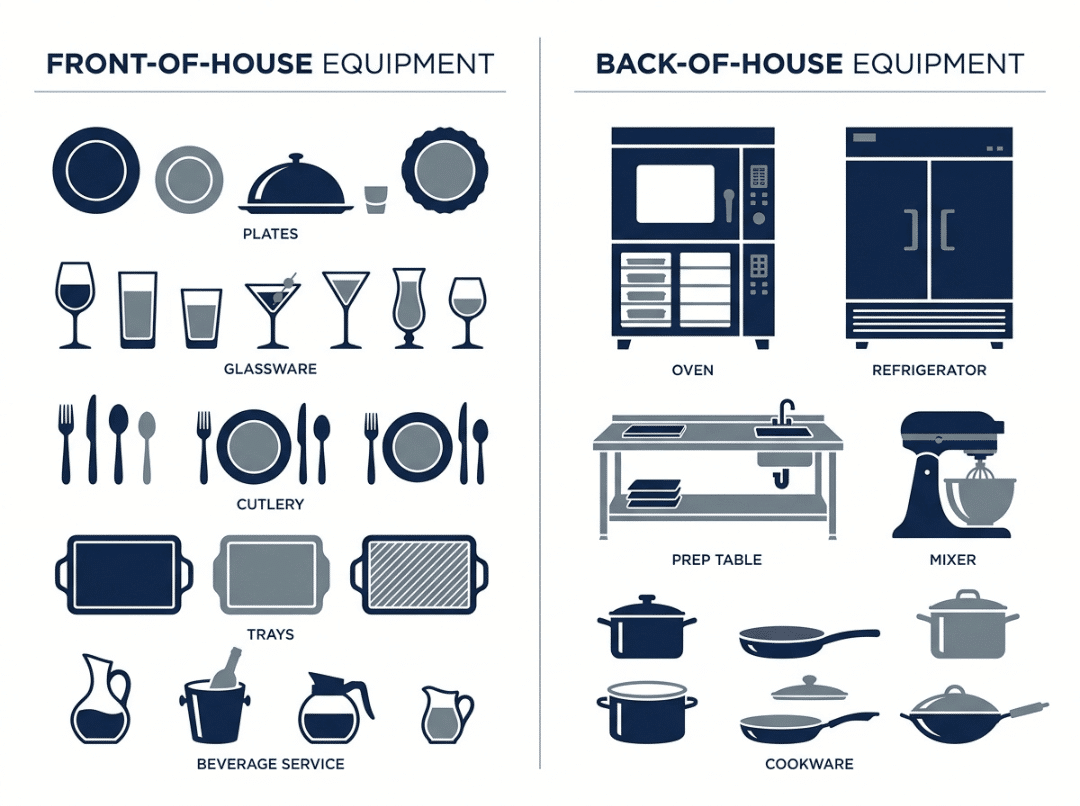
Service equipment is guest-facing and used to present and deliver food. Kitchen equipment is back-of-house and used to store, prepare, and cook it. They serve different purposes, carry different costs, and need to be budgeted separately.
Kitchen equipment is a heavy capital investment: commercial ovens, ranges, refrigeration units, and prep stations have long lifespans and require specialist installation and maintenance. They rarely touch a guest’s experience directly, but they make the food possible.
Service equipment works differently. It is purchased in volume, replaced regularly due to breakage and wear, and chosen partly for how it looks. A plate, a glass, or a cutlery set contributes to the visual and tactile impression a guest forms before they take a single bite. It also turns over far more quickly than kitchen machinery — a restaurant might replace its full dinnerware set every few years, while a commercial oven lasts a decade or more.
Why does this distinction matter for buyers? Because mixing these two budgets leads to sourcing mistakes. Operators who treat service equipment like capital equipment underspend on quantity and quality. Those who treat kitchen equipment like consumables overspend on replacements and maintenance.
The clearest way to think about it: kitchen equipment cooks the meal; service equipment delivers the experience.
Why Does Food and Beverage Service Equipment Matter in Hospitality Operations?
Service equipment matters because it shapes guest perception, drives service speed, and determines operational consistency at every cover, every shift, every day.
Guests form impressions faster than most operators realize. A smudged glass, a chipped plate, or a tray that tilts sends a message before the first bite. The opposite is also true: well-matched, polished equipment signals care and professionalism in the same instant. For hotels, this first impression often happens at breakfast, at room service delivery, or at banquet check-in — moments when the equipment is all the guest sees before the food arrives.
There is a direct operational case too. Durable trays and well-built trolleys mean one server can move more in a single trip, which reduces table wait times and lets smaller teams handle busier services. Commercial-grade dinnerware that survives high-temperature dishwashers cuts breakage costs over time. Reliable chafing dishes that hold temperature consistently prevent food safety issues at buffets and reduce waste. Each of these outcomes translates into faster service, lower ongoing spend, and fewer complaints reaching management.
In short, service equipment sits at the intersection of three operational priorities: guest experience, staff efficiency, and cost control. Invest in the right setup, and you improve all three simultaneously.
What Are the Main Types of Food and Beverage Service Equipment?
Each category of F&B service equipment addresses a specific moment in the service journey. Here is what each includes, what it does, and what to prioritize when choosing.
Tableware and Dinnerware
Plates, bowls, side plates, and platters form the foundation of every table setting. Material matters more than most buyers expect. Bone china and porcelain suit fine dining for their elegance and whiteness, but reinforced hotelware and stoneware survive the rigors of commercial dishwashers and heavy daily use far better. When evaluating options, focus on chip resistance along the rim, ease of stacking for back-of-house storage, and whether pieces are rated for both microwave and commercial dishwasher use. A beautiful plate that chips after two months is a cost problem, not a quality choice.
Glassware
Glassware covers water tumblers, wine glasses in red and white varieties, cocktail glasses, beer vessels, and juice glasses. Each shape is designed to enhance the drink it holds — the right glass improves aroma, temperature retention, and presentation. For busy venues, durability is just as important as shape. Tempered glass and reinforced-rim designs cut breakage significantly in high-volume service. Match your glassware selection to your actual drink menu: buying every style available creates storage problems and inconsistency. Buy what your menu genuinely needs, then spec for durability.
Cutlery and Flatware
Cutlery includes table forks, dinner knives, dessert spoons, soup spoons, and serving pieces. The workhorse material for commercial use is stainless steel, with 18/10 grade — meaning 18% chromium and 10% nickel — offering the strongest balance of corrosion resistance, shine, and long-term durability. Weight and finish signal service level: heavier, mirror-polished pieces feel premium at a fine-dining table, while lighter satin-finish sets suit a casual all-day dining operation. Consistency across every piece on the table matters as much as individual quality; mismatched sets undermine even excellent food.
Serving Trays and Service Trolleys
Trays and trolleys do the physical work of moving food and drinks from the kitchen or bar to the guest. Trays come in flat, round, and oval formats, most with non-slip surfaces that reduce accidents during busy service. Trolleys serve a wider range: tableside service for carving and dessert presentation, room service delivery, clearing between courses, and banquet setup. When buying, prioritize frame strength and wheel quality for trolleys — poor wheels are the most common failure point — and check that sizes fit your aisles, doorways, and elevator dimensions before ordering.
Buffet and Banquet Equipment
This category covers chafing dishes, fuel or electric food warmers, display risers, sneeze guards, and serving utensils used in self-service and event settings. Its core function is holding food at safe temperatures while keeping it presentable for extended periods — often two to four hours in a busy buffet. Look for consistent, reliable heat retention, surfaces that are easy to clean between refills, and modular configurations that let you scale a buffet layout up or down depending on event size. Poor temperature control in this category creates both safety and waste problems.
Beverage Service Equipment
Beverage equipment includes dispensers, pitchers, carafes, ice buckets, wine coolers, and bar tools for preparing and serving drinks. Dispensers suit self-service breakfast setups and large events where guests refill independently. Bar tools — shakers, strainers, jiggers, pourers — support cocktail and specialty beverage service. The key selection criteria are capacity relative to your service volume, ease of cleaning to maintain hygiene between uses, and a style that fits the formality of your service environment.
Coffee and Tea Service Sets
Coffee and tea sets include pots, cups, saucers, creamers, sugar bowls, and milk jugs used for hot beverage service. In hotels, cafés, and fine-dining restaurants, this equipment plays a disproportionately large role in the guest’s finishing impression of a meal. Coordinated sets that match your broader dinnerware style look more intentional and more professional. Prioritize heat retention — pots and cups that lose temperature quickly frustrate guests — and easy, clean pouring to avoid drips and spills at the table.
Table Linens and Accessories
Linens cover tablecloths, napkins, runners, and placemats. They do double duty: setting the visual tone of a room and protecting table surfaces. A well-chosen linen can transform the feeling of a dining space entirely, from functional to elegant. For commercial use, choose stain-resistant, color-fast fabrics that hold up to frequent industrial washing. Keep colors and textures consistent with your broader concept — mismatched or inconsistent linens create visual noise that works against even the best-designed room.
What Equipment Does Each Type of Hospitality Venue Actually Need?
The right F&B service equipment mix is not universal. It depends on your service model, guest volume, and the specific moments your staff and guests interact. Here is how the needs differ by venue type.
Full-Service Restaurants
A full-service restaurant needs a complete table setting for every cover at maximum capacity: dinner plates, bowls, side plates, matched water and wine glasses, full cutlery sets, serving trays, and napkins at minimum. Fine dining adds specialty glassware, premium flatware, and often tablecloths and coordinated accessories. The priority is consistency across every table and the durability to run two or three services per day, five to seven days a week, through commercial dishwashing.
Hotels
Hotels carry the widest equipment requirement of any hospitality venue because they run multiple food service formats simultaneously. A full-service hotel typically needs: restaurant tableware, glassware, and cutlery for dining room service; trays, insulated domes, and trolleys for room service; chafing dishes, banquet chafers, display risers, and serving utensils for banquet and buffet operations; and coffee and tea sets for in-room amenity service, lobby lounge, and meeting rooms. Each service context has different equipment priorities, and buying for all of them requires coordinated planning across departments.
Cafés and Coffee Shops
Cafés center their equipment needs on coffee and tea service — pots, cups, saucers, and carafes — alongside casual tableware for food items and glassware for cold drinks. Presentation matters in this setting because guests often linger and the visual experience is part of the concept. Trays are used for clearing more than for service. Durability is critical because turnaround is high and informal handling is constant. Specialty or decorative pieces can support the brand, but they need to be robust enough for daily use.
Buffet and Self-Service Venues
Buffet operations depend heavily on temperature management and organization. The core equipment is chafing dishes and food warmers, display risers to create visual levels, sneeze guards, and beverage dispensers for self-service drinks. Tableware for buffet venues needs to be sturdy and stackable, since guests handle it themselves and turnover is fast. The priority is food safety, visual appeal over a long service period, and equipment that is easy to refill and clean between rounds.
Banquet and Catering Operations
Banquet teams need equipment that scales, moves, and reassembles reliably across different venues and room layouts. Stackable dinnerware in large quantities, banquet chafing dishes with consistent heat output, folding or portable trolleys, and volume glassware that transports without excessive breakage are all priorities. Consistency across large table counts matters enormously — guests notice when place settings vary within the same room — so standardizing on a single pattern and buying sufficient backup stock from the start is essential.
Room Service Operations
Room service puts unique demands on service equipment. Trays need to be large enough to carry a full meal setup, stable enough for corridor transport, and designed for clean presentation. Insulated domes, carafe-style beverage vessels, and secure condiment containers matter more here than tableside presentation. Trolleys that fit standard hotel elevator dimensions and fold for storage when not in use support efficient room service delivery across large properties.
What Is Must-Have vs Optional Food and Beverage Service Equipment?
Must-have equipment is what you cannot complete a single service without. Optional equipment enhances your concept, supports specific menus, or enables event-driven revenue but is not needed on opening day.
This distinction is most important for new venues and growing operations managing a limited opening budget.
|
Category |
Must-have for most venues |
Optional or concept-specific |
|---|---|---|
|
Tableware |
Dinner plates, bowls, side plates |
Specialty platters, tasting dishes, display pieces |
|
Glassware |
Water glasses, wine glasses |
Cocktail, specialty beer, brandy, and digestif glasses |
|
Cutlery |
Dinner forks, dinner knives, dinner and dessert spoons |
Steak knives, fish cutlery, full serving sets |
|
Trays and trolleys |
Serving trays |
Room service trolleys, carving and dessert trolleys |
|
Buffet gear |
Depends on format |
Chafing dishes, warmers, risers, sneeze guards |
|
Beverage |
Pitchers, carafes, ice buckets |
Automated dispensers, full bar tool sets |
|
Coffee and tea |
Cups, saucers, pots |
Full coordinated service sets, specialty vessel types |
|
Linens |
Napkins |
Tablecloths, runners, placemats, specialty overlays |
Start with everything in the must-have column that applies to your service format. Add optional items as your concept solidifies, your menu expands, or your event business develops. A staged approach prevents opening budget overruns without creating gaps that affect guest experience from day one.
One practical note: par levels matter as much as which items you buy. Must-have items need to be stocked at two to three times your peak seating count to account for items in the dishwasher cycle and normal breakage. Buying the right items in insufficient quantities creates the same operational problem as not buying them at all.
How Do You Build the Right Food and Beverage Service Equipment Setup?
Building the right setup means matching every purchase decision to your specific venue, service model, and operational rhythm — not to a generic industry list.
Work through this framework before you place any orders.
Step 1: Define your service format clearly. Fine dining, casual full-service, café, buffet, banquet, and room service each call for different equipment priorities. Write down exactly what your service team does from the moment a guest arrives to the moment they leave. Every equipment decision should trace back to a step in that process.
Step 2: Map your peak volume and service patterns. Identify your maximum simultaneous covers, your busiest service periods, and how long your dishwasher cycle takes. These numbers directly determine your par levels. Running short during a Saturday dinner service or a conference banquet is a revenue and reputation problem, not just a logistics issue.
Step 3: Prioritize must-have items for your format. Use the must-have framework above and build the essential list for your specific venue type first. Resist adding optional items until the core is fully stocked at correct par levels.
Step 4: Specify commercial-grade durability for every category. Chip-resistant dinnerware, tempered or reinforced-rim glassware, and 18/10 stainless steel cutlery are the baseline for any commercial operation. Items that look better but fail faster always cost more in the long run. Check that every item is rated for the dishwashing and handling conditions of your specific kitchen.
Step 5: Coordinate styles across categories. Tableware, glassware, cutlery, and linens that share a consistent finish, color palette, and design language create a cohesive table setting. Piecemeal sourcing across too many suppliers usually produces visual inconsistency that undermines your presentation even when individual items are quality pieces.
Step 6: Confirm reorder reliability before committing. Choose ranges you can restock reliably and consistently. A supplier who discontinues a pattern, goes out of stock, or cannot match a previous batch forces costly full replacements instead of simple top-ups. Supplier consistency is part of the equipment decision, not an afterthought.
What Equipment Planning Mistakes Do Hospitality Operations Most Often Make?
The most common mistakes are not about choosing the wrong product — they are about planning errors that create operational problems from the first week of service.
Mixing residential-grade and commercial-grade items. Residential dinnerware, glassware, and cutlery are not built for commercial dishwashers, constant handling, or high-volume service. They chip, cloud, and corrode faster, leading to early and expensive replacements. Always specify commercial-grade products regardless of venue size.
Underestimating par levels. Buying enough for one full service is not enough. Items spend a significant portion of each service in the dishwasher, and breakage is a daily reality in any busy venue. Stock two to three times your peak cover count per item category as a working baseline.
Buying inconsistent patterns across suppliers. Sourcing dinnerware from three different suppliers to save money usually creates three slightly different whites, three different rim profiles, and tables that look inconsistent at scale. Standardize on a single range for each category and replace within that range.
Overbuying specialty items before validating demand. Specialty cocktail glassware, niche serving vessels, and decorative presentation pieces often sit in storage. Buy specialty items only when your menu and service model genuinely require them, and start with conservative quantities until you understand real usage.
Ignoring storage, stacking, and dishwasher compatibility. Equipment that does not stack efficiently wastes back-of-house space. Equipment that does not fit your dishwasher racks creates handling inefficiency every single shift. Confirm these specifications before finalizing orders, not after delivery.
Treating supplier reliability as secondary. The ability to reorder matching pieces quickly is as important as the quality of the initial purchase. A supplier who cannot maintain stock consistency, match batch colors, or deliver on short notice creates procurement headaches that compound over time. Evaluate suppliers on reorder reliability, not just opening price.
Frequently Asked Questions
What is food and beverage service equipment?
Food and beverage service equipment refers to the front-of-house tools used to serve, present, and manage food and drinks for guests. It includes tableware, glassware, cutlery, serving trays and trolleys, buffet equipment, beverage service tools, coffee and tea sets, and table linens. It does not include back-of-house kitchen cooking or food preparation equipment.
What is the difference between service equipment and kitchen equipment?
Service equipment is used front-of-house to deliver and present food and drinks to guests. Kitchen equipment is used back-of-house to store, prepare, and cook food. Plates, trays, and glassware are service equipment. Ovens, ranges, and refrigerators are kitchen equipment. They carry different budgets, maintenance cycles, and procurement logic.
What equipment does a new restaurant need first?
A new restaurant should prioritize dinner plates, bowls, side plates, water and wine glasses, full cutlery sets, serving trays, and napkins. These form the core service infrastructure for every cover. Specialty items, additional glassware types, and service trolleys can be added as the operation develops.
What equipment is required for buffet service?
Buffet service centers on chafing dishes, food warmers, display risers, sneeze guards, serving utensils, and beverage dispensers. These items keep food at safe temperatures, maintain presentation over extended service periods, and support guest self-service efficiently.
How much F&B service equipment should a venue buy?
A working baseline is two to three times your maximum seating capacity for core items like plates, glasses, and cutlery. This accounts for items in the dishwasher cycle and normal breakage during service. High-turnover venues and banquet operations may require higher multiples depending on service speed and event volume.
How do I choose the right F&B service equipment for my venue?
Start by defining your service format and mapping your peak volume. Then build from must-have items at correct par levels, specify commercial-grade materials throughout, coordinate styles across categories, and confirm that your supplier can restock your chosen patterns consistently. Every decision should connect directly to how your team operates during real service.
Final Verdict
Food and beverage service equipment is the operational backbone of every guest-facing dining experience. It covers the plates, glasses, cutlery, trays, trolleys, buffet gear, and beverage tools your team uses to serve guests — and it is entirely distinct from the kitchen equipment that produces the food. The right setup is not the most comprehensive list you can build. It is the one that fits your venue type, service style, and real operational volume, built from durable, commercial-grade essentials and expanded deliberately as your concept and revenue grow.
For most operators, the path forward is clear. Define your service format. Stock must-have items at proper par levels. Specify durability over price. Coordinate presentation across categories. Lock in supplier reliability before you commit. Do that, and every plate, glass, and tray that reaches a guest table reinforces the experience your operation is built to deliver.
Next step: Use the must-have table, the venue-type breakdown, and the six-step setup framework above to build your equipment list. Confirm par levels, durability specifications, and supplier reorder terms before you place your first order.