
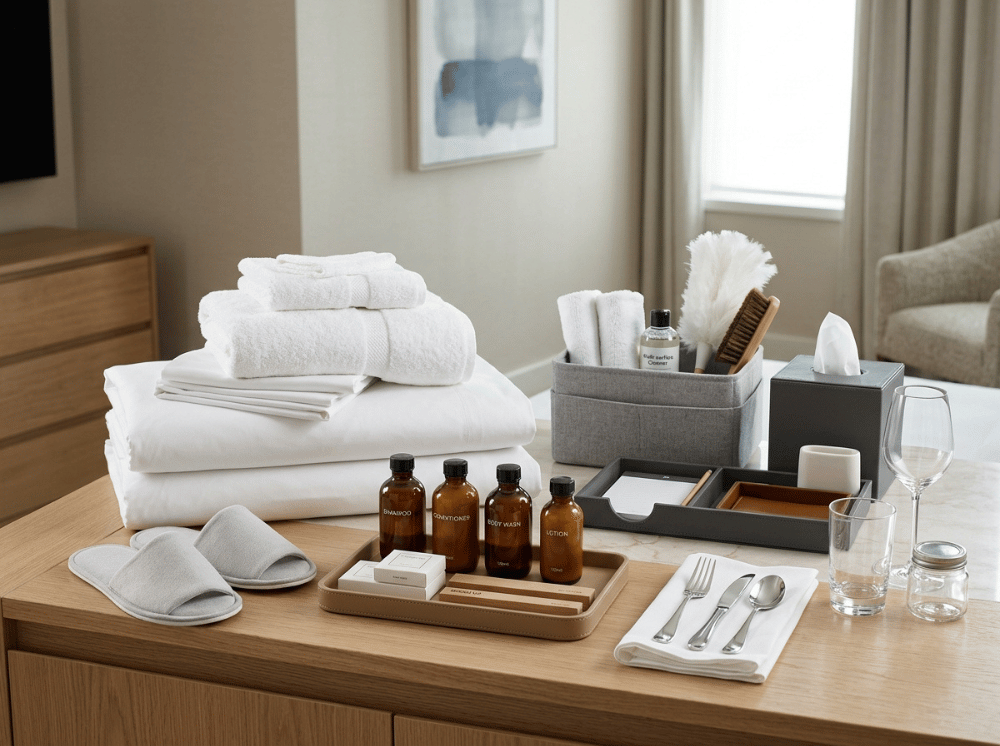
OS&E (Operating Supplies and Equipment) refers to the consumable and operational items a hotel needs to function day-to-day — linens, tableware, cleaning supplies, guest amenities, kitchen smallwares, and more. Unlike FF&E, OS&E is not permanently installed. It wears out, gets used up, or needs regular replacement, making supplier selection and procurement planning critical to both opening budgets and ongoing operating costs.
Every hotel opening involves thousands of individual purchasing decisions. Many procurement teams spend months specifying beds, lighting, and lobby furniture — only to discover, weeks before soft opening, that the tableware hasn’t been ordered, the housekeeping carts haven’t arrived, and the guest amenities are stuck at customs. OS&E procurement is where hotel projects most often run into avoidable problems.
This guide covers everything procurement managers, opening teams, GMs, and owner representatives need to know about hotel OS&E: what it includes, how it’s budgeted, which items benefit most from OEM/ODM customization, and how to choose a supplier capable of delivering consistently at scale.
The categories, benchmarks, and timelines here apply broadly to hotels, resorts, serviced apartments, and commercial F&B projects. Where data ranges are cited, they reflect commonly reported industry benchmarks — actual figures will vary based on property type, star rating, regional market, and brand standards.
What Does OS&E Mean?
OS&E stands for Operating Supplies and Equipment. The term covers every consumable, replaceable, or operational item a hospitality property needs to function — from the moment a guest walks through the door to the moment the kitchen closes at night.
The working definition used across the hospitality industry: if a guest uses it, wears it out, or takes it home, it is almost certainly OS&E. If it is bolted down, built in, or intended to last the full lifecycle of a renovation, it is more likely FF&E or a capital item.
OS&E is not a single purchase. It is an ongoing operational commitment. Your initial outfitting order establishes the foundation; replenishment orders — monthly, quarterly, or season-based — run for the life of the property.
OS&E Categories at a Glance
The table below maps the major OS&E categories, their typical lifespan, and the procurement model that most commonly applies.
|
Category |
Examples |
Typical Lifespan |
Procurement Model |
|---|---|---|---|
|
Bed & Bath Linens |
Sheets, duvet covers, bath towels, bath mats |
6–18 months |
Bulk order + scheduled replenishment |
|
Guest Amenities |
Toiletries, slippers, dental kits, robes |
Per stay / 6–12 months |
Ongoing consumable |
|
F&B Tableware |
Plates, bowls, flatware, glassware |
12–36 months (breakage-driven) |
Opening stock + replacement program |
|
Serving Equipment |
Trays, plate covers, chafing dishes, bread baskets |
2–5 years |
Opening order |
|
Kitchen Smallwares |
Pots, pans, prep tools, ladles, storage containers |
1–4 years |
Opening order + periodic replacement |
|
Housekeeping Supplies |
Cleaning chemicals, carts, vacuums, spray bottles |
Ongoing (consumable) / 3–5 years (equipment) |
Recurring supply |
|
Front Office Supplies |
Key cards, stationery, signage, printers |
Ongoing / 2–3 years |
Mixed |
|
Banquet & Event Items |
Banquet linens, coffee urns, AV accessories, and podiums |
1–8 years |
Event-volume-driven |
|
Staff Uniforms |
Server uniforms, chef coats, housekeeping attire |
6–12 months |
Seasonal or annual renewal |
|
Spa, Pool & Fitness |
Pool towels, robes, gym accessories, signage |
6–18 months |
Seasonal replenishment |
OS&E Categories by Procurement Type
Not all OS&E can be managed the same way. Understanding the procurement type behind each category helps teams plan cash flow, supplier relationships, and lead times more accurately.
Consumables (replenished continuously)
These items run out through normal use. Guest amenities, cleaning chemicals, paper goods, disposables, and laundry supplies fall under this category. Pricing stability and reliable supply chains matter most for this group.
Durables with predictable replacement cycles
Linens, tableware, glassware, and uniforms fall into this category. They last longer than consumables but break down through use, laundry, and attrition. Procurement teams should set replenishment schedules based on par levels rather than reactive ordering.
Equipment with longer service lives
Housekeeping carts, chafing dishes, coffee urns, and banquet service items are purchased at opening and replaced only when worn out or damaged. Unit quality matters more than price per piece for this group — total cost of ownership over five years is a more useful metric than unit cost.
Customized or branded items
Embroidered linens, logo-printed tableware, monogrammed robes, and branded guest amenities require longer lead times and a supplier with OEM/ODM manufacturing capability. These items also incur higher upfront design and sampling costs that must be built into the opening budget.
What Is Included in Hotel OS&E? A Department-by-Department Breakdown
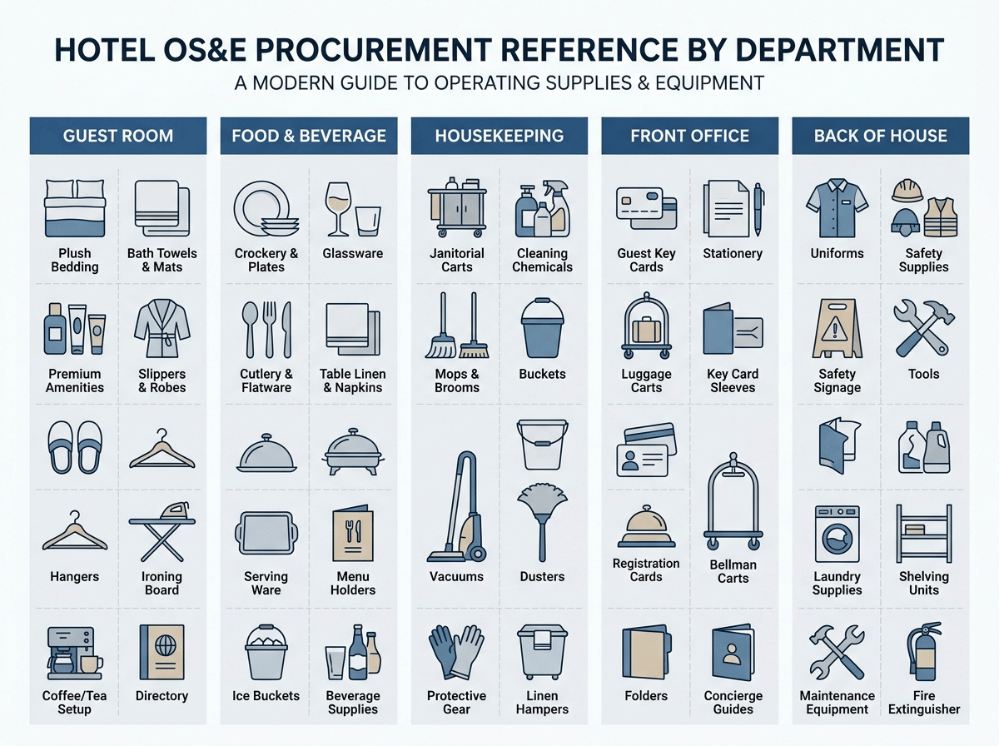
Guest Rooms and Housekeeping
Guest rooms typically represent the largest OS&E category, commonly accounting for 35–45% of the total opening budget depending on property type. Every item in this department directly affects guest reviews and brand perception.
- Bed and bath linens are the single largest recurring OS&E cost. Thread count, fabric composition, hem construction, and commercial laundry durability all affect the total cost of ownership. Investing in higher-specification linens (300 TC+ with reinforced hems) typically reduces replacement frequency by a meaningful margin over a three- to five-year operating cycle compared to lower-grade alternatives.
- Guest amenities — toiletries, dental kits, sewing kits, slippers, and laundry bags — are consumed per stay. For branded properties, these items are often custom-manufactured to brand standards. Boutique and independent properties increasingly use custom packaging and scent profiles to differentiate the in-room experience.
- Housekeeping equipment includes maid carts, vacuum cleaners, mops, cleaning chemicals, and storage organizers. This category is often underspecified at opening. Undersized housekeeping carts, for example, increase room turnover time and add labor cost across every operating day.
Food and Beverage
Hotels with restaurants, bars, room service, or all-day dining need a separate F&B OS&E budget. The key items:
- Tableware: Dinner plates, side plates, bowls, ramekins, and serving platters. Breakage is the primary cost driver. Commercial-grade porcelain or melamine reduces replacement frequency significantly compared to retail-grade alternatives.
- Flatware: Knives, forks, dessert spoons, and steak knives. Stainless steel grade (typically 18/10 for fine dining, 18/0 for casual) affects both durability and cost.
- Glassware: Wine glasses and tumblers have the highest replacement rate of any F&B OS&E category — typically 6–12 months in high-volume operations.
- Table linens and napkins: Replacement cycles of 6–18 months, depending on laundry frequency and linen quality.
- Staff uniforms: Server uniforms, chef coats, aprons, and name badges. Annual or biannual renewal is standard.
See our tableware collection for specification options across western dining, Asian dining, and buffet service contexts.
Banquet and Events
Banquet OS&E is commonly underestimated at opening. A hotel running 100+ events per year needs dedicated inventory separate from its restaurant. Banquet tableware, bulk linens, chafing dishes, and beverage service equipment all need to be stocked at event-volume quantities — not table-for-two quantities. See our buffet ornaments and presentation equipment for commercial-grade buffet display options.
Kitchen and Back-of-House
Kitchen OS&E covers the smallwares and operational tools that keep F&B service running — distinct from the capital equipment (ovens, refrigeration, dishwashers) classified as FF&E. Pots, pans, prep knives, cutting boards, storage containers, ladles, and kitchen safety supplies are all OS&E. This category is often split across multiple suppliers at opening, creating coordination complexity. Consolidating kitchen OS&E with a single supplier that covers the full smallwares range significantly reduces the admin burden.
Front Office and Lobby
Front office OS&E represents a smaller share of the total budget (typically 3–5%), but the items in this category are guest-facing from check-in. Key card holders, signage, branded stationery, and luggage carts all contribute to the property’s first impression.
Spa, Pool, and Fitness
Properties with leisure facilities need a separate OS&E plan for pool towels, spa robes, gym accessories, poolside signage, and safety equipment. Replacement cycles here are seasonal in resort properties and usage-driven in urban hotels. Pool towels and robes in active spa environments typically require replacement every 6–12 months.
OS&E vs. FF&E: What’s the Difference?
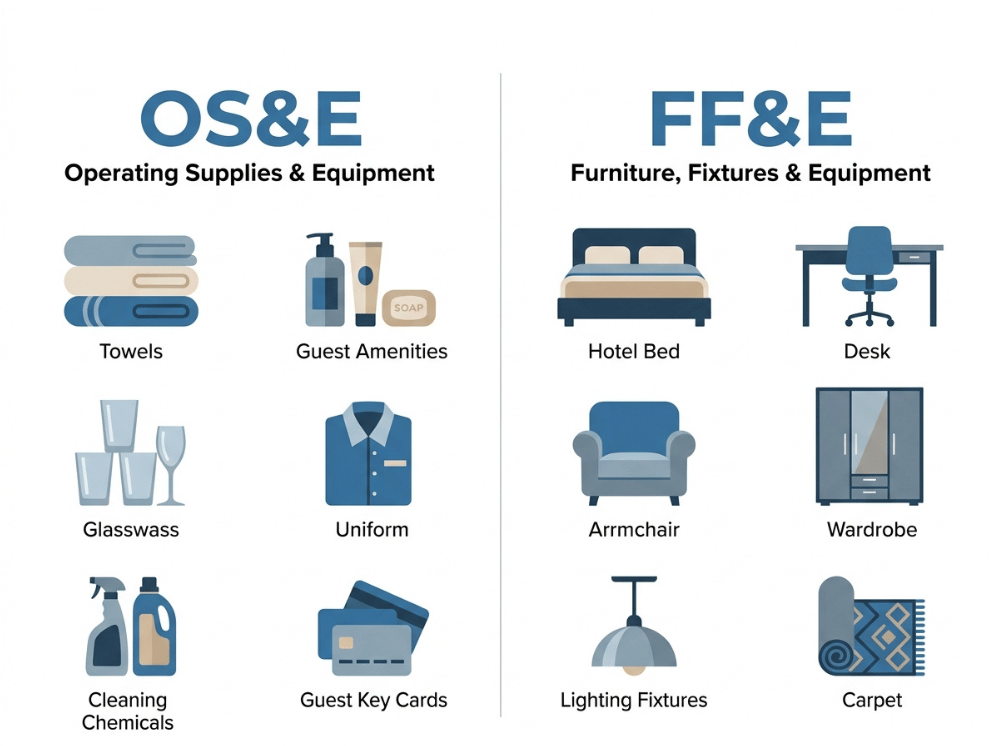
The distinction matters for budgeting, accounting, and procurement planning.
|
FF&E |
OS&E |
|
|---|---|---|
|
Full name |
Furniture, Fixtures & Equipment |
Operating Supplies & Equipment |
|
Lifespan |
Multi-year; not replaced frequently |
Short-term: replenished regularly |
|
Examples |
Beds, chairs, lighting, and built-in appliances |
Linens, tableware, cleaning supplies, and amenities |
|
Installation |
Often requires coordination or rough-ins |
Stocked and stored; no installation |
|
Budget timing |
Typically planned 12–18 months out |
Should be planned in parallel with FF&E |
|
Primary users |
Architects, interior designers, contractors |
Operations, housekeeping, and F&B teams |
A practical rule of thumb: FF&E answers the question “what furnishes the space?” — OS&E answers the question “what makes the space operational?”
According to industry benchmarks cited by hospitality project consultants, OS&E at opening typically represents 25–40% of the FF&E total for a midscale property. For luxury hotels with full spa facilities and multiple F&B outlets, that ratio can be higher. The implication: any project financial model that excludes OS&E from early budget planning is incomplete.
Why OS&E Matters Financially
Budget Benchmarks by Property Type
The following ranges reflect commonly reported industry benchmarks for OS&E at the initial outfitting stage. Actual figures depend on property type, room mix, F&B scope, brand standards, and sourcing market.
|
Property Tier |
OS&E Budget Per Room (Opening) |
Annual Replenishment Rate |
|---|---|---|
|
Economy / Limited Service |
$1,500 – $3,000 |
25–35% of the opening cost |
|
Mid-Scale / Select Service |
$3,000 – $6,000 |
20–30% |
|
Full-Service / Upscale |
$6,000 – $12,000 |
20–25% |
|
Luxury / Resort |
$12,000 – $25,000+ |
15–20% |
Luxury properties typically spend more per room at opening but show lower annual replenishment rates as a percentage, because higher-quality items last longer. Over a five-year operating cycle, the total cost of ownership often favors the upfront investment in better-specification OS&E.
Par Levels, Breakage Allowance, and Landed Cost
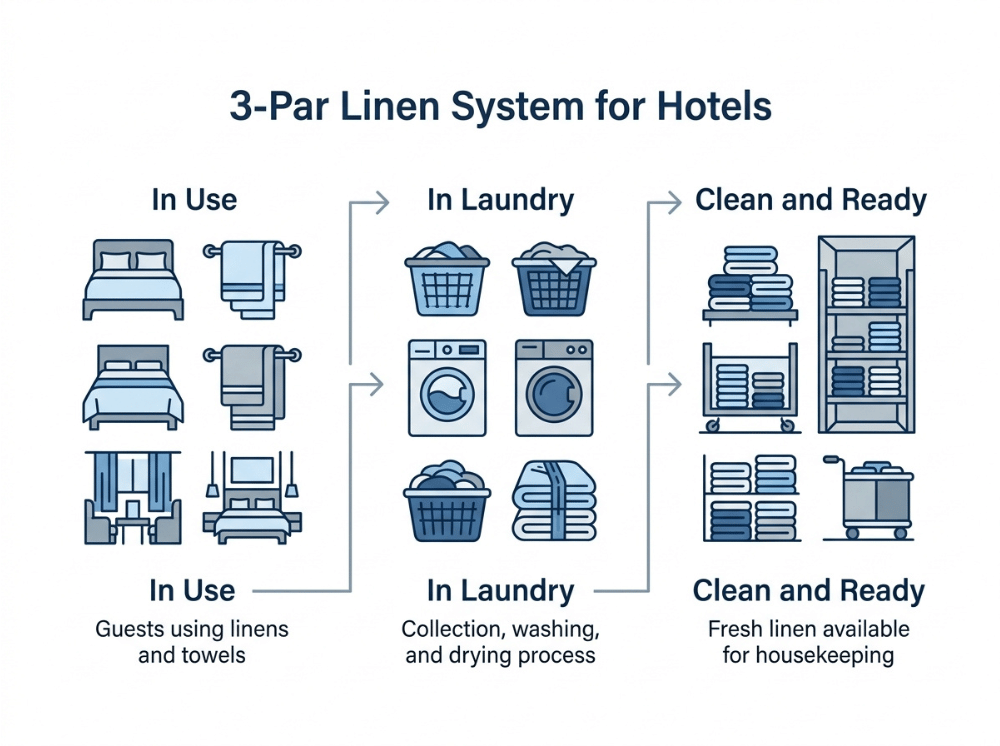
- Par level refers to the quantity of a given OS&E item needed to support continuous operations. The hospitality industry standard for linens is a 3x par: one set in use, one in laundry, one in reserve. Running below 3x par triggers emergency reorders — typically at a significant cost premium.
- Breakage allowance is critical for glassware and tableware. Ordering exact quantities at opening guarantees a shortage within months. Planning for a 10–15% overage on breakable items and a 5–10% buffer on linens provides a meaningful operational cushion.
- Landed cost — the total cost of an item, including manufacturing, freight, duties, and logistics — is the number that matters for cross-border procurement. Products sourced from China’s Greater Bay Area, for example, carry a logistics and import cost component that can add 10–20% to the unit price, depending on the destination market. Procurement teams sourcing internationally need to build landed cost into their supplier comparisons, not ex-works pricing alone.
How OS&E Affects the Guest Experience
OS&E is where a property’s service promises either hold up or fall apart. A five-star concept with poorly specified linens, inconsistent tableware quality, and generic bathroom amenities undermines every investment made in architecture and FF&E.
Conversely, well-sourced OS&E compounds the value of good design. Linens with the right weight and texture communicate quality before a guest reads a single word of marketing copy. A well-designed custom tableware series that reflects the property’s concept turns every meal service into a brand touchpoint. Spa robes and slippers that feel considered — not generic — directly contribute to repeat-booking intent.
The guest-experience implications of OS&E decisions are not subtle. It shows up in review scores, social media photography, and the granular comments guests leave explaining why a property met or exceeded expectations.
Which OS&E Items Are Best for Customization?
Custom OS&E manufacturing — OEM or ODM — is a practical option for many hospitality procurement categories, particularly for properties where brand differentiation is a strategic priority.
OEM (Original Equipment Manufacturing): The buyer provides the design specification; the manufacturer produces to that specification. Suitable for properties with existing brand standards and design assets.
ODM (Original Design Manufacturing): The manufacturer develops the design based on a creative brief; the buyer approves and places the order. Suited to properties that want bespoke OS&E without an in-house design team.
The categories where custom manufacturing offers the most procurement value:
- Linens and bath textiles: Embroidered logos, custom colors, and bespoke fabric compositions can be manufactured at scale with relatively modest minimum order quantities when working directly with a manufacturer.
- Tableware and dinnerware: Custom glaze colors, logo embossing, and bespoke plate shapes are standard capabilities for contract ceramic manufacturers. Lead times for custom tableware typically range from 8 to 14 weeks from design approval to delivery.
- Guest amenities: Custom-labeled toiletries, branded packaging, and property-specific scent profiles are common for upscale and luxury independent hotels.
- Buffet and serving equipment: Custom-sized chafing dishes, branded buffet display risers, and property-specific serving trays are frequently manufactured to specification for large resort openings.
- Staff uniforms: Color, fabric, and logo placement are all standard customization variables. Fabric durability under commercial laundry conditions should be a specification requirement, not an afterthought.
Working directly with a manufacturer rather than through a distributor typically shortens the customization feedback loop and reduces per-unit costs for mid- to large-volume orders. Wonhosp.com supports OEM and ODM production across all major OS&E categories — contact our sourcing team to discuss lead times and minimum quantities for your project.
How to Choose OS&E Suppliers for a Hotel Project
Supplier selection for OS&E is not a single decision — it is a procurement infrastructure decision that affects the property for years after opening. The criteria that matter most:
- Cross-category coverage. Managing 15+ individual suppliers across different OS&E categories creates coordination overhead, delivery window mismatches, and inconsistent quality standards across the property. A supplier that covers multiple OS&E categories under one roof simplifies procurement substantially.
- OEM/ODM capability. For branded or independent properties with specific design requirements, a supplier’s ability to manufacture to specification — not just supply from existing catalog inventory — is a key differentiator.
- Quality assurance systems. Ask specifically about in-process quality checks, incoming material inspection, and pre-shipment final inspection protocols. Third-party certifications (ISO 9001, OEKO-TEX for textiles, NSF for food-contact items, BSCI for social compliance) provide independent verification of claimed quality standards.
- International logistics experience. Cross-border procurement requires more than competitive pricing. Freight forwarding, export documentation, customs clearance coordination, and experienced shipping to your target region all affect whether OS&E actually arrives on time and in usable condition.
- Replenishment capability. OS&E is not a one-time transaction. Your supplier needs to support ongoing reorders at consistent specification and pricing — not just handle the opening order and disappear. Negotiate locked pricing for 12–24 months on high-volume items where possible.
- Sample policy. Never commit to a bulk OS&E order without physical samples. For linens, test fabric weight, colorfastness, and shrinkage after multiple commercial wash cycles. For tableware, test chip resistance, dishwasher durability, and stacking stability. For amenities, verify packaging quality and scent.
One-Stop Supplier vs. Multi-Vendor Procurement
|
Factor |
One-Stop Supplier |
Multi-Vendor |
|---|---|---|
|
Coordination complexity |
Low — single point of contact |
High — multiple timelines, contacts, invoices |
|
Quality consistency |
Easier to maintain across categories |
Varies by vendor |
|
Pricing leverage |
Higher volume = stronger negotiating position |
Fragmented spend = weaker per-vendor leverage |
|
Customization |
Possible if the supplier has OEM/ODM capability |
Variable |
|
Risk concentration |
Higher if the supplier fails |
Distributed |
|
Admin overhead |
Lower |
Significantly higher |
|
Best for |
Mid-to-large hotel openings; properties prioritizing efficiency |
Very specialized categories; markets with fragmented supply |
For most hotel opening teams working against a deadline, the coordination overhead of multi-vendor procurement is a risk multiplier rather than a benefit. A one-stop supplier with proven cross-category capabilities and OEM/ODM manufacturing support typically delivers better outcomes for the opening timeline and ongoing replenishment management.
Pre-Opening OS&E Ordering Timeline
|
Months Before Opening |
Action |
|---|---|
|
12–9 months out |
Finalize OS&E item list by department; establish par levels; initiate supplier evaluation and RFQ process |
|
9–7 months out |
Issue RFQs; receive supplier proposals; shortlist vendors; request samples for critical categories (linens, tableware, amenities) |
|
7–6 months out |
Sample review and approval; finalize supplier selections; place orders for custom and long-lead-time items |
|
6–4 months out |
Confirm production schedules; place orders for standard OS&E categories; negotiate replenishment terms |
|
4–2 months out |
Monitor production progress; arrange pre-shipment inspections; coordinate freight and customs clearance |
|
2–4 weeks out |
Receive OS&E deliveries; conduct quality inspection; distribute to departments; verify par levels; identify shortfalls and emergency reorder needs |
Custom items — branded amenities, logo tableware, embroidered linens — commonly require 8–16 weeks from design approval to delivery. Starting OS&E procurement in parallel with FF&E, not after it, is the most reliable way to avoid opening-week supply crises.
What to Check Before Placing an OS&E Order
Use this checklist before committing to a bulk OS&E order with any supplier:
- Physical samples reviewed and approved for all major categories
- Linen samples tested for shrinkage and colorfastness after commercial wash cycles
- Tableware tested for chip resistance and dishwasher durability
- Amenity packaging reviewed for quality and brand alignment
- Par levels confirmed by the department
- Overage buffer applied to breakable items (10–15%) and linens (5–10%)
- Custom branding proofs reviewed and signed off
- Lead times confirmed and mapped against the opening date
- Landed cost calculated (not just ex-works price)
- Replenishment pricing and terms negotiated
- Pre-shipment inspection arranged for large orders
- Delivery logistics and receiving schedule confirmed
Common OS&E Procurement Challenges
- Ordering exact quantities with no buffer. Reorder lead times of 6–12 weeks for many OS&E items mean that shortfalls during peak season carry real operational and guest-satisfaction costs. Plan for breakage and attrition from day one.
- Ignoring the total cost of ownership. A lower-priced item that requires replacement twice as often is rarely the better buy. Calculate cost per use, not cost per unit, for linens, tableware, and glassware.
- Treating OS&E as an afterthought. Custom OS&E items require an 8–16-week production lead time. Starting procurement after FF&E is specified — rather than in parallel — is one of the most common causes of opening delays.
- Fragmenting across too many suppliers. Each additional vendor adds coordination costs, shipping complexity, and the risk of quality inconsistency. Consolidation is a legitimate procurement strategy, not a compromise.
- Skipping sample validation. Linens that feel luxurious at trade shows can pill, shrink, or lose color after commercial laundering. Tableware that photographs well can chip within weeks under daily service conditions. Sample testing is not optional.
- Underestimating landed cost. For cross-border procurement, the ex-works price is only one component. Freight, duties, port handling, local logistics, and currency risk all affect the true cost of the order. Procurement teams need landed-cost comparisons, not factory-price comparisons.
How to Build a Smarter OS&E Strategy
A well-structured OS&E strategy is built on four principles:
1. Start early and plan in parallel. OS&E procurement should begin at the same time as FF&E specification — not after it. The longer the planning runway, the more supplier options are available, and the lower the premium for lead time compression.
2. Consolidate where it creates efficiency. Fewer suppliers means fewer coordination points, stronger negotiating positions, and more consistent quality across the property. Evaluate one-stop supplier options seriously, particularly for categories like tableware, linens, and serving equipment, where cross-category coverage is available.
3. Buy to the total cost, not the unit cost. Set quality specifications based on expected replacement cycles, not opening budget minimums. For high-use categories like bath linens, glassware, and chef uniforms, a 20–30% higher unit cost can translate into a meaningfully lower five-year operating cost.
4. Negotiate replenishment at the same time as opening orders. Locking in replenishment pricing and terms at the point of opening-order negotiation gives the property cost certainty and preferred-supplier relationships that pay dividends for years.
Frequently Asked Questions
What does OS&E stand for in hotels?
OS&E stands for Operating Supplies and Equipment. In hotel operations, OS&E covers the consumable and operational items needed for daily function — including linens, towels, toiletries, tableware, glassware, cleaning supplies, kitchen smallwares, staff uniforms, and guest room accessories. OS&E items wear out, get consumed, or require regular replacement during normal operations.
What is the difference between OS&E and FF&E in a hotel project?
FF&E (Furniture, Fixtures, and Equipment) refers to long-lived assets that furnish the space — beds, chairs, light fixtures, and built-in appliances. OS&E covers the consumable and operational items that make the space functional — linens, tableware, cleaning supplies, and amenities. Both categories need to be budgeted and procured before opening, but they follow different timelines, quality specifications, and supplier relationships.
How much does hotel OS&E cost per room?
OS&E opening budgets commonly range from approximately $1,500–$3,000 per room for economy properties, $3,000–$6,000 for mid-scale, $6,000–$12,000 for full-service upscale, and $12,000–$25,000+ for luxury and resort properties. These are commonly reported industry benchmarks — actual figures depend on property type, room mix, F&B scope, brand standards, and sourcing market. Annual replenishment typically runs 15–35% of the opening cost, depending on the property tier.
When should OS&E procurement start for a hotel opening?
OS&E procurement planning should start 9–12 months before the target opening date, in parallel with FF&E specification. Custom items such as branded linens, logo tableware, and personalized amenities commonly require 8–16 weeks from design approval to delivery. Starting procurement after FF&E is finalized — rather than in parallel — is one of the most common causes of opening-week supply problems.
Which OS&E items can be custom-manufactured?
Linens, bath textiles, tableware and dinnerware, guest amenities, buffet and serving equipment, and staff uniforms are all commonly available through custom manufacturing (OEM or ODM). OEM manufacturing suits buyers with existing design specifications; ODM suits buyers who want manufacturer-developed designs based on a creative brief. Both models are available through direct manufacturers with established hospitality supply capabilities.
What is a par level for hotel OS&E?
A par level is the quantity of a given OS&E item required to support continuous operations without running short. The hospitality industry standard for linens is a 3x par: one set in use, one in laundry, one in reserve. Operating below the required par level forces emergency reorders — typically at significantly higher cost and with longer wait times than planned replenishment.
Is it better to source OS&E from one supplier or multiple vendors?
For most hotel opening projects, a one-stop supplier with cross-category coverage and OEM/ODM capability offers clear practical advantages: lower coordination overhead, stronger pricing leverage, more consistent quality, and simpler replenishment management. Multi-vendor sourcing can provide more competitive pricing for highly specialized categories, but the administrative and logistics complexity increases proportionally with the number of suppliers.
Build a More Efficient OS&E Program
OS&E procurement is not a box to check before opening — it is a foundational operational decision that affects guest satisfaction, labor efficiency, and operating costs for years. The properties that get it right share a common approach: they start early, they buy to the total cost rather than the unit price, and they invest in supplier relationships that can support the property beyond opening day.
Wonhosp.com provides one-stop hotel OS&E supply from China’s Greater Bay Area, with OEM and ODM manufacturing capabilities across tableware, buffet and serving equipment, outdoor furniture, decorative fixtures, and custom hospitality products for five-star hotels and commercial tourism projects. Our team supports everything from initial product specification through production, quality inspection, and international logistics coordination.
If you are planning a hotel opening, renovation, or ongoing OS&E replenishment program, contact our sourcing team to discuss your requirements — or browse our product categories to explore what’s available for your project.