
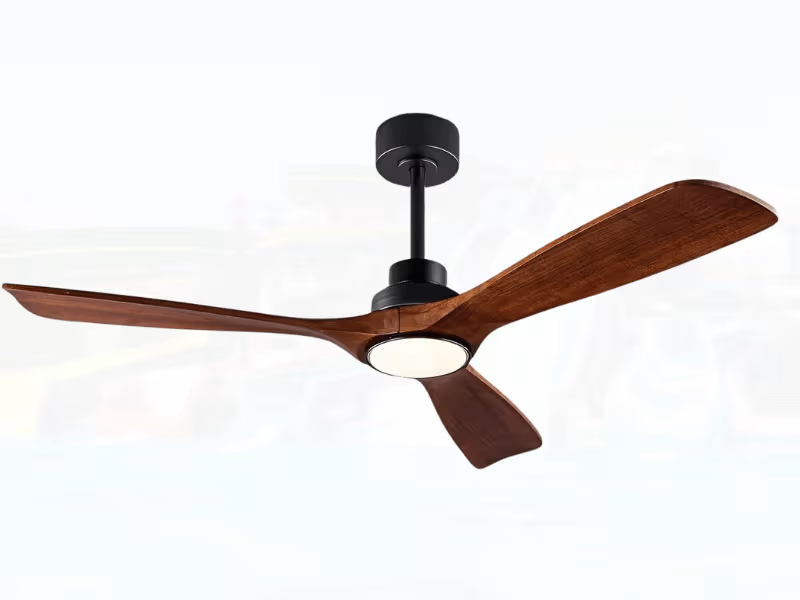
The right ceiling fan with light depends on room size, ceiling height, and how you use the space. Match blade span to square footage, confirm mount type (flush, downrod, or sloped) fits your ceiling, check CFM for real airflow performance, and choose a light source with the right lumens and color temperature for the room’s function. Noise level matters most in bedrooms, while style and finish should match existing fixtures rather than stand alone.
Buying a ceiling fan with light sounds simple until you’re standing in a showroom facing forty near-identical options, each promising “whisper-quiet” performance and “powerful airflow.” The specs on the box rarely tell you what you actually need to know: whether the fan will fit your ceiling, whether the light will actually illuminate the room, or whether it’ll hum audibly at 2 a.m.
This guide breaks down the ten factors that determine whether a ceiling fan with light performs well in your space—not generic advice, but the technical details (blade span formulas, CFM ranges, mounting clearances, Kelvin temperatures) that separate a fan you’ll love from one you’ll return.
Ceiling Fan With Light Buying Checklist
| # | What to Check | What It Means | Quick Guideline | Why It Matters |
|---|---|---|---|---|
| 1 | Room Needs | Define how the room is used before choosing a fan | Identify the room’s purpose, size, and environment first | A bedroom, patio, and home office need different airflow, lighting, and noise performance |
| 2 | Fan Type | Choose the right category for the space | Use low-profile fans for low ceilings, downrod fans for standard ceilings, damp-rated fans for humid areas, and wet-rated fans for exposed outdoor spaces | The wrong fan type can create safety issues, poor performance, or early wear |
| 3 | Blade Span | Match fan size to room size | 29–36″ for under 75 sq ft; 36–42″ for 76–144 sq ft; 44–50″ for 144–225 sq ft; 50–54″ for 225–400 sq ft; 54–72″ or multiple fans for over 400 sq ft | A fan that’s too small won’t move enough air; one that’s too large can overpower the room |
| 4 | Ceiling Height & Mounting | Make sure the fan fits the ceiling safely | Keep blades at least 7 ft above the floor; use flush mount for 8-ft ceilings; check downrod length and sloped-ceiling compatibility | Even a well-designed fan won’t work if it’s mounted at the wrong height or on the wrong ceiling type |
| 5 | Motor & Airflow | Focus on real performance, not marketing terms | Look for roughly 4,000–6,000 CFM for small to medium rooms and 6,000+ CFM for larger spaces; DC motors are quieter and more efficient | Motor quality affects cooling power, energy use, noise, and long-term durability |
| 6 | Light Quality | Evaluate the lighting like you would a main fixture | Choose the right Kelvin, lumens, CRI, diffuser style, and dimming compatibility | Since the light may be the room’s main light source, poor lighting specs can ruin usability |
| 7 | Controls | Pick the control method that fits daily use | Choose between pull chain, wall control, remote, or smart control based on convenience and setup | Control type affects comfort every day, especially in bedrooms and living rooms |
| 8 | Noise Level | Prioritize quiet performance in sensitive spaces | Aim for around 30–40 dB on low settings and under 55 dB on higher settings when possible; if dB isn’t listed, check for DC motors and user reviews | Noise is one of the most common causes of buyer regret, especially at night |
| 9 | Style & Finish | Match the fan to the room only after function is confirmed | Coordinate finish, blade shape, and overall look with the room’s fixtures and style | Style matters, but it should be the final filter rather than the first decision |
| 10 | Energy Use & Installation | Consider long-term cost and setup complexity | Look for ENERGY STAR models, LED lighting, and confirm whether installation is DIY-friendly or needs an electrician | A fan that’s efficient and correctly installed will cost less to run and perform better over time |
In short: the best ceiling fan with light matches your room’s size, ceiling height, lighting needs, and noise tolerance. Start with function and fit, then compare airflow, lighting, controls, and efficiency before deciding on style.
1. Start With the Room’s Needs, Not the Fan’s Look
It’s tempting to shop by style first. But a ceiling fan with light is a functional fixture before it’s a design statement, and the room dictates the function. A home office needs steady, glare-free light for screen work. A covered patio needs weather resistance. A primary bedroom needs quiet operation above almost everything else.
Before you start browsing, define three things: the room’s primary activity, its square footage, and any environmental factors (humidity, sloped ceilings, outdoor exposure). Every other decision in this guide flows from those three answers.
2. Match Fan Type to Your Room’s Purpose
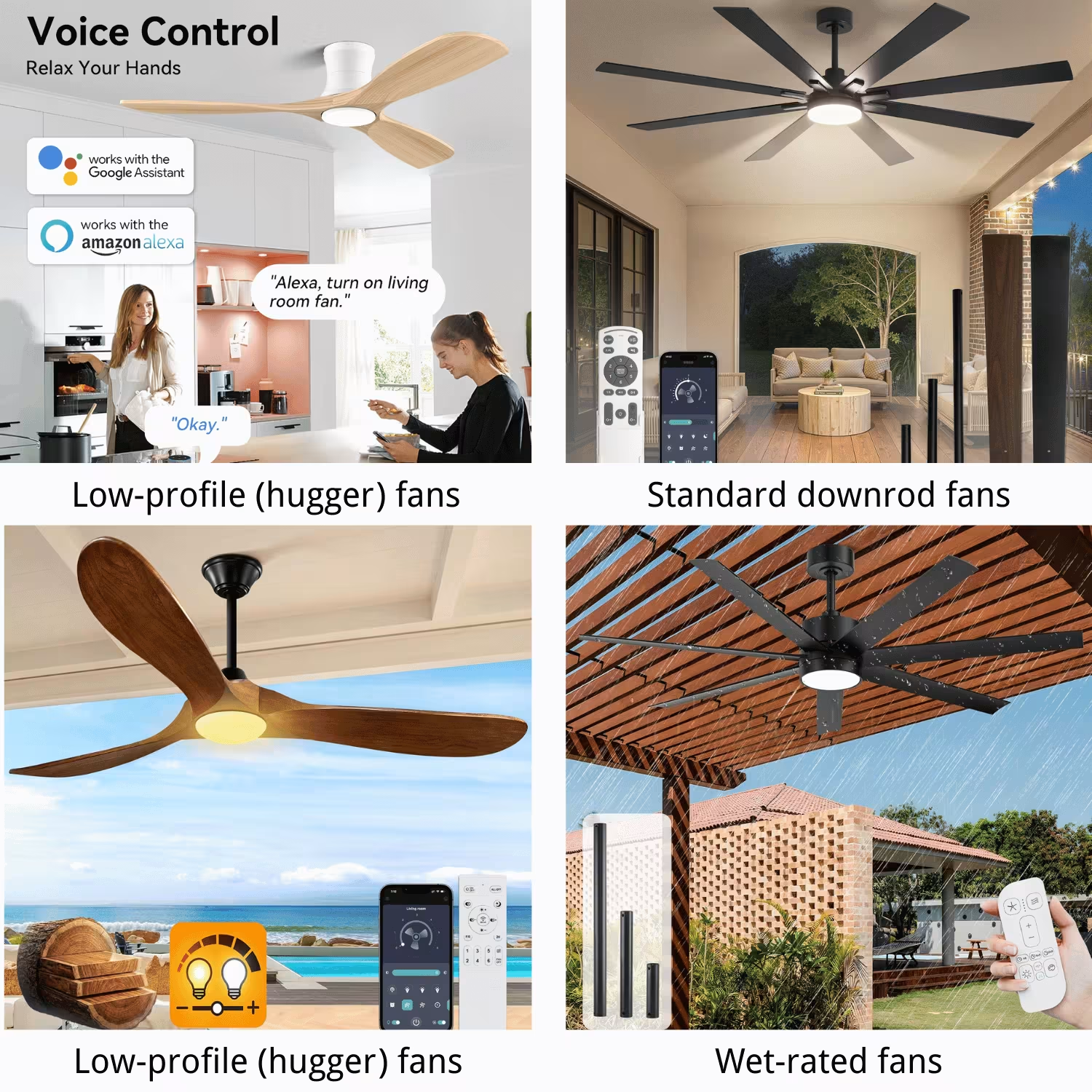
Ceiling fans aren’t interchangeable across room types. Four categories cover most residential needs:
- Low-profile (hugger) fans mount flush against the ceiling with no downrod. They’re the right choice for rooms with 8-foot ceilings or lower, where a standard downrod would bring the blades too close to head height.
- Standard downrod fans hang from a metal rod, typically 3 to 6 inches for 9-foot ceilings and longer for higher ceilings. This is the most common configuration for living rooms and bedrooms with average ceiling height.
- Damp-rated fans tolerate humidity and occasional moisture exposure. They’re built for covered porches, sunrooms, and high-humidity bathrooms.
- Wet-rated fans are engineered to handle direct rain and moisture and are required for open patios, gazebos, or any uncovered outdoor installation.
Installing an indoor-rated fan outdoors isn’t just a warranty violation — the motor housing and blades will degrade from moisture and UV exposure, often within a single season.
3. Get the Room Size and Blade Span Right
Blade span (the diameter of the fan measured tip-to-tip) needs to scale with room size, or the fan will either underperform or visually overwhelm the space. Choose based on square footage:
|
Room Size |
Recommended Blade Span |
|---|---|
|
Under 75 sq ft |
29–36 inches |
|
76–144 sq ft |
36–42 inches |
|
144–225 sq ft |
44–50 inches |
|
225–400 sq ft |
50–54 inches |
|
Over 400 sq ft |
54–72 inches (or multiple fans) |
For rooms over 400 square feet, a single oversized fan often creates uneven airflow. Two moderately sized fans working together typically circulate air more evenly than one large unit pushed to its limit.
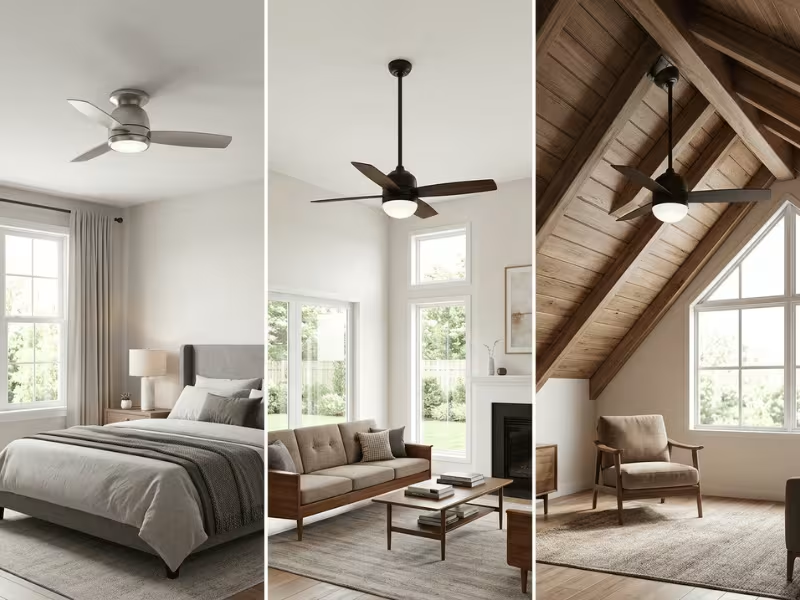
4. Check Ceiling Height and Mount Compatibility
This is where many buyers run into installation problems after the fan has already arrived. Three things need to align: ceiling height, mount type, and the electrical box behind the mounting point.
Clearance requirements: Blades should sit at least 7 feet above the floor and maintain at least 18 inches of clearance from walls in any direction. For 8-foot ceilings, a flush-mount fan is close to mandatory — a standard downrod will bring blades uncomfortably low.
Downrod length: As a rough estimate, add 1 inch of downrod for every foot of ceiling height above 8 feet. A 10-foot ceiling typically needs about a 12-inch downrod to bring the fan to an effective height; a 12-foot ceiling needs closer to 24 inches. Manufacturers usually publish sizing charts specific to their fan models, so check those before assuming a universal rule applies.
Sloped ceilings: Standard fan mounts are rated for slopes up to about 15–20 degrees. Anything steeper requires a sloped-ceiling adapter kit, which angles the downrod so the fan hangs level rather than tilted. Check the fan’s specifications for its maximum slope rating before buying if your ceiling has any pitch.
Electrical box: Ceiling fans are heavier than standard light fixtures and generate rotational torque during operation. They must be mounted to a fan-rated electrical box, not a standard light-fixture box. If you’re replacing a light fixture with a fan for the first time, this is worth confirming before purchase — it may require an electrician to swap the box even if the wiring itself is compatible.
5. Evaluate Motor Quality and Airflow Performance
The motor determines both how much air the fan actually moves and how long it lasts. Two figures matter most.
CFM (cubic feet per minute) measures airflow output. Higher CFM means more effective cooling. As a general benchmark, look for at least 4,000–6,000 CFM for small to medium rooms and upward of 6,000 CFM for larger, open-concept spaces.
AC vs. DC motors: AC motors are the traditional standard — reliable, less expensive, but generally noisier and less energy-efficient. DC motors use roughly 60–70% less energy, run quieter, and typically offer more speed settings, though they cost more upfront. Choose a DC motor if noise level or long-term energy cost matters more than initial price; choose AC if budget is the primary constraint and the room is one where fan noise isn’t a concern.
Motor warranties are also a useful proxy for build quality. Many reputable manufacturers back their motors for 10–15 years, while budget models often cap out at 1–3 years — a meaningful signal about expected lifespan.
6. Choose the Right Light Source and Color Temperature
The lighting component deserves as much scrutiny as the fan itself, since for many rooms, the fan’s light is the primary — not supplementary — source of illumination.
- Integrated LED vs. replaceable bulbs: Integrated LED fans have the light source built directly into the fixture, which offers a slimmer profile and longer rated lifespan (often 25,000–50,000 hours) but means the entire light kit needs replacing once the LEDs degrade. Fans with replaceable bulb sockets cost less to maintain long-term and let you swap in different bulb types, but the fixture design is typically bulkier. Choose integrated LED if a streamlined look and minimal maintenance matter more; choose replaceable bulbs if long-term flexibility or lower replacement cost is the priority.
- Color temperature (Kelvin): This determines whether the light appears warm or cool. 2700K–3000K produces warm, ambient light suited to bedrooms and living rooms. 3500K–4100K gives a neutral white better suited to kitchens and home offices. 5000K and above produces a cool, daylight-like tone useful for task-focused spaces but often too harsh for relaxation areas. Many mid-range and higher-end fans now offer adjustable color temperature, letting one fixture serve multiple moods.
- Lumens and primary lighting capability: For a fan light to function as a room’s primary light source (rather than supplementary), aim for at least 800–1,200 lumens for small rooms and 1,500+ lumens for larger spaces. If the listed lumen output is below that range, plan on supplementing with lamps or wall fixtures.
- CRI (Color Rendering Index): CRI measures how accurately a light source renders colors compared to natural light, on a scale up to 100. A CRI of 90 or above is considered high quality and matters most in spaces where color accuracy counts — kitchens, closets, or rooms used for tasks like makeup application. Budget fixtures often sit in the 70s–80s, which can make colors look slightly washed out or off-tone.
- Shade and diffuser design: Frosted or opal glass diffusers soften light output and reduce glare, which is preferable for bedrooms and living rooms. Exposed or clear-lens designs produce a more direct, brighter beam suited to task-oriented spaces but can create glare if positioned at eye level.
- Dimmability: Confirm the fan light is compatible with dimming — not all integrated LED fixtures are, and pairing a non-dimmable fan light with a dimmer switch can cause flickering or humming.
7. Decide Between Remote, Wall, and Smart Controls
Control options affect daily convenience more than most buyers expect. Pull chains are the most basic and least convenient. Wall controls offer a cleaner look and are useful when the fan replaces a wired light switch. Remote controls add flexibility, particularly for fans installed over beds or seating areas where reaching a wall switch is inconvenient. Smart controls, compatible with voice assistants or smartphone apps, allow scheduling and integration with broader smart-home systems — useful for buyers already invested in that ecosystem, but a feature with diminishing value if it’s the only smart device in the room.
8. Prioritize Noise Level for Bedrooms and Quiet Spaces
Noise is the single biggest source of post-purchase regret, particularly for bedroom installations, and it’s also the hardest spec to evaluate before buying.
- Decibel benchmarks: A well-engineered fan on its lowest setting should run around 30–40 dB — roughly the level of a quiet library. On higher settings, anything under 55 dB is generally acceptable for a bedroom; above that, the hum becomes noticeable during quiet activities like reading or falling asleep.
- When dB isn’t listed: Many product listings omit decibel ratings entirely. In that case, check for a few reliable proxies: DC motors are quieter than AC motors as a rule; verified customer reviews mentioning “quiet” or “silent” operation are more trustworthy than marketing copy; and higher-priced models within a manufacturer’s lineup often use better-balanced motors and higher-grade bearings, which directly reduce operational noise.
- Wobble and blade balance: A fan that wobbles isn’t just unstable — it’s often the actual source of the noise complaints buyers attribute to the motor. Wobble usually comes from uneven blade weight, an improperly tightened mounting bracket, or installation on a non-fan-rated box that can’t handle the torque. Blade balancing kits (small adhesive weights included with most fans) can fix minor wobble, but persistent wobble after balancing usually points to an installation issue rather than a product defect.
9. Match Style and Finish to Your Interior
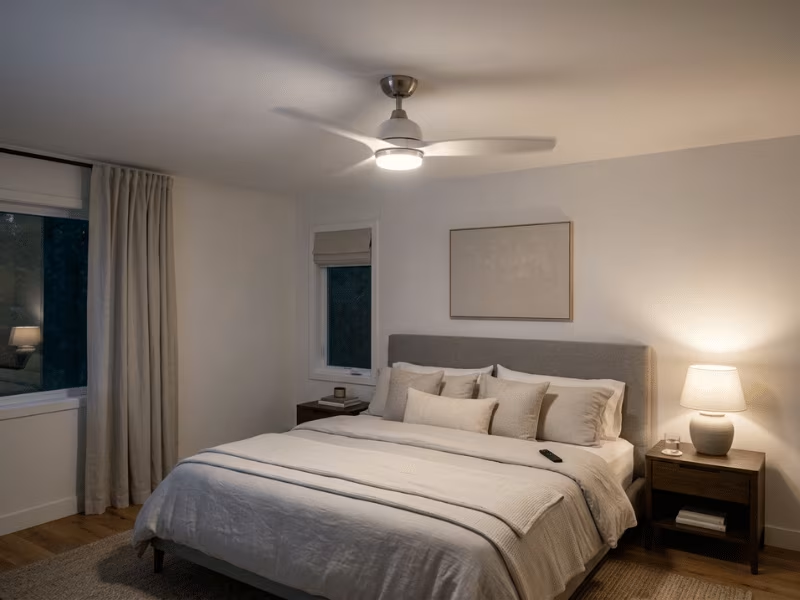
Once you’ve sorted function, match the finish and silhouette to the room’s existing fixtures rather than competing with them. Matte black and brushed nickel pair well with modern interiors; oil-rubbed bronze and wood-tone blades suit traditional or farmhouse aesthetics. Blade shape also affects perceived style — wide, paddle-style blades look more traditional, while narrow, angled blades read as contemporary. This is a lower-stakes decision than sizing or motor quality, but it’s the detail most likely to make a fan look out of place if you ignore it.
10. Factor In Energy Efficiency and Installation Complexity
These are two distinct considerations, often lumped together, that deserve separate attention.
- Energy efficiency: Look for ENERGY STAR certification, which indicates the fan moves air more efficiently relative to its power draw — often using 20% less energy than standard models. Integrated LED lighting compounds these savings, since LEDs use roughly 75% less energy than incandescent bulbs and last significantly longer.
- Installation complexity: A straight-swap installation (replacing an existing fan or fan-rated fixture with matching wiring) is often manageable as a DIY project for someone comfortable with basic electrical work. Installing a fan where only a light fixture previously existed, dealing with a sloped ceiling, or wiring the fan and light to operate on independent switches (a common request for bedrooms, where a low fan speed and dimmed light might need separate control) usually calls for a licensed electrician. Independent wiring in particular is worth deciding on before installation begins, since retrofitting separate switches after the fact often means opening up the ceiling box again.
Finding the Right Fit
Buying a ceiling fan with light isn’t about finding the fan with the most features — it’s about matching a specific set of specs to a specific room. A fan that’s perfect for a sunlit kitchen might be the wrong noise profile for a bedroom, and a fixture built for an 8-foot ceiling won’t work in a great room with vaulted ceilings.
Wonhosp designs its ceiling fan lineup around exactly this kind of room-specific matching. For bedrooms and other noise-sensitive spaces, Wonhosp’s DC-motor models run quietly at every speed setting. For homes with 8-foot ceilings, Wonhosp’s low-profile hugger fans avoid the clearance issues that come with standard downrod units. And for living rooms where the fan doubles as the main light source, Wonhosp’s warm-light models with remote control offer adjustable color temperature alongside quiet, reliable airflow.
Start with your room’s actual requirements — size, ceiling height, and noise tolerance — and let those numbers guide the decision. The right fan is the one that fits your space’s specifications, not the one with the flashiest listing.
Frequently Asked Questions
What size ceiling fan do I need for my room?
Blade span should scale with square footage: 29–36 inches for rooms under 75 sq ft, 36–42 inches for 76–144 sq ft, 44–50 inches for 144–225 sq ft, and 50–54 inches for 225–400 sq ft. Rooms over 400 sq ft often perform better with two smaller fans than one oversized unit.
Can I install a ceiling fan with light myself?
A direct swap for an existing fan or fan-rated fixture is typically DIY-friendly for someone with basic electrical experience. Installations involving a new fan-rated electrical box, sloped ceilings, or independent wiring for the fan and light usually require a licensed electrician.
How do I know if a ceiling fan will be quiet if the dB rating isn’t listed?
Check for DC motor construction, which is generally quieter than AC; read verified customer reviews for direct noise feedback; and consider that higher-tier models within a manufacturer’s lineup often use better-balanced motors that reduce operational noise.
Can a ceiling fan light replace a room’s main light fixture?
Yes, if the light output is high enough. Aim for at least 800–1,200 lumens for small rooms and 1,500+ lumens for larger rooms. Below that range, you’ll likely need to supplement the fan light with lamps or additional fixtures.
What’s the difference between a damp-rated and wet-rated ceiling fan?
Damp-rated fans tolerate humidity and suit covered porches or bathrooms. Wet-rated fans are built to withstand direct rain and moisture exposure and are required for uncovered outdoor spaces like open patios.
Do I need a downrod or a flush-mount (hugger) fan?
Flush-mount fans are recommended for ceilings 8 feet or lower to maintain safe clearance. Standard downrod fans work for 9-foot ceilings and above, with downrod length increasing about 1 inch for every additional foot of ceiling height.