

Sourcing commercial kitchen utensils for UAE hotels, restaurants, and catering operations requires more than a product checklist. The right procurement approach accounts for station-specific requirements, material durability under high-heat commercial conditions, UAE-specific lead times, and supplier reliability across multi-property portfolios.
Procurement decisions in commercial kitchens rarely fail at the dramatic end—a broken oven, a flooded prep area. They erode quietly, through utensils that warp after three months, color-coded boards that get mixed between stations, or a supplier who can’t fulfill a reorder during peak Ramadan service.
For procurement managers, F&B directors, and catering buyers operating at volume in the UAE, kitchen utensils sit in an awkward procurement category. They’re too operationally critical to treat as low-value consumables, yet too numerous and varied to give the same attention as capital equipment. The result is often ad hoc purchasing that drives up total cost, creates inconsistency across properties, and introduces hygiene risks that audits expose at the worst possible time.
This guide reframes the conversation. Rather than presenting a generic product list, it offers a structured approach to sourcing commercial kitchen utensils across the full range of UAE hospitality contexts—from hotel banquet kitchens and all-day dining outlets to high-turnover restaurants, fine dining, and central catering kitchens. The goal is to help your team make better decisions up front, reduce reactive purchasing, and build supplier relationships that hold up during demand spikes.
Why Commercial Kitchen Utensil Procurement Deserves a Framework
Most kitchens accumulate utensils incrementally—a few pieces during fit-out, more during operations when gaps appear, replacements bought in a hurry when something breaks. This approach works until it doesn’t. Inconsistent quality across the same item type, a mix of materials that creates cross-contamination risk, or a utensil spec that doesn’t match the cooking equipment it’s used with are all common outcomes of unstructured purchasing.
A procurement framework doesn’t need to be complicated. It needs to answer five questions for every utensil category:
- Station use — Which station will use this utensil, and under what conditions? A tong used in a banquet hot-holding setup has different requirements than one used on a live grill station.
- Material suitability — Is the material appropriate for the temperatures, food types, and surfaces it will contact?
- Heat, contact, and cleaning conditions — Will it go through a commercial dishwasher? Be exposed to open flame or induction? Contact acidic marinades or oils at high temperatures?
- Replacement frequency — Is this a high-wear item that needs a predictable reorder cadence, or a low-wear item that should last several years?
- Supplier continuity — Can your supplier provide the same specification consistently across multiple orders? This matters more than price per unit when you’re managing 10 or 20 kitchen outlets.
Applying these five criteria before sourcing—rather than after problems emerge—changes the quality of decisions at every stage.
Why Commercial-Grade Utensils Are a Different Category
The distinction between commercial-grade and consumer-grade utensils goes beyond branding. It reflects genuine differences in construction, load tolerance, and expected service life under professional kitchen conditions.
A consumer-grade spatula might perform well in a home kitchen used twice a day. In a hotel banquet kitchen running three services with 300 covers each, the same item will likely fail within weeks. Riveted handles loosen under repetitive stress. Thin-gauge steel bowls on ladles deform with repeated contact with hot surfaces. Plastic components not rated for commercial dishwasher temperatures warp or delaminate.
Commercial-grade utensils are engineered for continuous use, chemical exposure from sanitizing agents, and the mechanical stress of professional kitchen workflows. What this means practically:
- Heavier gauge materials that resist deformation under load and heat
- Full-tang or fully welded construction rather than riveted or adhesive-bonded joints
- NSF or equivalent hygiene certifications that confirm the item meets food safety contact standards
- Consistent batch specifications, so a replacement item purchased six months later matches the original in dimensions and weight
In UAE hospitality procurement, hygiene certification is not optional. Dubai Municipality and the Abu Dhabi Food Control Authority (ADFCA) both require that food-contact materials meet defined safety standards. Sourcing from suppliers who can provide documentation—not just verbal assurance—protects your operation during audits.
Commercial Kitchen Utensils Material Guide
Material selection is the single most consequential decision in kitchen utensil procurement. Getting it wrong costs more in replacements, staff time, and audit risk than any initial price saving.
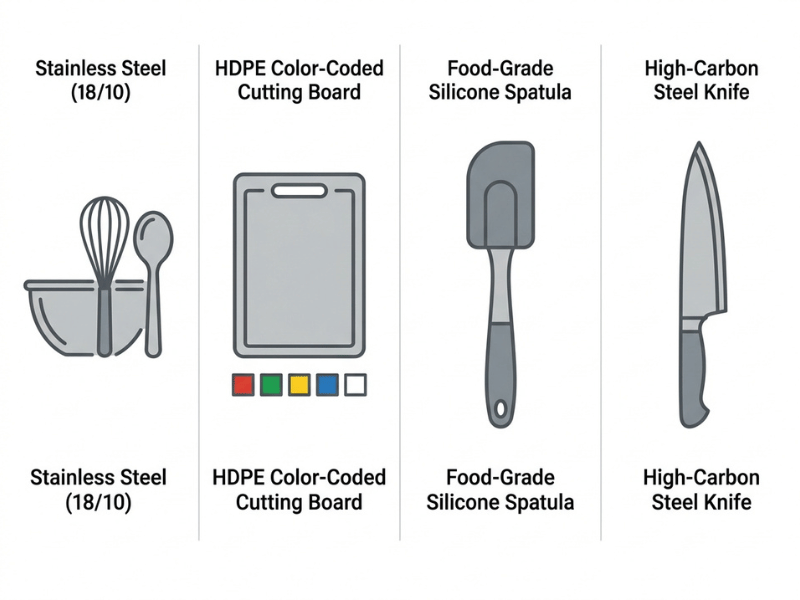
Stainless Steel (18/10 and 18/8)
Stainless steel is the default material for most professional kitchen utensils, and for good reason. It’s non-reactive, corrosion-resistant, easy to sanitize, and tolerant of both high heat and commercial dishwasher conditions. The grade matters:
- 18/10 stainless (18% chromium, 10% nickel) offers better corrosion resistance and a higher finish quality. It’s appropriate for service-facing utensils and items that will be exposed to acidic foods or saline environments.
- 18/8 stainless is slightly less corrosion-resistant but adequate for back-of-house prep and cooking utensils.
Construction quality matters as much as grade. A solid-handle ladle with a fully welded bowl will outlast a hollow-handle version with a spot-welded joint. When reviewing supplier samples, examine the weld points, check the gauge of the bowl or blade, and assess handle balance under load.
High-Carbon Steel
High-carbon steel is standard for professional knives and certain prep tools where edge retention takes priority over corrosion resistance. It requires more maintenance than stainless—handwashing, immediate drying, and periodic oiling—and is not suited to wet or highly acidic environments without care. In UAE kitchens handling significant quantities of citrus or marinated proteins, stainless steel knives are often the more practical choice for line cooks, with high-carbon steel reserved for specialist preparation tasks.
Nylon and Silicone
Nylon and silicone utensils play a specific and important role in commercial kitchens: protecting the surfaces of coated and non-stick cookware. For operations using non-stick hotel pans, silicone-coated utensils reduce surface degradation and extend equipment lifespan. The key procurement question is temperature rating. Food-grade silicone can typically handle up to 230°C, but this varies by manufacturer. Confirm ratings before use in high-heat applications.
Avoid low-grade nylon in proximity to an open flame or broiler—it can melt or off-gas at temperatures common in commercial kitchen environments.
Color-Coded HDPE
High-density polyethylene (HDPE) color-coded cutting boards and utensils are a hygiene standard in commercial kitchens, aligned with allergen management and cross-contamination prevention protocols. The color-coding system (typically red for raw meat, green for produce, yellow for poultry, blue for fish, white for dairy/bread) only functions if purchasing is consistent and staff training is maintained.
For UAE operations subject to HACCP audits, the procurement of color-coded HDPE should be treated as a non-negotiable specification. When sourcing, ensure the color is molded into the material—not surface-applied—so it doesn’t fade or chip with repeated dishwasher use.
Essential Commercial Kitchen Utensils by Station
Prep Station
The prep station drives volume. Utensil failure here creates downstream bottlenecks across every service. Core requirements include:
- Cutting boards (HDPE, color-coded, minimum 20mm thickness for durability)
- Chef’s knives and paring knives (commercial-grade stainless or high-carbon)
- Bench scrapers and bowl scrapers (stainless and flexible silicone)
- Mandoline slicers with safety guards
- Mixing bowls (18/10 stainless, nested, multiple sizes)
- Measuring jugs, scales, and portioning tools
Cooking Station
- Ladles (various sizes, fully welded bowl, heat-resistant handle)
- Slotted spoons and solid spoons
- Tongs (locking, 9″ and 12″, stainless with silicone or nylon tips for non-stick pans)
- Fish spatulas and turner spatulas
- Skimmers and spider strainers
- Whips and whisks (balloon and sauce)
- Thermometers (probe-style, HACCP-compliant)
Plating and Service Station
- Offset spatulas (various blade lengths)
- Plating tweezers and squeeze bottles
- Ring molds and presentation tools
- Sauce spoons (both round-bowl and offset styles)
- Service ladles (polished 18/10 for buffet visibility)
Baking and Pastry
- Pastry brushes (silicone, dishwasher-safe)
- Rolling pins (stainless or hardwood depending on preference)
- Bench knives and dough cutters
- Piping bags and nozzle sets
- Digital scales (high-precision, minimum 0.1g resolution for pastry)
- Silicone mats and perforated baking sheets
Hygiene and Safety
- Probe thermometer storage cases (color-coded)
- Sanitizer spray bottles (labeled, commercial-grade)
- Cut-resistant gloves (ANSI Level A4 or higher for knife-heavy prep)
- Oven mitts and heat-resistant gloves
Hotel vs. Restaurant vs. Catering: How Utensil Needs Differ
The same utensil specification rarely fits all types of operations. Procurement that ignores operational context creates unnecessary waste and service friction.
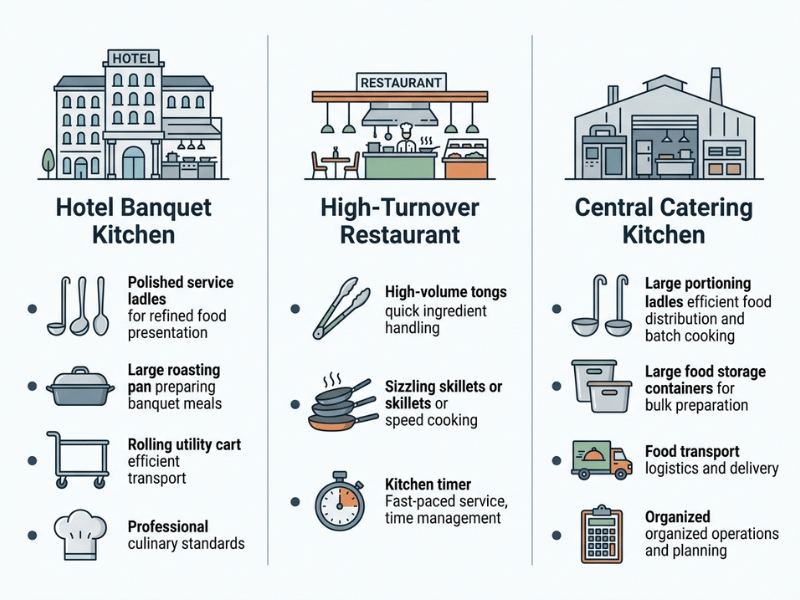
Hotel Buffet and Banquet Kitchens
Volume and presentation run simultaneously. Buffet utensils must be durable enough to survive high-turnover service and polished enough to be visible to guests. Banquet operations require utensils that can be deployed in bulk—often hundreds of pieces per service—and recovered, washed, and reset within tight turnaround windows. Procurement here should prioritize consistent batch sizing, easy identification, and the ability to quickly reorder identical specifications.
Hotel All-Day Dining
All-day dining kitchens operate across multiple cuisine types and service periods. The utensil range is typically broader and must cover breakfast prep, à la carte service, and afternoon operations. Durability and versatility matter more than specialization.
Fine Dining
Fine dining kitchens prioritize precision. Plating utensils, tweezers, and specialty tools are used with more care but must still meet commercial hygiene standards. Procurement volumes are lower, but specification quality is higher—this is not where to optimize on price.
High-Turnover Restaurants
High-turnover operations—fast casual, QSR, and full-service restaurants with rapid table turns—consume utensils at a faster rate than comparable hotel outlets. Replacement frequency is higher, making unit cost and reorder speed more significant procurement factors. Supplier stock availability in-country is particularly important for this segment.
Catering and Central Kitchens
Central kitchen operations require utensils that can scale. Portioning tools, large-volume ladles, and batch-cooking equipment support consistent output across multiple delivery points. Utensil standardization is critical here—when a utensil spec changes mid-contract, it can affect portion accuracy and workflow across an entire fleet of outlets.
High-Wear Items and Smart Reorder Logic
Certain utensil categories wear out faster than others, and reactive purchasing of these items—waiting until they fail before reordering—creates unnecessary operational disruption. High-wear categories in most commercial kitchens include:
- Cutting boards (surface scoring creates hygiene risk; replace on a defined cycle, not on visual inspection alone)
- Locking tongs (hinge mechanisms fatigue under repeated use and high-heat exposure)
- Probe thermometer tips (calibration drift and tip damage are common; maintain spares)
- Pastry brushes (bristle loss is a food safety issue)
- Squeeze bottles (valve and cap degradation)
Smart reorder logic starts with usage data. Track which items are being replaced most often, which stations are driving consumption, and whether damage patterns suggest a specification problem rather than a volume problem. A tong that breaks every three months might indicate the wrong grade was specified for that station—not simply that tongs wear out quickly.
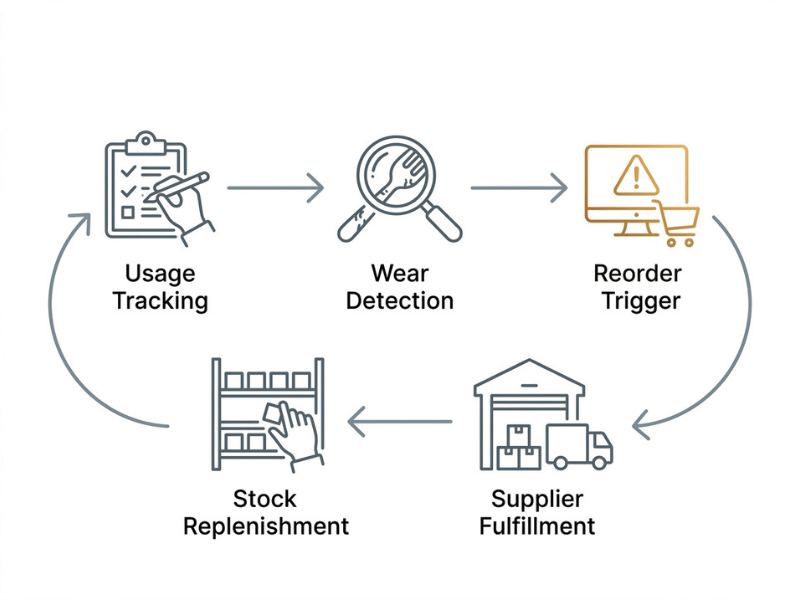
For UAE operations, build seasonal demand into reorder planning. The period around Ramadan, Eid, and the peak winter tourism season (October through March) places significant pressure on kitchen capacity and utensil inventory. Orders placed without accounting for this seasonality—or for the import lead times common on specialty items—risk stockouts at the worst moments.
Common Mistakes When Buying Commercial Kitchen Utensils
- Specifying material without specifying construction. “Stainless steel” covers a wide range of build quality. A hollow-handle ladle and a solid-handle ladle are both stainless steel, but they will perform very differently in a high-volume kitchen. Always request construction details alongside material specifications.
- Optimizing for unit price without considering total cost. A lower-cost utensil that needs replacing every three months will cost more annually than a higher-cost item with a 12-month service life—and the replacement process creates administrative overhead and temporary shortages.
- Buying across multiple suppliers without standardization. Inconsistent utensil sizing creates portion variance. Mixed handle styles across the same utensil type create confusion during fast-paced service. Standardizing on a core supplier for primary utensil categories simplifies training, inventory management, and reorder processes.
- Ignoring hygiene certification requirements. In the UAE, procuring food-contact materials without verifiable compliance documentation poses audit and liability risks. This applies to everything from cutting boards to ladles.
- Failing to account for lead times on imported goods. Many premium commercial kitchen utensils are imported. Standard air freight lead times from Asia or Europe to the UAE typically range from 5 to 15 business days; sea freight can extend to 30–45 days. For fit-out projects and seasonal restocking, failure to build this into procurement timelines causes avoidable delays.
How to Choose a Kitchen Utensils Supplier in the UAE
The UAE hospitality supply market is large and varied. Selecting the right supplier involves more than price comparison. For procurement managers sourcing at volume, the following criteria typically matter most:
- Stock consistency across orders. A supplier who can deliver 200 ladles to the same specification in March and then fulfill a 50-unit reorder in August without variation is more valuable than one offering the lowest unit cost. Request batch consistency guarantees—or at minimum, ask how the supplier manages spec changes across production runs.
- In-country stock vs. import-on-demand. Suppliers holding stock in the UAE can fulfill urgent reorders within days. Suppliers sourcing on-demand from abroad cannot. For high-wear items and fast-replenishment needs, in-country availability is a material factor.
- Project supply capability. Hotel fit-outs and multi-outlet launches require coordinated, phased delivery—not a single bulk shipment. Confirm that your supplier can manage phased delivery schedules aligned with a project timeline and provide documentation for each tranche.
- Multi-property procurement support. For hotel groups or F&B management companies operating across multiple properties in Dubai, Abu Dhabi, or other emirates, the ability to consolidate purchasing under a single supplier relationship—with consistent pricing and specifications across properties—significantly reduces administrative complexity.
- Hygiene and quality documentation. The supplier should be able to provide NSF certification or equivalent food-contact compliance documentation on request, without delay. If a supplier cannot readily produce this information, treat it as a risk indicator.
- Responsiveness and after-sales support. In a market where peak-season demand can arrive with little warning, supplier responsiveness matters. Test this before committing to a major procurement relationship—not after.
Ziyuan supports procurement teams across the UAE hospitality sector with sourcing, documentation, and project coordination for commercial kitchen supplies, including comprehensive coverage of the utensil category for hotel, restaurant, and catering operations.
Make Your Next Procurement Decision Count
A kitchen’s performance depends on every link in the chain—not just the equipment, but the tools that connect skilled hands to quality output. Commercial kitchen utensils are that link. When they’re specified correctly, sourced reliably, and managed with a reorder logic that anticipates demand, they become invisible in the best possible way: the kitchen just works.
For procurement managers and F&B directors ready to move past reactive purchasing, the right starting point is a structured utensil audit by station and operation type, followed by a supplier conversation that addresses specification, certification, and continuity—not just price.
Ready to source commercial kitchen utensils for your operation in the UAE? Contact the Ziyuan team to request a tailored utensil list or bulk quote for your property or project.
Frequently Asked Questions
What is the difference between commercial-grade and consumer-grade kitchen utensils?
Commercial-grade kitchen utensils are constructed to withstand continuous professional use, chemical sanitizers, and commercial dishwasher cycles. They use heavier gauge materials, fully welded or full-tang construction, and meet food safety certification standards such as NSF. Consumer-grade utensils are not designed for these conditions and typically fail much faster in a professional kitchen environment.
Which materials are best for commercial kitchen utensils in a hotel or restaurant?
18/10 stainless steel is the most widely used material in commercial kitchens due to its corrosion resistance, durability, and ease of sanitization. Color-coded HDPE is required for cutting boards in HACCP-compliant operations. Silicone and commercial-grade nylon are appropriate for utensils used with non-stick cookware. High-carbon steel is suitable for specialist knife applications where edge retention is prioritized.
What hygiene certifications should commercial kitchen utensils carry in the UAE?
Food contact materials used in UAE commercial kitchens should comply with Dubai Municipality and ADFCA requirements. NSF International certification is widely recognized and accepted. When sourcing from international suppliers, request compliance documentation before purchase—verbal assurances are not sufficient for audit purposes.
How should we plan for utensil restocking during UAE peak hospitality season?
The peak hospitality season in the UAE runs roughly from October through March, with additional demand spikes during Ramadan and Eid. Procurement teams should place restocking orders at least 6–8 weeks before peak periods to account for import lead times. Maintaining a safety stock level for high-wear items—typically 20–30% above base inventory—reduces the risk of service disruption.
What is the best approach to procuring multi-property utensils in the UAE?
Centralizing purchasing through a single supplier relationship across multiple properties standardizes specifications, simplifies reordering, and typically provides better pricing through consolidated volume. The supplier should demonstrate the ability to deliver phased shipments to different locations in line with a coordinated project or replenishment schedule.
How often should commercial kitchen cutting boards be replaced?
Cutting boards should be inspected regularly for deep scoring, warping, or discoloration. Surface scoring creates areas where bacteria can accumulate and are difficult to sanitize effectively. Most commercial kitchen operations replace cutting boards on a set schedule—typically every 6 to 12 months, depending on usage intensity—rather than waiting for visual failure. HACCP audits often flag boards on appearance alone.
What lead times should we expect when sourcing commercial kitchen utensils for UAE hotel fit-outs?
Lead times depend on whether the supplier holds local stock or sources on order. In-country suppliers can fulfill standard orders within days. Imported goods from Asia typically require 5–15 business days by air and 30–45 days by sea. For fit-out projects, sourcing should begin 8–12 weeks before the target delivery date to allow time for specification confirmation, sample approval, and shipping.