
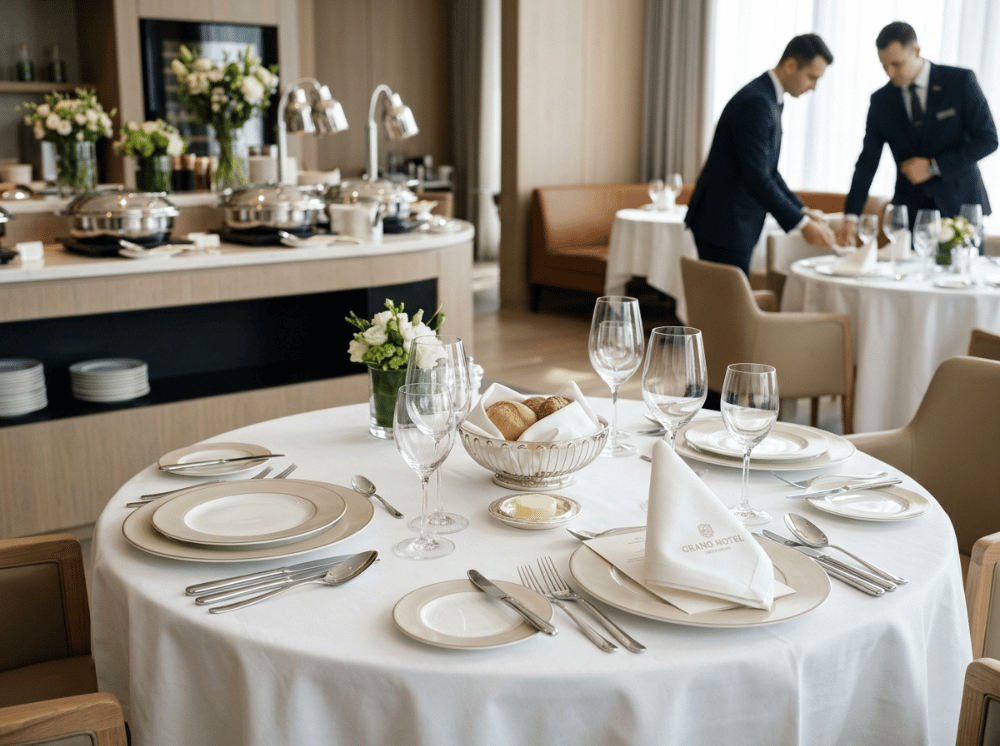
Walk into any well-run hotel dining room during a full breakfast rush, and you’ll see the difference the right equipment makes. Plates hold their finish under constant washing. Chafers keep eggs at a safe temperature without drying them out. Flatware matches across every table, and servers reset covers in seconds. None of that happens by luck. It’s the result of front-of-house equipment chosen with intent.
From the manufacturer’s side, we watch this play out across thousands of properties. The operations that treat serviceware as a long-term system—not a line item to squeeze—consistently spend less over time and present better to guests. The ones that buy on price alone end up replacing bent forks, chipped plates, and clouded glasses far sooner than they planned.
This guide is built for that first group. It’s a procurement-focused breakdown of food and beverage service equipment: what the categories are, how materials perform, how to match equipment to your operation, how much to stock, and how to choose a supplier who can hold quality across every reorder. By the end, you’ll know exactly what to specify and why.
Quick answer: Food and beverage service equipment covers the tableware, flatware, glassware, hollowware, buffetware, serving tools, and beverage service pieces that guests interact with front-of-house. For hotels and restaurants, the right choices come down to material grade, durability during commercial washing, operating type, and a supplier that can maintain consistent quality across reorders.
What Counts as Food and Beverage Service Equipment?
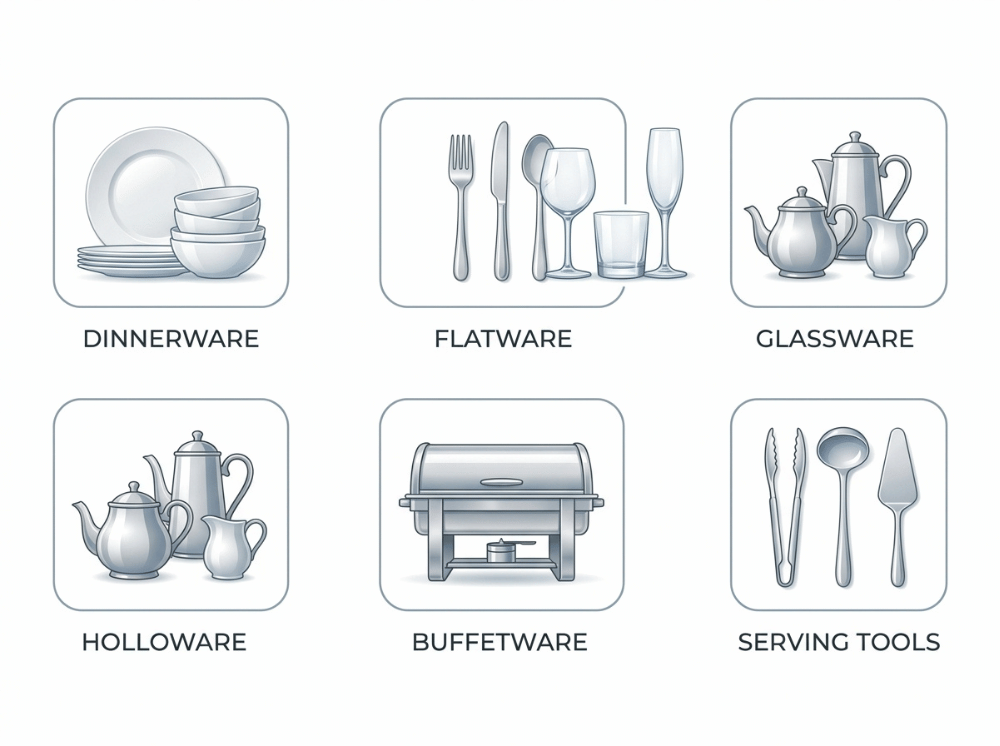
Food and beverage service equipment refers to the front-of-house serviceware and support tools used to present, hold, and deliver food and drink to guests. It’s everything a guest sees, touches, and judges—plates, forks, glasses, serving dishes, buffet chafers, and the tools servers use to keep the floor moving.
It’s worth drawing a clear line here. Front-of-house serviceware is not the same as back-of-house kitchen equipment. Ovens, prep tables, walk-in coolers, and dishwashers belong to production. Service equipment belongs to presentation and delivery. The two categories have different buyers, different replacement cycles, and different performance priorities. This guide focuses on the front-of-house side, because that’s where guest perception and daily wear collide most directly.
Broadly, the equipment covered here falls into four working groups:
- Tabletop equipment — dinnerware, flatware, glassware, and hollowware
- Buffet and banquet equipment — chafing dishes, dispensers, soup kettles, and display pieces
- Beverage service tools — pitchers, carafes, ice buckets, and wine chillers
- Serving and transport tools — utensils, trays, and clearing gear
Treat these as long-term operational assets rather than one-time purchases. A well-specified flatware program can run for years across thousands of wash cycles. A poorly specified one becomes a recurring cost that quietly drains your budget. The equipment on your table also signals the kind of experience guests can expect before the first course arrives—which makes every specification decision a brand decision too.
Core Categories of Hospitality Service Equipment
This is the backbone of any service equipment program. Here’s what each category includes and how to choose within it.
Dinnerware
Dinnerware should be selected around your menu format and service volume. Vitrified china is the industry standard for full-service restaurants and hotels—it’s fired at high temperatures to become non-porous, making it chip-resistant, dishwasher-safe, and stable under heavy use. Porcelain suits fine dining, where a refined finish and lighter feel matter. Melamine works for casual outdoor, poolside, and institutional settings where breakage is the primary concern.
One practical rule outperforms almost any brand choice: standardize your plate sizes across the menu. Consistent sizing simplifies storage, speeds expediting, and keeps replacement ordering clean. Mixed dimensions create friction in every dish room and on every shelf.
Flatware
Flatware is the most tactile part of the dining experience—guests feel the weight and balance of a fork before they taste anything. For hospitality operations, 18/10 stainless steel is the benchmark: 18% chromium for corrosion resistance and 10% nickel for luster and durability. It retains its shine and shape through commercial dishwashing far better than lower-grade materials. 18/0 stainless steel reduces nickel costs and adds one useful trait—it’s magnetic, so it works with flatware retrievers that reduce losses in high-turnover settings.
Grade is only half the story. Weight is set by the gauge of the steel, not the alloy, and it splits into three practical tiers:
- Medium weight — economical and flexible, suited to cafeterias and budget casual concepts
- Heavyweight — a more substantial feel for hotel all-day dining and banquets
- Extra heavy weight — the premium tier for fine dining and luxury service
Then there’s construction. Stamped flatware is punched from flat sheet steel—lighter and cheaper. Forged flatware is shaped from a single thick billet, resulting in better balance, consistent weight distribution, and a pattern that wraps around all sides of the handle. Forged pieces outperform stamped ones in both durability and feel. Explore our [stainless steel flatware collection] to compare grades and weights side by side.
Glassware
Match glassware to your beverage program. Most full-service operations need, at a minimum, an all-purpose water glass, a red wine glass, a white wine glass, and a highball or rocks glass. Tempered glass reduces breakage risk across the board, and rim-tempered glassware reinforces the most vulnerable point of impact, valuable in high-volume service where glasses collide constantly.
For buffets and banquets, prioritize stackable, uniform families. A consistent stemware line looks better across a large room and makes replacement far simpler when a tray goes down. Browse our [commercial glassware range] to see tempered and stackable options built for volume.
Holloware
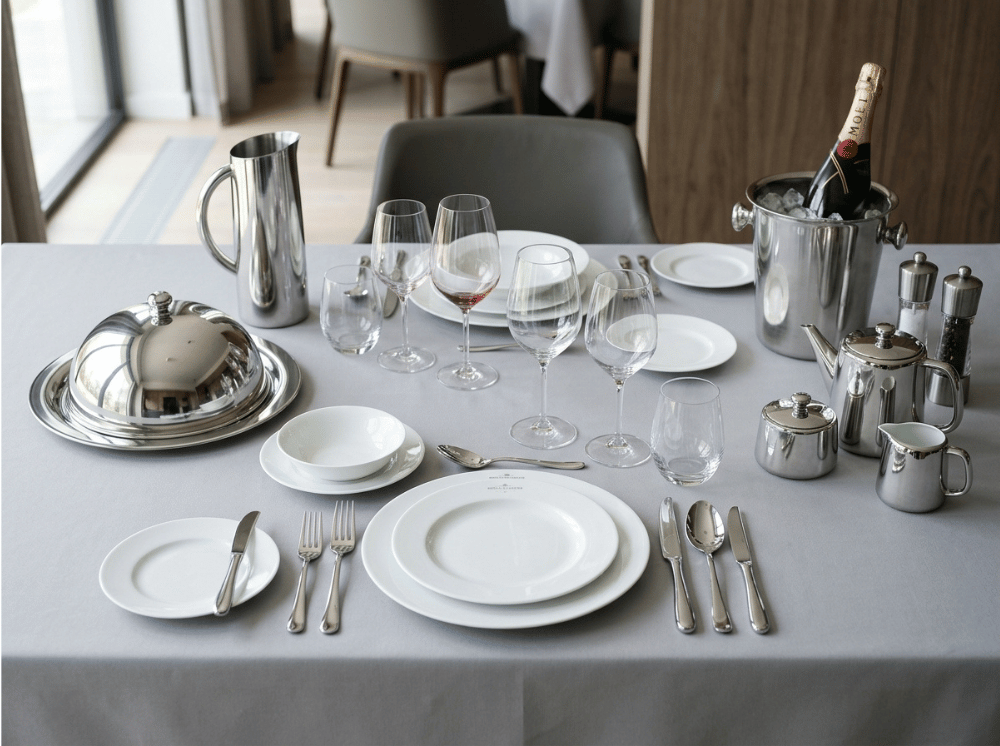
Hollowware refers to the hollow metal serving pieces used to hold and present food and drink—coffee pots, teapots, creamers, sugar bowls, water jugs, soup tureens, and entrée dish covers. In hotel operations, these pieces often carry the property’s finish and become part of the brand identity as much as they are functional tools.
The core choice is stainless steel versus silver-plated. Stainless steel is durable, low-maintenance, and built for daily service. Silver-plated pieces elevate the fine-dining presentation but require more polishing and careful handling. For most operations, stainless steel wins on total cost. See our [hotel holloware collection] for finishes that coordinate across a full service line.
Buffetware
Buffetware carries a food safety responsibility, not just a presentation one. The FDA Food Code requires hot foods to be held at 135°F (57°C) or above and cold foods at 41°F (5°C) or below. Your equipment has to meet those standards in real-world service conditions.
Chafing dishes are the foundation of any hot buffet—a frame, a water pan, a food pan, and a heat source. Pre-heat the water pan before service, because a cold chafer won’t reach temperature fast enough and creates an opening for bacterial growth. Soup kettles and insulated dispensers hold soups, sauces, and beverages at steady temperatures through long service periods. For banquets serving 200+ covers, electric units with thermostatic control offer tighter control than fuel-based options—though fuel-based chafers remain the right call for off-site catering and venues without reliable power. Our [buffetware and chafing dishes] range covers both electric and fuel-based holding.
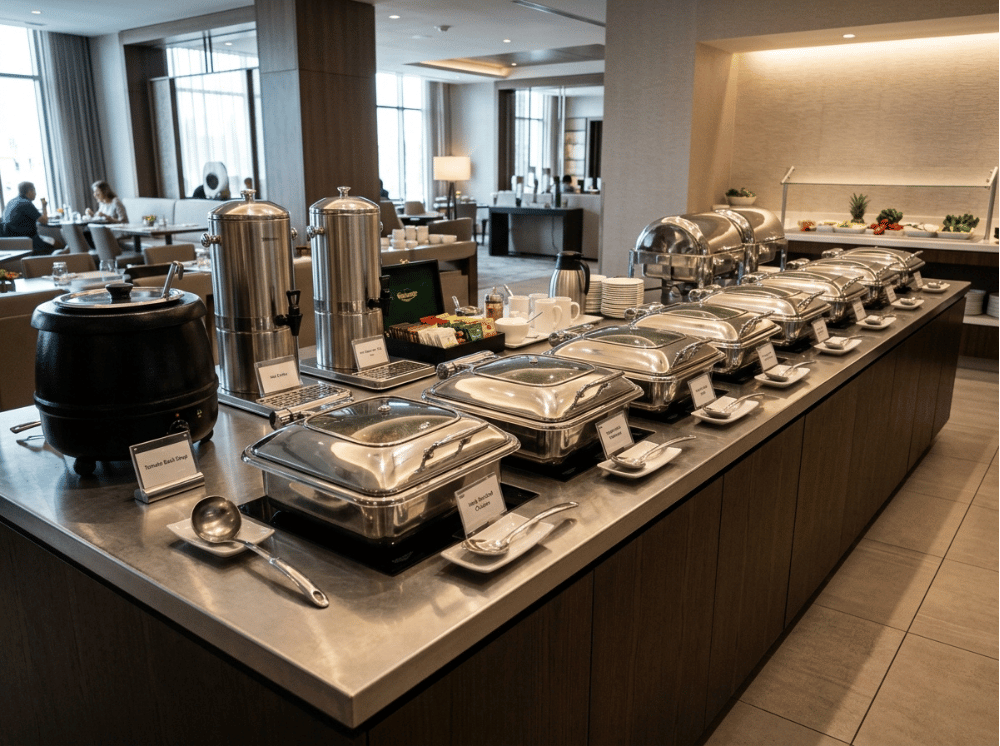
Callout — Fuel vs. electric buffetware: Choose fuel-based for off-site catering, outdoor events, and no-power venues. Choose electric for indoor hotel buffets and high-cover banquets where precise, consistent holding matters most.
Serving Tools and Utensils
Serving tools complete a buffet and family-style program: serving spoons, slotted (pierced) spoons, cold meat forks, tongs, and cake servers. Match the utensil set to each buffet station—a slotted spoon for anything served in liquid, a cold meat fork for carving lines, and tongs for handled service.
The detail that separates a polished program from a patchy one is family consistency. Serving pieces should share the same finish and design language as your flatware and hollowware. When they don’t, a buffet line looks like it was assembled from spare parts. Coordinated [buffet serving utensils], keeping the visual system intact from table to station.
Beverage Service Tools
Beverage service tools cover pitchers, carafes, ice buckets, wine chillers, and coffee and tea service pieces. Insulated pitchers and dispensers hold temperature for water and juice service; non-insulated carafes are standard for wine and short-hold water service. Whatever you choose, prioritize clean-pour spout designs that don’t drip—a dripping pitcher undoes an otherwise sharp presentation.
For wine and sparkling service, single-bottle chillers should hold enough ice to maintain temperature through a full dining occasion, and floor-standing coolers allow smooth tableside presentation without awkward handling.
How to Choose Service Equipment by Operation Type
Categories tell you what exists. Operation type tells you what to actually buy. Here’s how the pieces come together by setting.
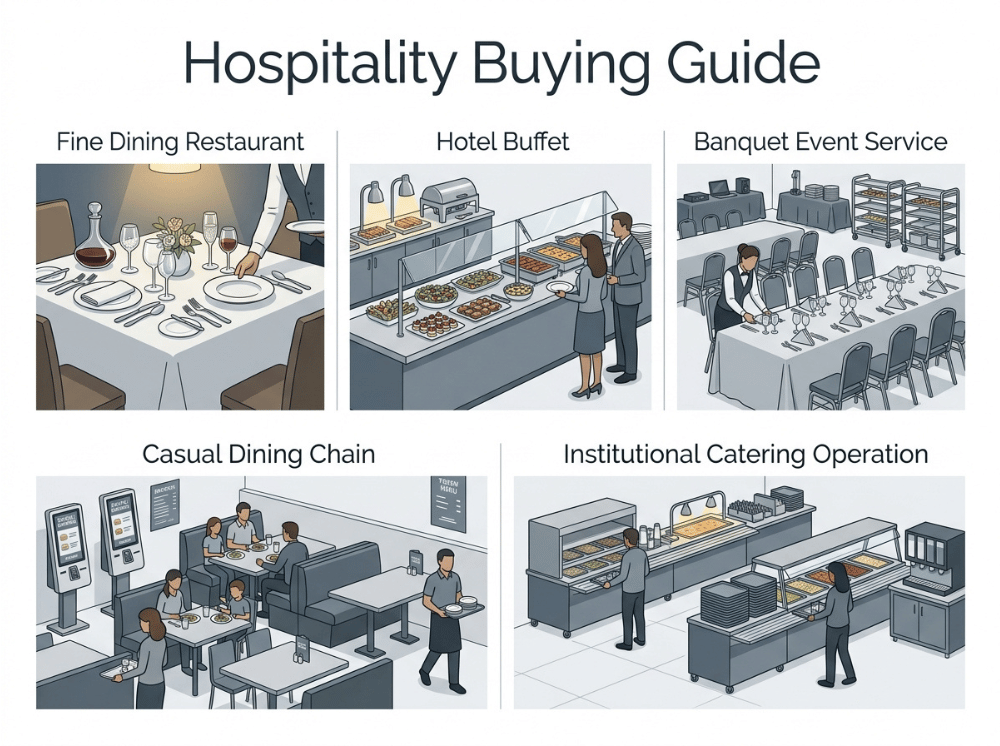
Fine Dining Restaurants
Specify extra-heavy or forged flatware, high-grade vitrified china or porcelain, and polished hollowware. Build out the full beverage program with wine-specific glassware, and add the specialty service pieces that formal service demands—crumbers, fish sets, and coordinated serving tools. Here, hand-feel and presentation directly shape the guest experience, so weight and finish earn their premium.
Hotel Buffets
Prioritize durable 18/10 flatware, stackable dinnerware, and robust chafers and dispensers. Volume is relentless—pieces cycle through the wash all day—so corrosion resistance and ease of replacement matter more than ornamentation. Coordinated serving utensils and patterns that stay in production keep the whole operation consistent across outlets. Matched [hotel cutlery sets] make cross-outlet consistency simpler to maintain.
Banquet and Event Service
Banquet operations run enormous quantities through fast turnarounds, so uniformity across thousands of pieces is the deciding factor. Specify high par stock, guaranteed pattern continuity, and stackable, transport-friendly pieces that reset quickly. A supplier who can hold a pattern for years is worth more here than a slightly cheaper unit price.
Casual Dining Chains
Choose entry-level 18/10 or quality 18/0 in medium weight with a satin finish. Satin hides fingerprints and minor scratches through heavy daily use, keeping tables looking clean for longer. Multi-location chains benefit most from simplified SKUs and patterns that stay in production for years, so every location can reorder from the same spec.
Institutional and Catering Operations
For cafeterias and institutional dining, magnetic 18/0 flatware pairs with retrievers to control loss—one of the highest ongoing costs in the segment. Durable melamine or tempered dinnerware absorbs high-volume handling. For off-site catering, fuel-based buffetware travels well and works in venues without reliable power.
Material and Durability Considerations
Durability is where upfront savings either hold up or unravel. A few material comparisons should anchor every purchasing decision.
- Dinnerware materials. Vitrified china offers the best balance of durability and appearance for most commercial services. Porcelain reads as more refined but is better reserved for lower-impact fine dining. Melamine is the most break-resistant and the right choice where drops are frequent, though it can’t match the finish of fired ceramics.
- Stainless steel grades. The comparison runs are 18/10, 18/0, and 13/0. 18/10 leads on corrosion resistance and shine, thanks to its nickel content. 18/0 is more affordable and magnetic but bends and dulls more easily. 13/0 is used primarily for knife blades, where its composition supports blade forging and a sharper edge while still resisting rust.
- Glass. Tempered and rim-tempered glass outperform standard glass under commercial impact. In high-volume service, the reduced breakage rate more than covers the difference.
- Holloware. Stainless steel withstands daily service with minimal labor. Silver-plated pieces look richer but add a real maintenance burden—regular polishing, careful storage, and a plating layer that wears over time. Weigh the presentation gain against the labor cost honestly.
- Finish. Mirror polish reads as formal and premium, but shows fingerprints and water spots faster. Satin or matte finishes hide wear and fingerprints better in daily use. Both can be produced in 18/10 or 18/0, so the finish is a presentation decision, not a durability one.
Standardization, Par Stock, and Replacement Planning
Getting quantities and consistency right is what sets seasoned buyers apart.
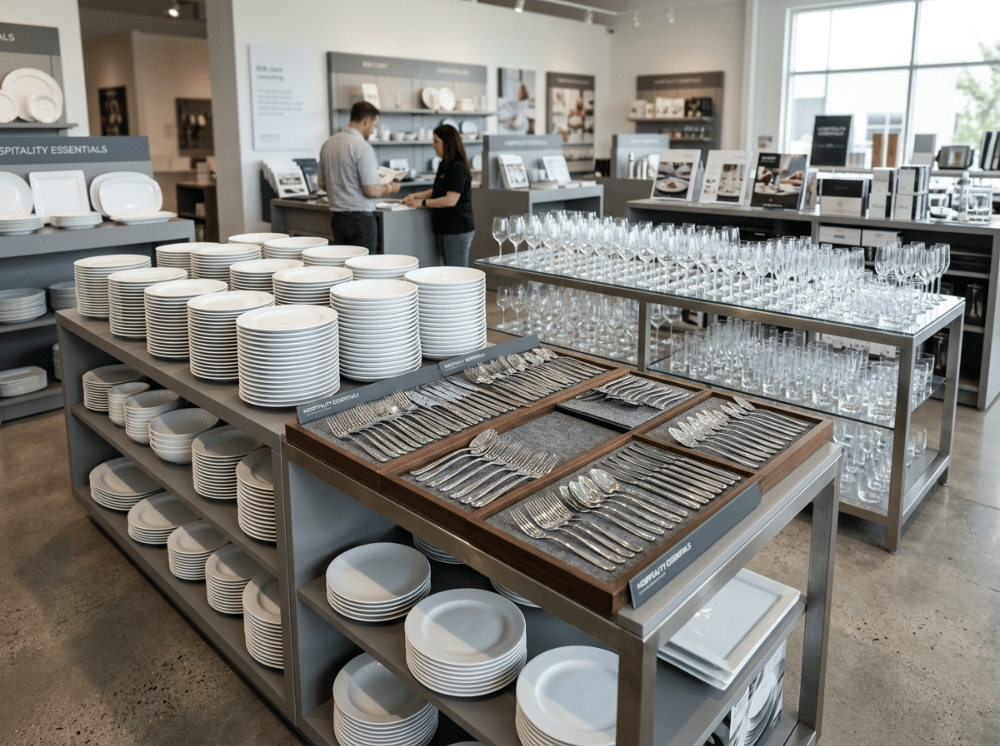
The working benchmark for stock is the 3x par rule: for every cover, keep three sets of flatware and glassware in circulation—one in service, one in the dish room, and one in reserve. For banquet-heavy properties or operations with high breakage, move that ratio closer to 4x. Running out of clean covers mid-service is an avoidable failure that no guest forgets.
To size an order, start with your maximum cover count, factor in the number of courses served, and account for turnover over a service period. A 125-seat fine-dining restaurant, for example, often needs around 625 teaspoons alone, once you factor in multiple courses and washing cycles. Build headroom into every order for loss and breakage.
Standardization is the quiet multiplier. Keep plate sizes limited and consistent. Hold a single flatware family across every outlet in a property or portfolio. And insist on pattern continuity—confirm with your supplier that a pattern will stay in production, because a discontinued line forces a full replacement when all you needed was a top-up. Cross-outlet standardization reduces purchasing complexity, simplifies storage, and shortens staff training time.
Planning par levels for a new property or refresh? [Request bulk order support] from Wonhosp and we’ll help you calculate quantities against your cover count and service style.
What to Look for in a Hospitality Equipment Supplier
The product matters, but so does the partner behind it. Equipment is only as good as the supplier’s ability to deliver it consistently, order after order. When evaluating a manufacturer, weigh these factors:
- Material and weight consistency. Every reorder should match the last—same alloy, same gauge, same finish. Inconsistency is the fastest route to a mismatched service line.
- Pattern continuity. Confirm the pattern stays in production so top-ups don’t force full replacements.
- MOQ and lead times. Understand minimum order quantities and production timelines to plan opening orders, seasonal ramps, and replacements without gaps.
- Commercial durability. Ask how pieces perform under commercial dishwashing and chloride exposure—the real test of any stainless steel program.
- OEM/ODM capability. For branded or signature table settings, a supplier offering custom patterns, finishes, and packaging gives you room to differentiate.
- Logistics and packaging. Reliable bulk shipping, protective packaging, and export experience keep large orders arriving intact and on schedule.
The best suppliers aren’t order-takers. They understand service flow, sanitation demands, and the operational realities of high-volume dining—and that expertise shows up in product design and in support when something goes wrong. For branded programs, our [custom hospitality tableware (OEM/ODM)] service is built around exactly these needs.
Building a Coordinated Service Equipment Program
Individual categories are easier to buy well than a whole program is to assemble well. The properties that get it right treat their equipment as one coordinated system.
Start with visual alignment. Flatware, hollowware, and serving-piece finishes should share a common design language. When a satin flatware line meets mirror-finish hollowware and an unrelated serving set, a table looks fragmented, even if every piece is high-quality. Coordinated product families keep presentation clean across every outlet in a property.
Sequence your purchases sensibly. Buy the tabletop essentials first—dinnerware, flatware, glassware—since they touch every cover. Layer in specialty and serving pieces once the core is settled. This keeps a new opening functional early and lets you refine the presentation without holding up service.
When you upgrade, phase it. Replacing an entire service line at once is expensive and disruptive. Instead, upgrade by outlet or by category, keeping the existing spec in service until the new one is fully cycled in. A supplier with strong pattern continuity makes phased upgrades far less painful, because the pieces you buy today will still be available when you’re ready to expand.
Frequently Asked Questions
What is food and beverage service equipment?
Food and beverage service equipment is the front-of-house serviceware and support tools used to present, hold, and deliver food and drink to guests. The main categories are dinnerware, flatware, glassware, hollowware, buffetware, serving tools, and beverage service pieces. It’s distinct from back-of-house kitchen equipment, which handles production rather than service.
What equipment is essential for hotel buffet service?
A hotel buffet needs chafing dishes and soup kettles to hold hot food safely, insulated beverage dispensers, stackable dinnerware, durable 18/10 flatware, and a coordinated set of serving utensils. Hot foods must be held at 135°F (57°C) or above, and cold foods at 41°F (5°C) or below, so temperature-control equipment is non-negotiable.
What is holloware in hospitality service?
Hollowware refers to hollow metal serving pieces used to hold and present food and drink—coffee pots, teapots, creamers, sugar bowls, water jugs, soup tureens, and entrée dish covers. It’s typically made from stainless steel or silver-plated metal and serves both a functional and a presentation role, often carrying a hotel’s branded finish.
What stainless steel is best for restaurant flatware?
18/10 stainless steel is the industry benchmark for hospitality flatware—18% chromium for corrosion resistance and 10% nickel for shine and durability. It outperforms 18/0 (no nickel, more affordable, magnetic) and 13/0 (used mainly for knife blades) in both longevity and appearance under commercial dishwashing.
How much tableware and flatware should a hotel stock?
The common industry rule is three times your maximum cover count—one set in service, one in the dish room, and one in reserve. Operations with high breakage or heavy banquet volume should move closer to four times. Size orders from cover count, courses served, and turnover, then add headroom for loss and breakage.
What temperature must hot buffet food be held at?
The FDA Food Code requires hot foods to be held at a minimum of 135°F (57°C) throughout service. Chafing dishes, soup kettles, and heat lamps maintain this standard, and staff should check temperatures regularly with instant-read probe thermometers across the service period.
How do you choose a supplier for hospitality service equipment?
Look for consistent material grade and weight across reorders, guaranteed pattern continuity, clear MOQ and lead times, proven durability under commercial dishwashing, and OEM/ODM options for branded pieces. Reliable bulk packaging and export logistics matter for large orders.
What is the difference between front-of-house serviceware and kitchen equipment?
Front-of-house serviceware is what guests interact with—plates, flatware, glassware, hollowware, and buffet pieces used to present and deliver food. Kitchen equipment is back-of-house production gear such as ovens, prep tables, and dishwashers. They have different buyers, replacement cycles, and performance priorities.
Specify With Confidence — Then Talk to Wonhosp
Choosing food and beverage service equipment comes down to five decisions: the right category mix, the right materials, a fit with how your operation actually serves, disciplined standardization and par planning, and a supplier who can hold quality across every reorder. Get those right, and durability and consistency lower your total cost over time—while pattern selection becomes the easy last step.
The wrong equipment works against your operation every shift. The right equipment quietly supports service speed, food safety, staff efficiency, and guest satisfaction.
Planning a service equipment program for a hotel, restaurant, catering service, or institutional dining operation? Contact Wonhosp for product recommendations, bulk order support, and OEM/ODM options. Our team will help you match material, weight, finish, and quantity to your service style and budget—so your first order performs as well as your last.