
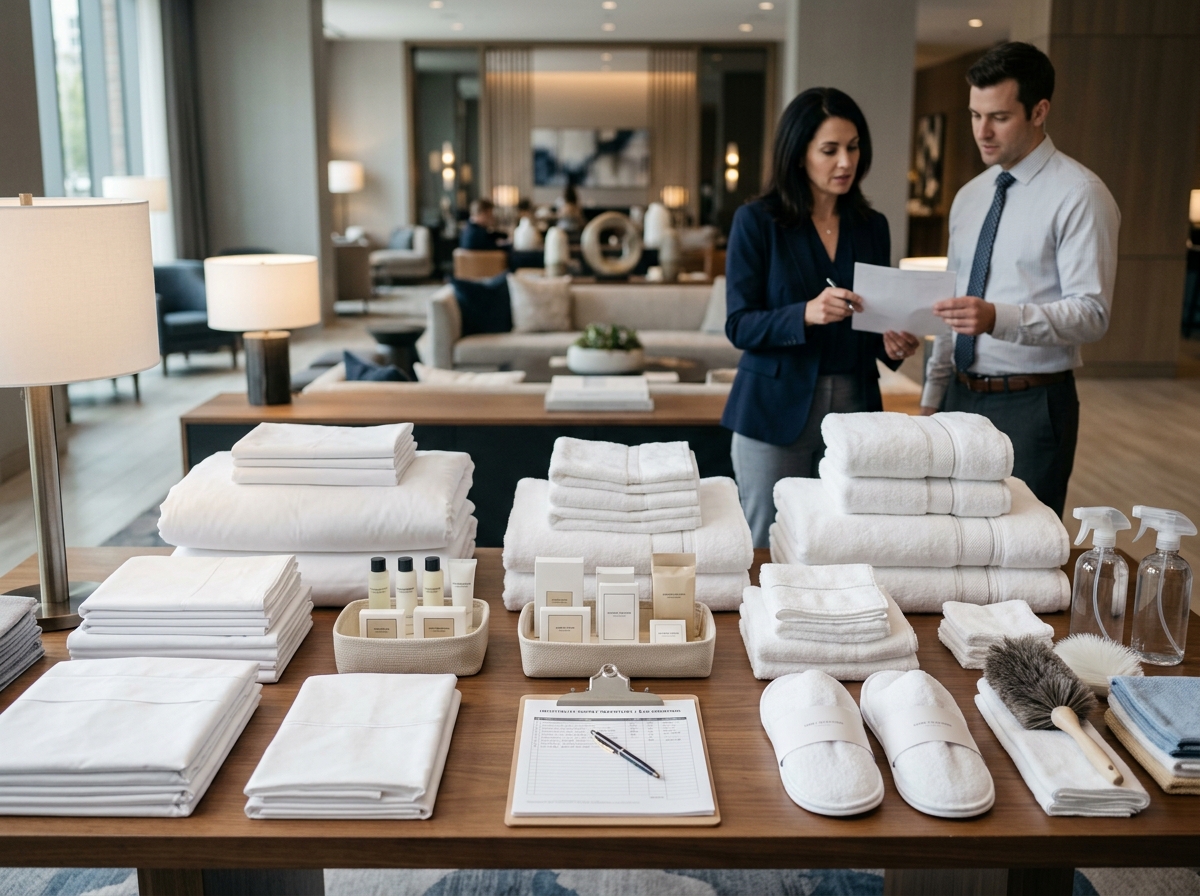
The top hospitality supplies suppliers in the USA include Guest Worldwide, American Hotel Register, HD Supply, 1888 Mills, Manchester Mills, National Hospitality Supply, DZEE Textiles, Cintas, Ecolab, and Mayfair Hotel Supply. Each serves different property types and procurement needs — this guide breaks down their strengths, limitations, and best-fit scenarios so you can build a smarter supplier stack.
Procurement in hospitality has never been more complicated — or more consequential. Supply chain disruptions, shifting sustainability mandates, rising material costs, and increasingly demanding guests have turned what was once a relatively routine purchasing function into a strategic discipline. Choose the wrong supplier, and you’re dealing with inconsistent product quality, missed delivery windows, and unhappy housekeeping teams. Choose well, and you gain a supply chain that quietly supports every guest experience you’re trying to deliver.
This guide was written for hotel operators, purchasing managers, and hospitality procurement professionals who need a reliable, detailed reference — not a recycled list of brand names. Whether you’re outfitting a 40-room boutique property, managing procurement across a regional portfolio, or overseeing FF&E for a new-build hotel project, the supplier landscape varies significantly depending on your scale, budget, and operational priorities.
To build this guide, we evaluated 10 of the most widely used and recommended hospitality supplies suppliers currently operating in the US market. Each was assessed across eight dimensions: product range, pricing transparency, minimum order requirements, lead times, sustainability credentials, customer support, technology and ordering systems, and geographic coverage. We’ve also included a quick-comparison table, a multi-supplier procurement stack model, and six due diligence questions to ask before signing any supplier agreement.
A note on methodology: this guide reflects publicly available information, direct supplier documentation, and procurement intelligence gathered from industry professionals. Where specific pricing data is unavailable (as is common with contract-based hospitality suppliers), we’ve noted this clearly rather than speculating.
What Does a Hospitality Supplies Supplier Actually Provide?
Before comparing suppliers, it’s worth aligning on terminology — because “hospitality supplies” means very different things depending on who you ask.
OS&E vs. FF&E: What’s the Difference?
The two most commonly used categories in hotel procurement are OS&E (Operating Supplies and Equipment) and FF&E (Furniture, Fixtures, and Equipment). Understanding the distinction matters because most suppliers specialize in one or the other — and some cover both.
OS&E refers to the consumable and operational items that keep a hotel running day-to-day. These are the products that guests use, housekeeping replenishes, and purchasing managers reorder on a recurring basis.
FF&E refers to the physical assets that define a property’s look and feel — items that are typically specified during a build or renovation and replaced on a much longer cycle.
|
Category |
Type |
Examples |
|---|---|---|
|
Linens & Bedding |
OS&E |
Sheets, pillowcases, duvet covers, mattress protectors |
|
Towels & Bath |
OS&E |
Bath towels, hand towels, washcloths, bath mats |
|
Amenities |
OS&E |
Shampoo, conditioner, body wash, dental kits, sewing kits |
|
Paper Products |
OS&E |
Toilet paper, facial tissue, napkins, key card envelopes |
|
Housekeeping Supplies |
OS&E |
Cleaning chemicals, carts, gloves, bags |
|
Uniforms |
OS&E |
Front desk, housekeeping, F&B staff apparel |
|
Guest Room Accessories |
OS&E |
Hangers, ice buckets, luggage racks, waste bins |
|
Food & Beverage Supplies |
OS&E |
Tableware, glassware, serving equipment |
|
Furniture |
FF&E |
Beds, desks, chairs, sofas, case goods |
|
Fixtures |
FF&E |
Lighting, mirrors, window treatments |
|
Equipment |
FF&E |
Safes, minibars, HVAC units |
|
Technology |
FF&E |
TVs, phones, locks, and entertainment systems |
Most of the suppliers featured in this guide are OS&E specialists — meaning they’re better suited to ongoing procurement than to one-time capital project purchasing. Where a supplier has meaningful FF&E capabilities, we’ve noted it in their profile.
Why This Distinction Matters for Procurement Strategy
OS&E and FF&E procurement require fundamentally different approaches. OS&E purchasing is high-frequency, operationally driven, and sensitive to lead times and stock availability. FF&E procurement is project-based, specification-heavy, and typically involves longer lead times, design coordination, and capital budget approval.
If you’re a purchasing manager handling day-to-day operations, the majority of this guide is directly relevant to your role. If you’re managing an FF&E project for a new build or renovation, you’ll want to pair this guide with dedicated FF&E sourcing resources — and consider custom manufacturing suppliers like Ziyuan, which offers OEM/ODM production for hotels requiring fully customized product specifications at scale.
Why This Market Matters to Buyers Right Now
How Large Is the US Hospitality Supplies Market?
The US hospitality industry is one of the largest in the world. According to the American Hotel & Lodging Association (AHLA), the US hotel industry generated approximately $218 billion in revenue in 2023, and that scale flows directly into procurement budgets across thousands of properties.
Hospitality supplies represent a significant share of hotel operating costs. Industry benchmarks typically place linen and room supplies at 3–5% of total revenue for a mid-scale property, with larger full-service hotels spending considerably more when F&B and housekeeping supplies are factored in.
What’s Driving Price Volatility in 2024–2025?
Several converging forces are making procurement more difficult — and more expensive — than it was pre-pandemic.
Cotton and textile pricing remain elevated. Global cotton prices saw significant spikes following pandemic-era supply disruptions, and while markets have partially stabilized, hotel textile buyers are still navigating higher per-unit costs compared to 2019 baselines. Buyers sourcing direct from manufacturers — particularly those with OEM/ODM capabilities in established textile-producing regions — have been better insulated from these fluctuations.
Freight and logistics costs have moderated from their 2021–2022 peaks but remain above historical norms for many import-dependent supply categories.
Labor and energy costs are flowing through to product pricing across cleaning chemicals, paper products, and amenities — categories where domestic manufacturers have faced consistent cost pressure.
For procurement professionals, this environment makes supplier diversification — and direct-source relationships — more valuable than they’ve been in years.
The Sustainability Shift: From Nice-to-Have to Procurement Criteria
Sustainability has moved from a brand positioning exercise to an active procurement criterion. Several forces are accelerating this shift:
- Brand standards: Major hotel brands, including Marriott, Hilton, and IHG, have published sustainability commitments that cascade into property-level procurement decisions, particularly regarding single-use plastics and chemical safety.
- Guest expectations: According to Booking.com’s 2023 Sustainable Travel Report, 76% of global travelers say they want to travel more sustainably — and purchasing choices at the property level are increasingly visible to environmentally conscious guests.
- Municipal regulation: Several US cities and states have enacted or proposed restrictions on single-use plastic amenities, making sourcing compliant suppliers a compliance issue rather than a preference.
Suppliers that can demonstrate credible sustainability credentials — certified textiles, eco-certified chemicals, reduced packaging programs — are gaining meaningful procurement share.
How I Scored Each Supplier
Choosing a hospitality supplies supplier involves more trade-offs than most supplier scorecards acknowledge. A large distributor might offer unbeatable breadth but fall short on customization. A textile specialist might deliver exceptional quality but require minimum orders that only make sense at scale.
To give this guide genuine utility, each of the 10 suppliers was evaluated across eight dimensions. Here’s the framework — including why each dimension was weighted the way it was.
The 8-Dimension Evaluation Framework
|
Dimension |
Weight |
Why It Matters |
|---|---|---|
|
Product Range |
15% |
Broader range = fewer supplier relationships to manage. Critical for properties seeking consolidation. |
|
Pricing & Value |
20% |
Total cost of ownership, not just unit price. Includes minimum orders, shipping, and reorder flexibility. |
|
Minimum Order Requirements |
10% |
High MOQs exclude smaller properties. Low MOQs may signal premium pricing or limited scale. |
|
Lead Times & Reliability |
20% |
In hospitality, stockouts are operationally damaging. Reliable lead times matter more than fast ones. |
|
Sustainability Credentials |
10% |
Increasingly, a brand standard requirement and regulatory concern. |
|
Customer Support |
10% |
Dedicated account management, order tracking, and issue-resolution capabilities. |
|
Technology & Ordering Systems |
10% |
Online ordering, inventory integration, and reporting tools are critical for multi-property operators. |
|
Geographic Coverage |
5% |
National distribution capability vs. regional limitations. |
How to Use This Framework for Your Property
These weights reflect a mid-scale-to-full-service hotel operator’s perspective. Adjust them based on your specific context:
- Independent boutique hotels: Weight minimum order requirements and customer support are higher. Large distributors may not serve you well.
- Multi-property portfolios: Prioritize technology/ordering systems, as well as geographic coverage. Consolidation efficiency matters.
- Luxury properties: Shift weight toward product quality and customization capability. Price is less critical than brand consistency.
- New-build projects: Lead times and FF&E capability become primary criteria during pre-opening procurement.
- Sustainability-committed brands: Increase the sustainability credentials weighting to 20%+ and filter accordingly.
No single supplier scores perfectly across all eight dimensions. The goal of this framework isn’t to find a perfect supplier — it’s to match the right supplier to the right procurement role within your overall supply strategy.
Quick Comparison — All 10 Suppliers at a Glance
Use this table as a fast reference before diving into individual profiles. Ratings are relative assessments based on the eight-dimensional framework described in Part 4.
| Supplier | Best For | Product Focus | Min. Order | Sustainability | Pricing Model |
|---|---|---|---|---|---|
| Guest Worldwide | Mid-scale to upscale branded hotels | Full OS&E range | Moderate | ✓ Good | Contract-based |
| American Hotel Register | Properties of all sizes needing broad catalog access | Full OS&E + some FF&E | Low | ✓ Good | Catalog + contract |
| HD Supply | Full-service and extended-stay properties | Broad maintenance & OS&E | Low–Moderate | ✓ Moderate | Catalog + account |
| 1888 Mills | Bulk textile buyers; upscale and luxury | Textiles (towels, linens) | High | ✓✓ Strong | Contract/volume |
| Manchester Mills | Mid-scale to full-service; US-manufactured preference | Textiles | Moderate | ✓✓ Strong | Contract |
| National Hospitality Supply | Boutique and independent hotels | Full OS&E range | Low | ✓ Moderate | Catalog |
| DZEE Textiles | Budget-conscious buyers; high-volume textile procurement | Textiles | Moderate–High | ✓ Moderate | Volume/contract |
| Cintas | Properties needing managed linen/uniform programs | Uniforms + managed textile services | Service contract | ✓ Moderate | Service contract |
| Ecolab | Properties with strong hygiene/sustainability mandates | Cleaning chemicals + hygiene | Moderate | ✓✓✓ Best-in-class | Contract |
| Mayfair Hotel Supply | Independent and boutique properties | Full OS&E range | Low | ✓ Moderate | Catalog |
Key: ✓ = Basic credentials | ✓✓ = Certified programs | ✓✓✓ = Industry-leading
This table is a starting point. The supplier profiles in Part 6 provide the context needed to make an informed decision — because the right choice depends heavily on your property type, scale, and procurement priorities.
The Top 10 Hospitality Supplies Suppliers in the USA
1. Guest Worldwide
Best for: Mid-scale to upscale branded hotels requiring a single-source OS&E partner
Guest Worldwide is one of the most recognized names in US hotel procurement — and for good reason. As a subsidiary of Central National-Gottesman, Guest Worldwide operates with the scale and supply chain infrastructure to serve branded hotel chains consistently across national portfolios.
What they supply: Guest Worldwide covers the full OS&E spectrum, including guest amenities, textiles, paper products, housekeeping supplies, and in-room accessories. Their amenity programs include both branded partnerships (with names like Crabtree & Evelyn and Gilchrist & Soames) and private-label options for budget-conscious buyers.
Strengths:
- Deep experience serving branded hotel segments (Marriott, Hilton, Hyatt, and IHG affiliates are common customers)
- A broad product catalog reduces the need for multiple supplier relationships
- Dedicated account management for mid-to-large accounts
- Reliable national distribution network
Limitations:
- Less suited to independent or boutique properties where personalization and low MOQs are priorities
- Pricing is contract-based and largely opaque to first-time buyers — you’ll need to request a formal quote
- Custom product development is limited compared to OEM/ODM-focused suppliers
Procurement verdict: If you’re managing procurement for a branded mid-scale to upscale property and need a dependable, single-source OS&E partner, Guest Worldwide is a strong default choice. For custom-branded products or highly differentiated guest experiences, supplement with a manufacturing partner.
🔗 Guest Worldwide official website
2. American Hotel Register
Best for: Hotels of all sizes needing broad catalog access and flexible ordering
American Hotel Register (AHR) has been operating since 1866 — a tenure that reflects both its institutional position in the industry and the depth of its product relationships. Today, AHR is one of the largest hospitality supply distributors in the US, serving properties ranging from limited-service roadside hotels to full-service resorts.
What they supply: AHR’s catalog is exceptionally broad, covering guest room supplies, textiles, housekeeping products, F&B supplies, furniture, and technology. This breadth makes them particularly valuable for properties that want to consolidate vendor relationships and manage procurement through a single platform.
Strengths:
- One of the widest product selections in the market
- No minimum order requirements on most catalog items — a significant advantage for smaller properties
- Robust online ordering platform with account management tools
- Competitive pricing across standard OS&E categories
Limitations:
- With such a wide catalog, product quality can vary significantly across categories
- Customization options are limited — AHR is primarily a distributor, not a manufacturer
- Customer support quality can be inconsistent outside of major account programs
Procurement verdict: American Hotel Register is arguably the most versatile supplier on this list. For a small or independent hotel looking to simplify procurement with a single trusted source, AHR is often the most pragmatic starting point.
🔗 American Hotel Register official website
3. HD Supply
Best for: Full-service hotels, extended-stay properties, and multi-property operators with maintenance and OS&E needs
HD Supply Hospitality is a division of HD Supply (now part of The Home Depot Pro), and its positioning reflects that heritage: it’s built for operators who need maintenance, repair, and operations (MRO) supplies alongside traditional hotel OS&E.
What they supply: HD Supply’s hospitality division covers guest-room textiles, housekeeping supplies, amenities, and cleaning products — but its real differentiator is its MRO coverage. Maintenance teams who need plumbing supplies, HVAC components, lighting, and tools alongside their OS&E orders can consolidate those purchases through a single account.
Strengths:
- Unmatched MRO and maintenance supply integration
- National distribution reach backed by The Home Depot Pro’s logistics infrastructure
- Strong technology platform with multi-property account management
- Reliable stock levels across high-turnover OS&E categories
Limitations:
- Less competitive on premium or luxury-tier textile products
- Customer service experience can feel transactional compared to dedicated hospitality distributors
- Product curation is less hospitality-specific than specialists like Guest Worldwide or American Hotel Register
Procurement verdict: HD Supply is the preferred choice for full-service and extended-stay properties where the maintenance and OS&E procurement overlap is significant. If your engineering and housekeeping teams currently manage separate supplier relationships, consolidating both under HD Supply may generate meaningful efficiency gains.
🔗 HD Supply Hospitality official website
4. 1888 Mills
Best for: Upscale and luxury properties requiring premium, certified textile programs at volume
1888 Mills is one of the few US-based textile manufacturers on this list — a distinction that matters in a market increasingly conscious of supply chain transparency and domestic production. Founded in 1888 in Griffin, Georgia, the company manufactures towels and linens for some of the most recognized hotel brands in North America.
What they supply: 1888 Mills specializes in towels, bath linens, and bedding. Their product range includes both standard hospitality-grade textiles and premium branded programs under names like Fieldcrest and Martha Stewart. For properties seeking traceable, US-manufactured textiles, 1888 Mills is one of the few manufacturers that can credibly deliver at scale.
Strengths:
- US-based manufacturing with strong supply chain transparency
- Certified product programs (OEKO-TEX, Better Cotton Initiative)
- High-quality textile construction suited to upscale and luxury segments
- Custom branding and weaving capabilities for high-volume buyers
Limitations:
- High minimum order quantities make them less accessible to smaller properties
- Product range is limited to textiles — you’ll need additional suppliers for other OS&E categories
- Lead times for custom programs can extend beyond standard catalog orders
Procurement verdict: 1888 Mills is the right choice for upscale or luxury hotel groups that prioritize quality, certifications, and supply chain accountability for their textile programs. For properties below 150 rooms or without dedicated linen programs, the MOQ requirements may make 1888 Mills impractical without a group purchasing arrangement.
5. Manchester Mills
Best for: Mid-scale to full-service hotels seeking US-manufactured linens with strong ESG credentials
Manchester Mills occupies a similar market position to 1888 Mills — a US-based textile manufacturer with a focus on quality and sustainability — but with a different product emphasis and customer profile. Manchester Mills is particularly well-regarded for its linen programs and its responsiveness to mid-scale hotel buyers who may not meet the volume thresholds required by larger textile manufacturers.
What they supply: Manchester Mills produces a range of bed linens, bath towels, and specialty textile products for the hospitality market. Their manufacturing operations are based in the US, and the company has pursued sustainability certifications, including OEKO-TEX Standard 100.
Strengths:
- Accessible to mid-scale hotel buyers at lower volume thresholds than 1888 Mills
- US manufacturing supports shorter lead times and reduced import exposure
- Strong sustainability credentials for buyers with ESG procurement requirements
- Responsive customer service with hospitality-specific account expertise
Limitations:
- The product range is narrower than that of full-service distributors
- Less brand recognition than 1888 Mills in the luxury segment
- Custom product programs have longer lead times than standard catalog orders
Procurement verdict: Manchester Mills is a strong choice for mid-scale hotel operators seeking the quality and supply-chain certainty of domestic textile manufacturing without the high MOQ requirements of larger manufacturers. A natural fit for independent and regional hotel groups.
🔗 Manchester Mills official website
6. National Hospitality Supply
Best for: Independent and boutique hotels needing accessible, flexible OS&E procurement
National Hospitality Supply (NHS) caters to a segment of the market that the larger distributors often underserve: independent hotels, boutique properties, and smaller regional operators who need broad OS&E access without contract volume commitments.
What they supply: The NHS offers a comprehensive OS&E catalog covering guest room supplies, textiles, amenities, housekeeping products, and F&B supplies. The company operates with a customer-first approach that emphasizes accessibility and flexibility — attributes that matter considerably to buyers without dedicated procurement teams.
Strengths:
- Low or no minimum order requirements across most product categories
- Straightforward online ordering without the need for formal contract negotiation
- Competitive pricing on standard OS&E categories
- Personalized customer service suited to independent operators
Limitations:
- Smaller scale means distribution reach may be less consistent than national players
- Product range, while broad, may not match the depth of AHR or HD Supply
- Less technology infrastructure for multi-property operators
Procurement verdict: National Hospitality Supply is a practical, accessible option for independent and boutique hotel operators who need reliable OS&E access without the complexity of large distributor programs. If you’re managing procurement for a single property without a dedicated purchasing team, NHS removes significant friction from the process.
🔗 National Hospitality Supply official website
7. DZEE Textiles
Best for: Budget-conscious hospitality buyers and high-volume linen procurement
DZEE Textiles is a wholesale textile supplier serving hotels, motels, and hospitality operators across the US. The company positions itself as a value-focused alternative in the hospitality textile market — offering competitive per-unit pricing on towels, linens, and bedding for buyers whose primary procurement driver is cost.
What they supply: DZEE’s range covers bath towels, hand towels, washcloths, bed sheets, pillowcases, and related textile products. They serve a wide range of property types but are particularly well-suited to economy and limited-service segments where durability and price point matter more than premium finish.
Strengths:
- Competitive pricing for standard hospitality textiles
- Accessible minimum order requirements for mid-size buyers
- Online ordering with transparent catalog pricing (less common in this supplier category)
- Broad product range within the textile category
Limitations:
- Product quality is suited to economy/limited-service segments — less appropriate for upscale or luxury properties
- Limited sustainability certifications compared to 1888 Mills or Manchester Mills
- Customer support and account management are less robust than full-service distributors
Procurement verdict: DZEE Textiles delivers clear value for economy and limited-service hotel operators who need reliable, cost-effective textile supply. For upscale properties or buyers with sustainability mandates, the quality tier and certification profile may not meet brand standards.
🔗 DZEE Textiles official website
8. Cintas
Best for: Hotels requiring managed uniform and linen programs with ongoing service
Cintas is one of the most recognized names in managed workwear and uniform programs across North America — and its hospitality division extends that model to hotel operators who want to outsource their linen and uniform procurement entirely.
What they supply: Cintas offers uniform rental and managed linen programs for front desk, housekeeping, F&B, and maintenance staff. Their hospitality offering also includes restroom supply services and hygiene programs. The core value proposition is service-based: rather than purchasing products outright, hotels enter managed service contracts where Cintas handles supply, cleaning, repair, and replacement.
Strengths:
- Fully managed service model removes procurement and laundering burden from hotel operations
- National infrastructure ensures consistent service delivery across multi-property portfolios
- Strong compliance and safety credentials for uniform programs
- Predictable cost model through service contracts
Limitations:
- Managed service contracts may be more expensive than direct purchase over a long time horizon
- Less flexibility to customize products compared to manufacturing suppliers
- Not suitable for properties that prefer to own their linen and uniform assets
Procurement verdict: Cintas is the right choice for hotel operators who want to remove the operational complexity of uniform and linen management entirely. The managed service model trades procurement control for operational simplicity — a worthwhile trade for many properties, particularly those without dedicated laundry facilities.
🔗 Cintas Hospitality official website
9. Ecolab
Best for: Properties with stringent hygiene standards, sustainability commitments, or regulatory compliance requirements
Ecolab is the undisputed category leader in hospitality hygiene, cleaning chemicals, and sanitation programs. Serving over one million customer locations globally, Ecolab’s hospitality division provides cleaning chemistry, dispensing systems, training, and technical support for hotel housekeeping, F&B, and laundry operations.
What they supply: Ecolab’s hospitality product range covers housekeeping chemicals, laundry chemistry, F&B sanitization, pest control, and water treatment. Their programs are designed around total system outcomes — meaning Ecolab doesn’t just supply chemicals, it provides dispensing equipment, training, and compliance monitoring to ensure consistent results.
Strengths:
- Industry-leading hygiene and sanitation science, particularly relevant post-pandemic
- Sustainability programs, including concentrated chemistry, water reduction systems, and packaging initiatives
- Strong compliance and audit support for properties operating under brand standards or regulatory requirements
- Global scale with deep US market infrastructure
Limitations:
- The service contract model means costs can be higher than commodity chemical alternatives
- Product range is limited to hygiene and cleaning — you’ll need other suppliers for OS&E categories
- Implementation requires staff training and systems integration — not a plug-and-play option
Procurement verdict: Ecolab is the benchmark choice for any property where hygiene standards, regulatory compliance, or brand-level sanitation audits are active drivers in procurement. For full-service hotels, resorts, and properties with F&B operations, Ecolab’s system-based approach delivers measurable outcomes that commodity chemical suppliers cannot match.
🔗 Ecolab Hospitality official website
10. Mayfair Hotel Supply
Best for: Independent hotels and boutique properties seeking personalized service and quality OS&E
Mayfair Hotel Supply rounds out this list as a specialized distributor serving the independent and boutique hotel segment. Mayfair’s positioning is built around personal service, product quality, and the kind of flexibility that larger distributors often can’t offer to smaller accounts.
What they supply: Mayfair offers a broad range of OS&E, including guest-room accessories, textiles, amenities, and housekeeping supplies. Their catalog is curated rather than exhaustive — reflecting a deliberate focus on quality over volume.
Strengths:
- Strong customer service and account management for independent hotels
- Curated product selection emphasizing quality
- Flexible ordering with accessible minimum quantities
- Good fit for boutique and lifestyle properties where product selection communicates brand identity
Limitations:
- Smaller scale means less pricing leverage than major distributors
- Geographic coverage may be more limited than that of national players
- Technology and ordering platforms are less sophisticated than AHR or HD Supply
Procurement verdict: Mayfair Hotel Supply is a reliable, service-oriented option for independent and boutique hotel operators who want more than a catalog relationship. If your property values a supplier partner who understands the independent hotel context and can flex to meet your needs, Mayfair is worth a direct conversation.
🔗 Mayfair Hotel Supply official website
How to Build a Multi-Supplier Procurement Stack
One of the most consistent mistakes hotel procurement teams make is treating supplier selection as an either/or decision. The reality of hospitality procurement is that no single supplier does everything well — and trying to force one to do so is usually a false economy that shows up in product quality, service gaps, and missed cost opportunities.
The smarter approach is a multi-supplier procurement stack: a deliberate combination of suppliers assigned to specific roles based on their strengths.
The Role-Based Supplier Model
Think of your supply base as having three layers:
1. The Primary OS&E Distributor
This is your broadest, highest-volume relationship — the supplier handling the majority of your recurring guest room and housekeeping supplies. Selection criteria: breadth, reliability, pricing, and technology. Best candidates: Guest Worldwide, American Hotel Register, HD Supply.
2. The Category Specialist(s)
These suppliers deliver superior quality or value in specific categories where your primary distributor underperforms. Common examples: a dedicated textile specialist for linens and towels, a certified cleaning chemistry partner for housekeeping operations. Best candidates: 1888 Mills or Manchester Mills (textiles), Ecolab (hygiene/chemicals), Cintas (managed uniforms).
3. The Custom/Branded Supplier
For properties where the guest experience depends on differentiated, branded product — custom-embroidered linens, private-label amenities, or bespoke room accessories — a manufacturing partner with OEM/ODM capability fills a role that no distributor can. This is where Ziyuan becomes relevant: as a China-based one-stop hotel supplies manufacturer offering custom production, OEM/ODM services, and global sourcing, Ziyuan gives procurement teams direct-manufacture access to custom hotel supplies that traditional distributors simply don’t offer.
Practical Stack Recommendations by Property Type
| Property Type | Primary Distributor | Category Specialist | Custom/Branded Supplier |
|---|---|---|---|
| Economy/Limited-Service | American Hotel Register | DZEE Textiles | — |
| Mid-Scale Independent | National Hospitality Supply or AHR | Manchester Mills | Ziyuan (if custom branding is a priority) |
| Full-Service Branded | Guest Worldwide | Ecolab + 1888 Mills | Brand standard-approved |
| Boutique/Lifestyle | Mayfair Hotel Supply | Category-specific | Ziyuan (OEM/ODM for differentiated product) |
| Extended-Stay | HD Supply | Cintas (uniforms) | — |
| Upscale/Luxury | Guest Worldwide | 1888 Mills + Ecolab | Ziyuan (custom amenities/linens) |
| New-Build/Pre-Opening | AHR (OS&E setup) | Multiple specialists | Ziyuan (FF&E and OS&E custom production) |
Managing two to four supplier relationships is significantly more efficient than managing ten — and significantly more effective than relying on a single source that compromises on quality in critical categories.
6 Questions to Ask Before You Sign Any Supplier Agreement
Supplier agreements in hospitality procurement are often signed under time pressure — a new opening, a contract renewal, a response to a supply disruption. That pressure creates risk. Here are six questions that should be answered clearly before you commit.
1. What are the actual minimum order requirements, and do they apply per SKU or per order?
MOQ structures vary significantly across suppliers and product categories. Some suppliers apply minimums at the order level (you must spend $X per order); others apply them per SKU (you must order Y units of each item). Understanding the structure matters because SKU-level MOQs can make flexible reordering impractical for smaller properties.
2. What is your standard lead time — and what happens when you miss it?
Ask for documented lead time commitments, not verbal assurances. Then ask specifically: what is the supplier’s policy when lead times aren’t met? Are there penalties, priority fulfillment options, or compensation mechanisms? Suppliers who struggle to answer this clearly are usually telling you something important.
3. How are price changes communicated and applied?
Contract pricing can offer short-term stability, but most agreements include provisions for price adjustments tied to material or freight cost indices. Understand the mechanism: how much notice are you given before a price change takes effect? Is there a cap on annual increases? This matters particularly in the current inflationary environment.
4. What sustainability certifications apply to the products you’re selling us?
Ask for documentation, not marketing language. Certifications like OEKO-TEX Standard 100, Better Cotton Initiative (BCI), and Green Seal are verifiable. “Eco-friendly” or “sustainable” without supporting certification is not considered so. If your brand standards or ESG commitments require certified products, verify this before signing — not after delivery.
5. What does your customer support model actually look like?
The difference between a dedicated account manager who responds within hours and a shared support inbox with 48-hour response times is significant when you’re managing an operational stockout. Ask specifically: who is your named contact? What are their response time commitments? What escalation path exists for urgent issues?
6. What are the contract exit terms?
This question is often skipped — and it shouldn’t be. Understanding termination clauses, notice periods, and minimum purchase commitments protects you if the supplier relationship underperforms or your business circumstances change. Read the termination language carefully before you sign.
Sustainability — What Procurement Teams Need to Know in 2026
Why Sustainability Has Become a Procurement Priority
Sustainability in hotel procurement is no longer driven solely by brand values. It’s being driven by brand standards, guest expectations, regulatory requirements, and — increasingly — investor and ESG reporting frameworks. For procurement managers at branded properties, it’s often a compliance function rather than a discretionary one.
According to the Cornell Center for Hospitality Research, sustainability practices are positively and measurably correlated with guest satisfaction scores and willingness to pay, giving procurement decisions a direct revenue dimension that finance teams are increasingly paying attention to.
Key Certifications to Understand
OEKO-TEX Standard 100: Tests for harmful substances in textiles. Applicable to linens, towels, and all textile products that come into contact with guests. Look for this certification when sourcing bedding and bath products.
- Green Seal GS-37: A third-party certification for commercial cleaning products. Relevant when evaluating housekeeping chemical suppliers.
- Better Cotton Initiative (BCI): A global program supporting more sustainable cotton farming. Relevant for large-volume textile buyers evaluating supply chain impact.
- USDA BioPreferred: Identifies bio-based products, including certain cleaning chemicals, that reduce reliance on petroleum-based inputs.
- B Corp Certification: While less product-specific, B Corp status indicates a supplier’s overall commitment to social and environmental standards — useful for evaluating company-level practices.
Practical Sustainability Actions for Procurement Teams in 2026
1. Audit your current supplier certifications. Many procurement teams don’t have a clear picture of which products in their current supply base carry active certifications. A one-page supplier certification audit is a practical starting point.
2. Prioritize concentrated chemistry. In cleaning and housekeeping chemicals, concentrated products — particularly those from Ecolab — dramatically reduce both plastic packaging waste and per-use cost. This is one of the highest-leverage sustainability decisions in OS&E procurement.
3. Evaluate single-use amenity alternatives. Several US states have enacted or are considering restrictions on single-use plastic amenity bottles. Transitioning to refillable dispensers or biodegradable packaging now avoids a reactive scramble for compliance later. Suppliers like Gilchrist & Soames and Eco by Sonya Driver offer compliant amenity programs.
4. Consider direct-source procurement for custom textiles. Sourcing custom-branded textiles directly from manufacturing partners — rather than through distribution layers — provides greater visibility into production practices and enables direct verification of certifications. OEM/ODM manufacturers like Ziyuan work directly with hospitality buyers on custom product specifications, giving procurement teams a traceable supply chain from production to property.
5. Set supplier sustainability KPIs in your next contract cycle. Include minimum certification requirements and annual reporting obligations in supplier agreements. This shifts sustainability from a point-in-time evaluation to an ongoing contractual expectation.
Conclusion — Choosing the Right Suppliers for Your Property
Property-Type Recommendations at a Glance
After reviewing all 10 suppliers across eight dimensions, here are our final recommendations by property type:
Economy and limited-service hotels: Start with American Hotel Register for broad OS&E access and DZEE Textiles for cost-effective textile supply. Together, these two relationships cover the majority of recurring procurement needs at a price point suited to tighter operating margins.
Independent mid-scale hotels: National Hospitality Supply or Mayfair Hotel Supply as the primary OS&E relationship, supplemented by Manchester Mills for textile quality and Ecolab for housekeeping chemistry. For custom-branded products, explore direct-source manufacturing options.
Full-service branded properties: Guest Worldwide as the primary OS&E distributor, supported by 1888 Mills for premium textiles and Ecolab for hygiene programs. Cintas is worth evaluating if uniform management is an operational pain point.
Boutique and lifestyle hotels: Prioritize suppliers who can support product differentiation — Mayfair Hotel Supply for OS&E, and a manufacturing partner like Ziyuan for custom-branded linens, amenities, and room accessories that reflect the property’s identity.
Multi-property portfolios and new builds: American Hotel Register or HD Supply for consolidated OS&E management and technology integration. Supplement with specialists in your highest-spend categories. For new-build OS&E and FF&E sourcing, direct manufacturing relationships offer high cost and customization advantages.
The Bigger Picture
The suppliers on this list are a starting point — not a complete procurement strategy. The most effective hotel procurement programs treat supplier relationships as ongoing partnerships, not transactional arrangements. They review contracts annually, benchmark pricing regularly, and invest in understanding what their suppliers do best.
They also recognize the strategic value of direct-source and custom manufacturing relationships — particularly as differentiation becomes a more critical driver of guest experience and brand positioning. Properties that source generic, off-the-shelf OS&E look and feel generic. Properties that invest in custom-branded, quality products communicate a brand promise from the moment a guest walks through the door.
Frequently Asked Questions
What is the best hospitality supplies supplier in the USA?
There is no single best supplier — the right choice depends on your property type, scale, and procurement priorities. Guest Worldwide and American Hotel Register are the most versatile options for mid-scale to full-service hotels. For specialized textile procurement, 1888 Mills and Manchester Mills lead the field. For hygiene and cleaning programs, Ecolab is the benchmark.
What is the difference between OS&E and FF&E in hotel procurement?
OS&E (Operating Supplies and Equipment) refers to consumable, day-to-day items like linens, amenities, and cleaning products. FF&E (Furniture, Fixtures, and Equipment) refers to capital assets like furniture, lighting, and technology. Most distributors on this list focus on OS&E; FF&E procurement typically involves separate specialist suppliers or direct manufacturers.
How many suppliers should a hotel work with?
Most hotel properties benefit from a multi-supplier model with two to four core relationships: a primary OS&E distributor, one or two category specialists, and optionally a custom/branded manufacturing supplier. Working with more than five active suppliers typically creates management overhead that erodes the value gained from specialization.
Are US-based hospitality suppliers better than overseas manufacturers?
For standard OS&E products, US-based distributors offer convenience, reliable logistics, and accessible account management. For custom-branded products, OEM/ODM manufacturers — including those based in established production regions like China — often offer superior customization capability, lower per-unit costs at volume, and direct supply chain oversight. The best procurement strategies combine both.
What sustainability certifications should I look for in a hospitality supplier?
For textiles: OEKO-TEX Standard 100 and Better Cotton Initiative (BCI). For cleaning products: Green Seal GS-37 or EPA Safer Choice. For company-level practices: B Corp certification. Always request documentation rather than relying on marketing claims.
How do I evaluate a new hospitality supplies supplier?
Request a formal product catalog and pricing structure, clarify minimum order requirements and lead times, verify sustainability certifications, check for client references in your property segment, and review contract exit terms carefully before committing.
Editorial Disclosure
This guide was produced by the editorial team at Ziyuan, a China-based one-stop hotel-supplies manufacturer offering OEM/ODM production, custom hotel-supplies sourcing, and global supply solutions for hospitality projects worldwide. Ziyuan is included in procurement stack recommendations where custom manufacturing or direct-source supply is relevant to the buyer’s context. All other supplier profiles reflect independent editorial assessment based on publicly available information, supplier documentation, and industry knowledge. Ziyuan does not have commercial agreements with any of the other 10 suppliers featured in this guide.
Read More: Top Hotel Suppliers in the U.S.: 10 Best Companies by Category (2026 Guide)