
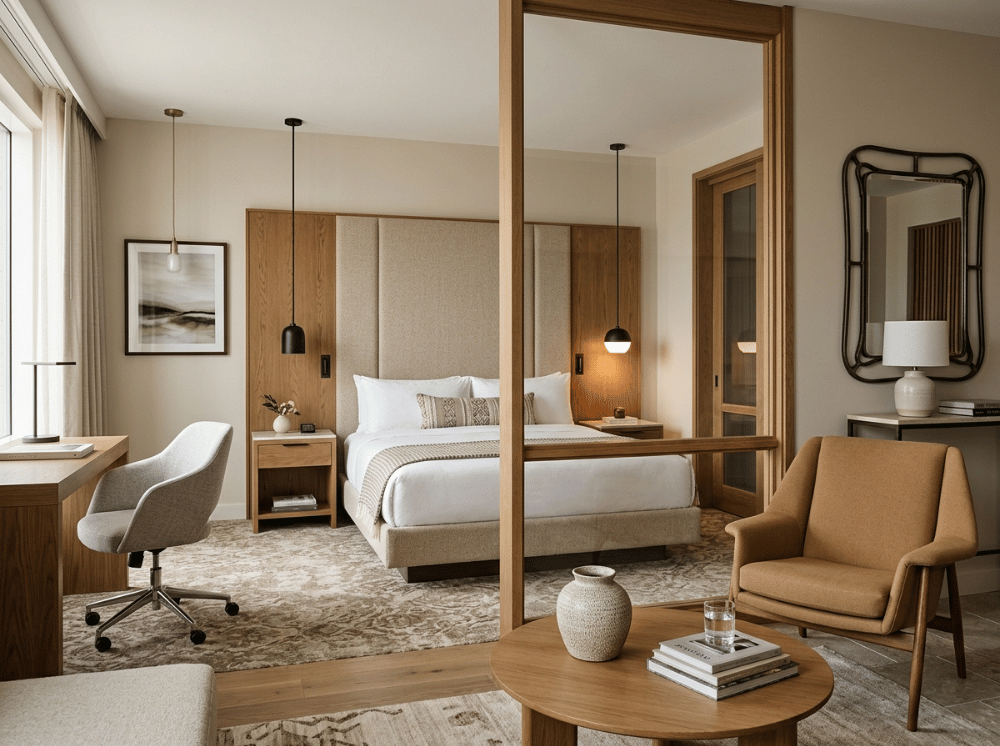
Hotel FF&E (Furniture, Fixtures, and Equipment) refers to all non-structural, movable assets that define a hotel’s guest experience — from beds and lighting to lobby seating and in-room technology. FF&E typically accounts for 7–15% of total construction or renovation costs, depending on property tier and project scope.
If you’re managing a hotel opening, a brand-mandated renovation, or a property improvement plan, FF&E decisions carry real financial weight. The wrong supplier, a missed lead time, or a material specification that fails brand review can push back your opening and quickly drain your contingency budget.
This guide is written for hotel buyers, procurement managers, project teams, and property owners who need a clear, practical reference — not just definitions. You’ll find budget benchmarks, replacement cycles, a comparison of sourcing models, a pre-order checklist, and the questions that experienced procurement teams ask before placing a single purchase order.
What Does Hotel FF&E Mean?
FF&E stands for Furniture, Fixtures, and Equipment. In the hospitality context, it refers to all non-structural items inside the property — everything that isn’t physically part of the building itself.
A common way to frame it is this: if you could pick up the hotel and shake it, everything that falls out is FF&E. Beds, headboards, desks, lounge chairs, pendant lights, bathroom mirrors, TVs, minibars — all FF&E. Walls, floors, plumbing, and load-bearing structures are not.
That distinction matters for budgeting, asset management, and accounting. FF&E items are classified as tangible assets with a defined useful life, typically depreciated over 5 to 15 years depending on the item category. In U.S.-based hotel projects, FF&E depreciation is typically handled under IRS asset class guidelines — consult a qualified tax advisor for property-specific guidance.
From a procurement standpoint, FF&E is where your supply chain decisions have the most visible impact on the guest experience and the property’s ability to hold its segment positioning.
Common Examples of Hotel FF&E by Area
FF&E spans every corner of the property. Here’s a breakdown organized by area, which is how most procurement schedules are structured:
|
Hotel Area |
Common FF&E Items |
|---|---|
|
Guest Rooms |
Beds, headboards, nightstands, desks, desk chairs, pull-out sofas, wardrobes, luggage racks, mirrors, TVs, in-room safes, minibars, curtains, blackout blinds |
|
Lobby & Reception |
Reception desk, lounge seating, coffee tables, accent chairs, pendant lighting, floor lamps, artwork, decorative accessories |
|
Restaurant & Bar |
Dining tables, dining chairs, bar stools, banquette seating, bar counters, shelving, pendant lighting, wine storage units |
|
Guest Bathrooms |
Vanity mirrors, bathroom vanity units, towel rails, shower enclosures, bath accessories, bathroom lighting |
|
Fitness Center |
Cardio equipment (treadmills, bikes), weight stations, mirrors, storage benches, sound systems, rubber flooring |
|
Back of House |
Staff lockers, breakroom furniture, office desks and chairs, storage shelving, kitchen equipment carts |
|
Corridors & Elevators |
Console tables, artwork, seating alcoves, corridor lighting, elevator interior panels and lighting |
This table reflects broad hospitality norms. Your actual FF&E schedule will depend on brand standards, design intent, and the specific areas included in the project scope.
FF&E vs. OS&E: What’s the Difference?
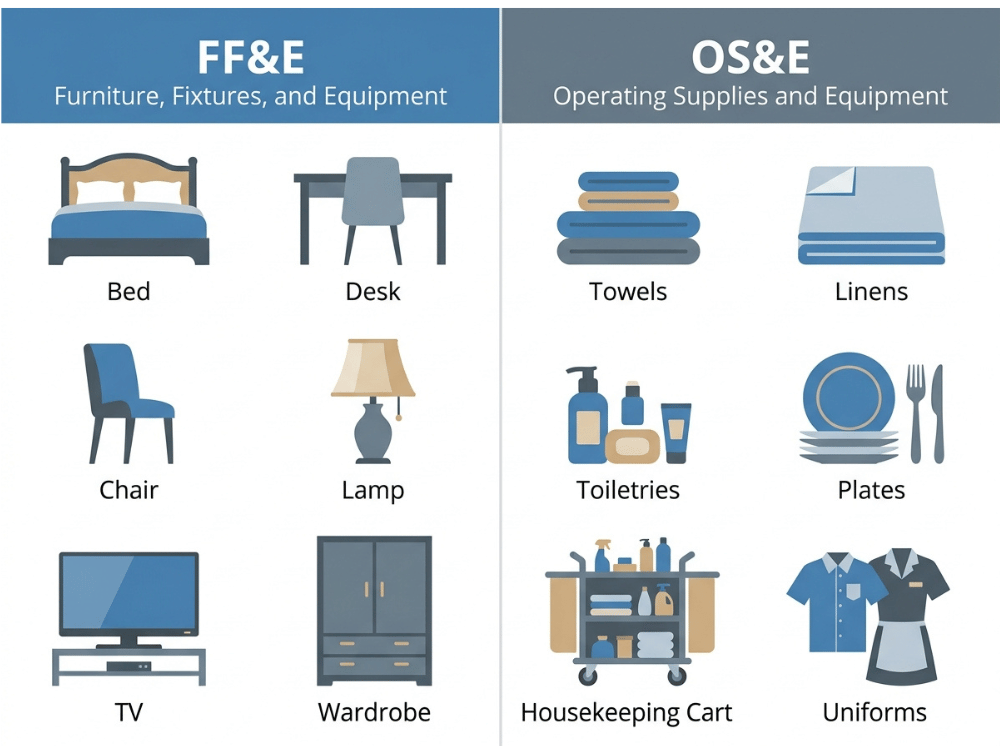
Hotel buyers frequently work across both FF&E (Furniture, Fixtures, and Equipment) and OS&E (Operating Supplies and Equipment). They’re related but governed by different budget owners, timelines, and procurement processes.
|
Category |
FF&E |
OS&E |
|---|---|---|
|
Full Name |
Furniture, Fixtures & Equipment |
Operating Supplies & Equipment |
|
Examples |
Beds, desks, lighting, lobby chairs, TVs |
Linens, towels, crockery, uniforms, cleaning supplies |
|
Replenishment |
Replaced every 5–15 years |
Replaced frequently — some items monthly |
|
Budget Owner |
Developer, owner, project team |
Hotel operator, GM, department heads |
|
Procurement Timing |
12–18 months before opening |
Closer to opening — often 3–6 months out |
|
Primary Risks |
Delays, wrong specs, brand rejection |
Missing supplies, poor opening readiness |
The short way to remember it: FF&E defines the space. OS&E keeps it running. Both need to be in place before the first guest arrives — but they follow different sourcing timelines and require different supplier relationships.
Why FF&E Matters for Hotel Operations and Profitability
FF&E is often described as the “skin and personality” of a hotel. That’s accurate — but from an ownership perspective, it’s also a direct driver of financial performance.
- Guest experience and review scores are closely tied to FF&E quality. According to industry research cited by Hongye Furniture Group, 73% of travelers prioritize sleep quality, which is directly influenced by mattress and bedding selection — both FF&E items. Premium FF&E is also associated with 15–25% higher average daily rates (ADR) compared with properties using standard-grade furnishings.
- Brand compliance is non-negotiable for franchised properties. Brands review FF&E finishes, dimensions, durability ratings, and room layouts. A rejected finish at the approval stage can stall production and compress your entire installation window.
- Asset value is the long-term consideration. FF&E is a capitalized asset. Maintaining it appropriately — and budgeting for its replacement — protects both the property’s physical condition and its ability to attract brand-standard audits and future financing.
Hotel FF&E Budget Benchmarks by Property Tier
Budget benchmarks vary meaningfully by property segment. The figures below reflect typical industry ranges based on 2025–2026 data from sources including Artone Manufacturing and Hongye Furniture Group. These are reference points — actual costs depend on location, material specifications, the custom-versus-standard product mix, and logistics.
|
Property Tier |
Estimated FF&E Budget per Room |
Typical FF&E as % of Total Construction |
|---|---|---|
|
Economy |
$3,000 – $8,000 |
5 – 8% |
|
Midscale |
$8,000 – $15,000 |
7 – 10% |
|
Upscale |
$20,000 – $35,000 |
8 – 12% |
|
Luxury |
$35,000 – $50,000+ |
10 – 15% |
Key cost drivers include:
- Custom vs. standard product mix: Luxury properties typically specify custom woodwork, imported stone, and bespoke lighting, which commands a 25–40% cost premium over off-the-shelf equivalents
- Material grade: Solid hardwood carries a longer lifespan (12–15 years) than engineered wood (7–10 years), but at a higher unit cost
- Logistics and installation: These are frequently underbudgeted. Freight, customs duties, warehousing, and installation labor can add 20–35% to the product cost alone
Always budget total landed cost — not just unit price. Product cost is only one component of the true procurement spend.
Typical FF&E Replacement Cycles
Not all FF&E ages at the same rate. High-contact, high-wash items degrade faster. Technology becomes obsolete. Casegoods — when specified and maintained correctly — can outlast a full brand renovation cycle.
|
FF&E Category |
Typical Replacement Cycle |
|---|---|
|
Soft goods (curtains, bedding, upholstery) |
3 – 5 years |
|
Technology (TVs, in-room safes, minibars) |
5 – 7 years |
|
Casegoods (desks, wardrobes, nightstands) |
7 – 12 years |
|
Structural millwork & fixed joinery |
10 – 15 years |
These cycles are general benchmarks. Commercial-grade product selection, preventive maintenance programs, and the property’s occupancy level will all shift these timelines — in either direction.
A practical note from the Artone Manufacturing 2026 guide: selecting high-durability, commercial-grade furniture at the outset can extend the replacement cycle from roughly 5 to 9 years, materially changing the total lifecycle cost of the investment.
How Hotel FF&E Procurement Works: Sourcing Models Compared
There are three primary models hotel buyers use to source FF&E. Each comes with trade-offs in cost, control, lead time, and expertise required.
|
Procurement Model |
Best For |
Advantages |
Limitations |
|---|---|---|---|
|
Procurement Firm / Agent |
Large or complex projects, branded hotels, global sourcing |
Project management, global supplier network, brand approval expertise |
Adds agency margin; less control over supplier relationships |
|
Distributor / Dealer |
Smaller properties, domestic sourcing, mixed product categories |
Regional availability, smaller order minimums, faster access for reorders |
Higher per-unit costs; limited customization options |
|
Direct Manufacturer (OEM/ODM) |
Mid-to-large projects with defined specs, custom or branded product requirements |
Lowest landed cost, full customization, factory-direct quality control |
Requires buyer expertise, longer lead times, and higher MOQs |
For procurement teams sourcing custom case goods, branded millwork, or hospitality-grade seating at scale, working directly with a qualified contract manufacturer removes intermediary margins and gives you control over material specifications, finish options, and quality inspection at source.
Wonhosp.com works directly with hotel project teams on OEM and ODM supply—from full-custom specifications to one-stop sourcing across multiple product categories. Details on the supply model are covered in the hotel supplier guide.
Choosing the right model:
- Use a procurement firm if this is your first hotel project, the scope is large, or your internal team lacks hospitality sourcing experience
- Use a distributor if you need fast turnaround, small quantities, or domestic delivery
- Source directly from manufacturers if you have defined specs, a volume to negotiate, and the ability to manage production and logistics oversight.
What to Check Before Ordering Hotel FF&E
Before releasing purchase orders, experienced procurement teams run through a structured pre-order review. Use this checklist as a starting point:
Product Specifications
- Room dimensions confirmed — all FF&E fits within clearance requirements (including ADA-accessible rooms)
- Material specifications locked and approved by the designer and brand
- Finishes reviewed under the property’s actual lighting conditions (not just photo references)
- Fire and safety compliance verified (ASTM E84 Class A, BS EN 1021, or relevant local standards)
- Durability ratings confirmed for high-traffic items — seating should be tested to a minimum of 1,000 cycles
Commercial Terms
- Lead times confirmed and cross-referenced against the installation schedule
- Incoterms agreed and clearly stated on the purchase order (EXW, FOB, CIF, DDP — each shifts cost and risk responsibility)
- Payment terms documented
- Warranty terms confirmed in writing — minimum 1–2 years for most hospitality FF&E
Logistics and Delivery
- Packaging adequate for long-haul freight — room-ready packaging prevents site damage
- Warehousing plan confirmed if delivery precedes site readiness
- Installation responsibility agreed — supplier, contractor, or third party
- Spare parts availability confirmed for high-use or custom components
Approvals
- Sample or mock-up room signed off by owner, designer, brand, and operations team
- Brand approval documentation on file before production commences
Skipping any of these creates downstream risk. A rejected finish, an undersized wardrobe, or a shipment that arrives without adequate packaging — all of these are avoidable with a clear pre-order process.
Common FF&E Sourcing Mistakes
Even experienced project teams run into these. Most are avoidable with a better process.
- Starting procurement too late. Custom FF&E production windows run 12–26 weeks. Add freight, customs, and warehousing, and you need 12–18 months of lead time for a major project. Starting at 6 months out leaves no room for revisions, delays, or brand review cycles.
- Comparing unit price instead of landed cost. A $400 chair at FOB origin can cost $620 landed after freight, duties, insurance, and installation. Build a landed cost comparison across all supplier bids — not just the product quote.
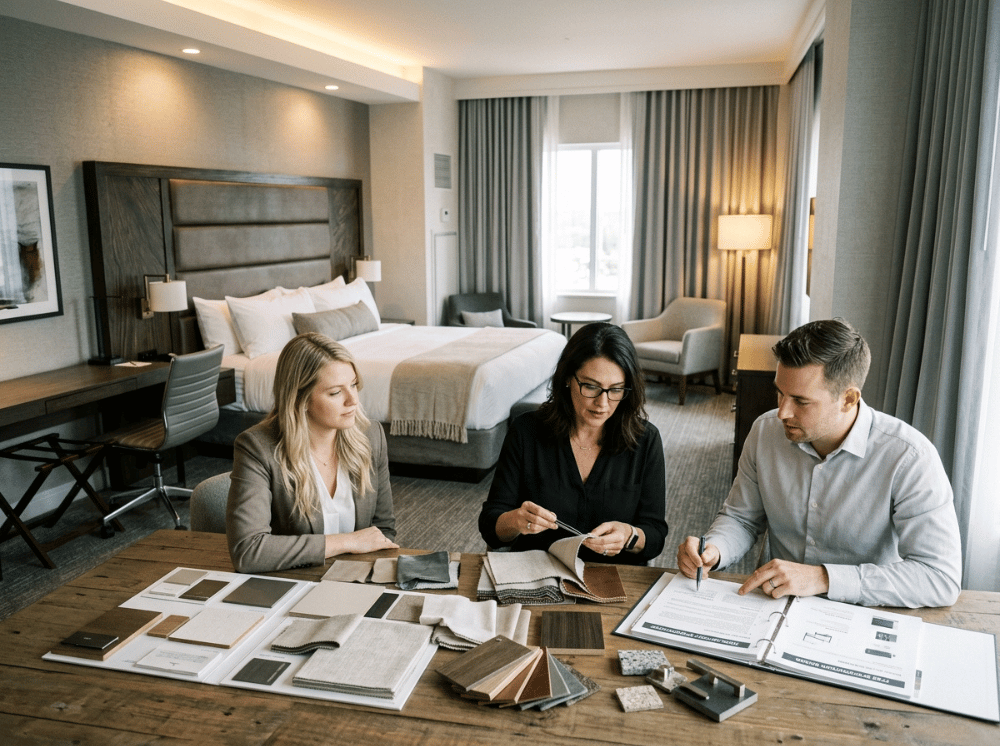
- Skipping physical samples. Photos don’t capture how a finish looks under warm hospitality lighting, or how a fabric performs after 100 wipes. Always review physical samples before approving production. For large orders, build a mock-up room and get every stakeholder to sign off.
- Ignoring installation requirements. FF&E can only be installed after floors are finished, dust is controlled, elevators are operational, and room access is clear. Coordinate your delivery sequence with the construction schedule — not as an afterthought.
- Weak or vague specifications on the RFP. Vague specs produce vague bids. Suppliers will fill in gaps in their favor. A detailed RFP that specifies dimensions, materials, finishes, durability standards, and warranty requirements protects your budget and eliminates bid comparability issues.
- No contingency budget. Finishes get discontinued. Shipments arrive with damage. Room counts change. Industry practice is to carry a 10–15% contingency on top of the product budget, especially for complex projects with custom items or imported goods.
The FF&E Reserve: What Hotel Owners Need to Know
An FF&E reserve is a dedicated fund maintained by hotel owners to cover ongoing repairs, replacements, and capital improvements to FF&E over time. It is a standard requirement under most hotel management agreements and franchise agreements.
Industry benchmarks typically set the FF&E reserve contribution at 4% of gross room revenue, accruing annually. OCCA Design Studio recommends starting at a lower rate — around 2% — when FF&E is new, then increasing the contribution systematically each year as assets age.
The reserve matters for several reasons:
- It funds soft goods replacement (every 3–5 years) without emergency capital calls
- It covers unplanned damage or component failures
- It protects the property’s competitive position when a new hotel opens nearby
- It provides liquidity for partial refresh projects between full PIPs
Owners who neglect the reserve tend to face larger, more disruptive renovation requirements later — and often at the worst possible point in a market cycle.
Property Improvement Plans (PIPs) and Renovation Cycles
A Property Improvement Plan (PIP) is a brand-mandated document that outlines required upgrades to bring a hotel property into compliance with current brand standards. PIPs are typically triggered at sale, at franchise renewal, or when a brand audit identifies a property falling below the required standard.
FF&E is almost always the largest cost component within a PIP. Common PIP-driven FF&E requirements include:
- Full guestroom FF&E replacement (casegoods, soft goods, lighting)
- Lobby and public space refresh
- Technology upgrades (TVs, in-room entertainment, smart room controls)
- Fitness center equipment replacement
- Corridor and elevator interior updates
The typical hotel renovation cycle lasts 7–10 years for a full FF&E overhaul, with partial soft-goods refreshes occurring every 3–5 years in between.
Managing PIP requirements efficiently — especially the procurement of custom or volume FF&E — is where direct manufacturer relationships and a structured sourcing process offer the clearest cost advantage. Volume pricing, factory-direct customization, and consolidated logistics can meaningfully reduce total PIP FF&E spend compared with distributor or retail sourcing.
Frequently Asked Questions
What items are included in hotel FF&E?
Hotel FF&E includes all movable, non-structural items used in the property. This covers guestroom furniture (beds, desks, wardrobes, chairs), lobby and public area seating and lighting, restaurant and bar furniture, bathroom vanity mirrors and accessories, in-room technology (TVs, safes, minibars), window treatments, artwork, and outdoor furniture. It does not include structural elements such as walls, floors, plumbing, or fixed building systems.
Is carpet considered FF&E in a hotel?
Carpet is generally treated as a building improvement or fixed asset rather than FF&E, particularly when it is glued down or installed wall-to-wall. However, area rugs and loose carpet tiles are commonly classified as FF&E. Classification depends on how the carpet is installed and the property’s accounting treatment. Consult your accountant for project-specific guidance.
How much does hotel FF&E cost per room?
FF&E costs per room vary significantly by property tier. Industry benchmarks suggest: economy properties typically spend $3,000–$8,000 per room, midscale properties $8,000–$15,000, upscale properties $20,000–$35,000, and luxury properties $35,000–$50,000 or more. These figures reflect product costs only — freight, installation, and contingency add materially to the total landed spend.
How often does hotel FF&E need to be replaced?
Replacement cycles vary by item category. Soft goods (bedding, curtains, upholstery) typically require replacement every 3–5 years. In-room technology such as TVs and safes typically lasts 5–7 years before becoming functionally obsolete. Casegoods (desks, nightstands, wardrobes) generally have a lifespan of 7–12 years when specified and maintained to commercial-grade standards.
Who is responsible for FF&E procurement in a hotel project?
In new-build and major renovation projects, FF&E procurement is typically managed by the developer, project owner, or a specialist FF&E procurement firm working alongside the interior designer. In brand-affiliated properties, the brand may also have approval rights over specified products. For ongoing replacement procurement, responsibility usually shifts to the hotel operator or general manager, working within the FF&E reserve budget.
Can hotels source FF&E directly from manufacturers?
Yes. Hotel owners and procurement managers with defined product specifications, sufficient order volume, and the capacity to manage production and logistics oversight can source directly from commercial manufacturers. Direct sourcing eliminates distributor or agent margins and offers greater control over customization, quality inspection, and delivery terms. It is most effective for custom or high-volume orders where OEM or ODM manufacturing is appropriate.
Plan Smarter, Source Better
Hotel FF&E is not a purchasing task — it’s a project-critical discipline. The decisions made at the specification and sourcing stage shape guest experience, brand compliance, lifecycle cost, and ultimately, property performance.
The teams that navigate FF&E most effectively start early, build detailed specifications, compare landed costs rather than unit prices, and establish direct relationships with qualified supply partners who can deliver at the required quality level and project scale.
If you’re planning a hotel opening, PIP execution, or renovation and need supply support — from custom casegoods to volume hospitality product sourcing — the wonhosp.com team works directly with buyers and project teams on OEM/ODM manufacturing, specification-to-delivery coordination, and one-stop hotel supply solutions. Reach out to discuss your project scope and requirements.