
Getting hotel OS&E procurement wrong is expensive. Order too little and your housekeeping team runs out of towels mid-service. Order the wrong specs, and you’re stuck with mismatched glassware across two restaurants. Miss a lead time and your opening date slips.
This guide fixes that. Hotel OS&E covers the everyday supplies and equipment that keep a property running, and how you plan them directly affects your opening timeline, guest experience, and operating budget. Below, you’ll learn exactly what OS&E includes, how it differs from FF&E, which items belong in each department, and how to build a checklist, set a realistic budget, and choose a supplier who won’t let you down.
If you manage hotel procurement or lead an opening project, this is built for you.
What Is Hotel OS&E?
Hotel OS&E stands for Operating Supplies and Equipment. It’s everything a hotel needs to function day to day, across every department, that isn’t part of the fixed building or its furniture.
Think linens, towels, glassware, cutlery, cleaning chemicals, guest amenities, and front-desk stationery. These are the items your staff touch, your guests use, and your operation consumes constantly.
Here’s what makes OS&E different from most purchases: these items wear out, get used up, or need regular replacement. That turns procurement into an ongoing cycle, not a one-time buy. Underestimate that cycle and you create shortages. Overestimate it, and you tie up cash in storage.
Getting OS&E right means smoother service, fewer emergencies, and a predictable budget. Getting it wrong shows up fast, usually in guest complaints.
OS&E vs FF&E: What’s the Difference?
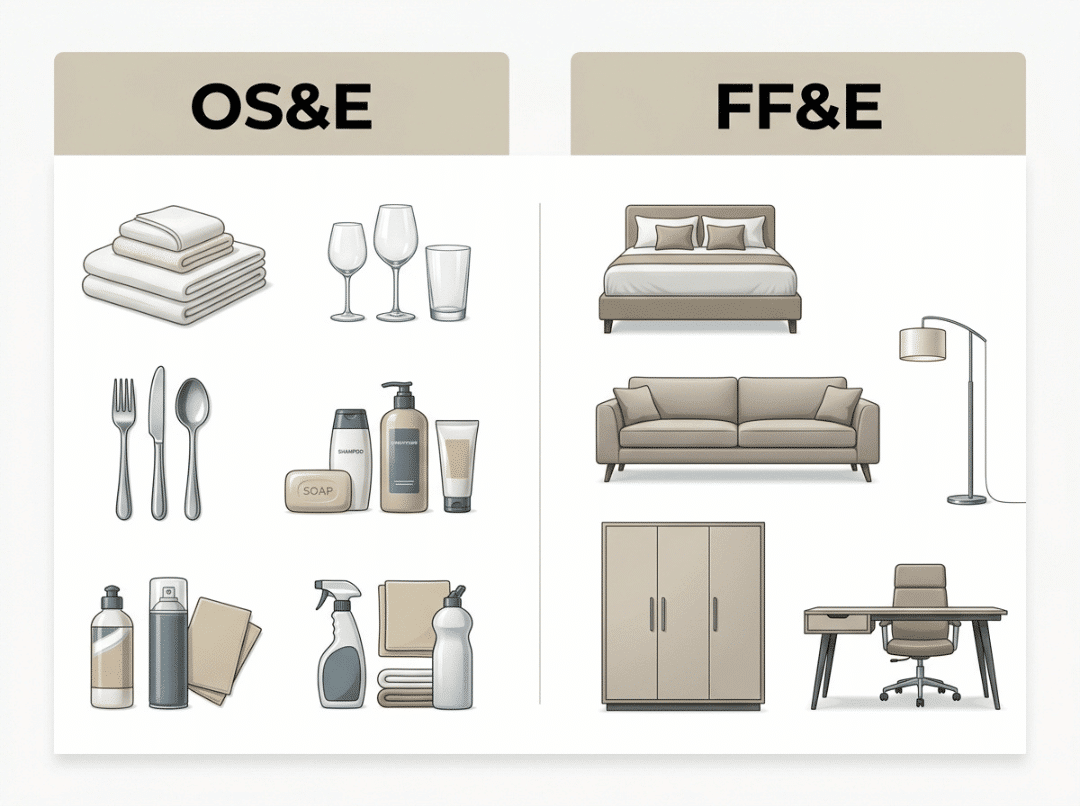
Buyers often blur OS&E and FF&E together, but they sit in different budgets, timelines, and accounting categories. FF&E stands for Furniture, Fixtures, and Equipment: the durable, high-value assets that furnish a property, like beds, sofas, and lighting.
The distinction matters because it changes how you plan and pay. FF&E is usually a capital expense you buy once. OS&E is an operating expense you keep buying.
|
Factor |
OS&E |
FF&E |
|---|---|---|
|
Full name |
Operating Supplies & Equipment |
Furniture, Fixtures & Equipment |
|
Asset type |
Consumable / short-life |
Fixed asset / long-life |
|
Movable? |
Highly portable |
Semi-fixed or fixed |
|
Lifespan |
Weeks to a few years |
5–15+ years |
|
Examples |
Linens, glassware, cutlery, amenities |
Beds, sofas, lighting, casegoods |
|
Buying timing |
Pre-opening + ongoing |
Mainly pre-opening / renovation |
|
Accounting |
Usually OpEx |
Usually CapEx |
Quick rule: if you replace it often, it’s OS&E. If it stays for years, it’s FF&E. Keep the two budgets separate, or your forecasting will drift.
What Should Be Included in Hotel OS&E?
A strong procurement plan works department by department. This prevents gaps and makes budgeting accurate. Below is each operational area, why it matters, and the procurement risk most teams overlook.
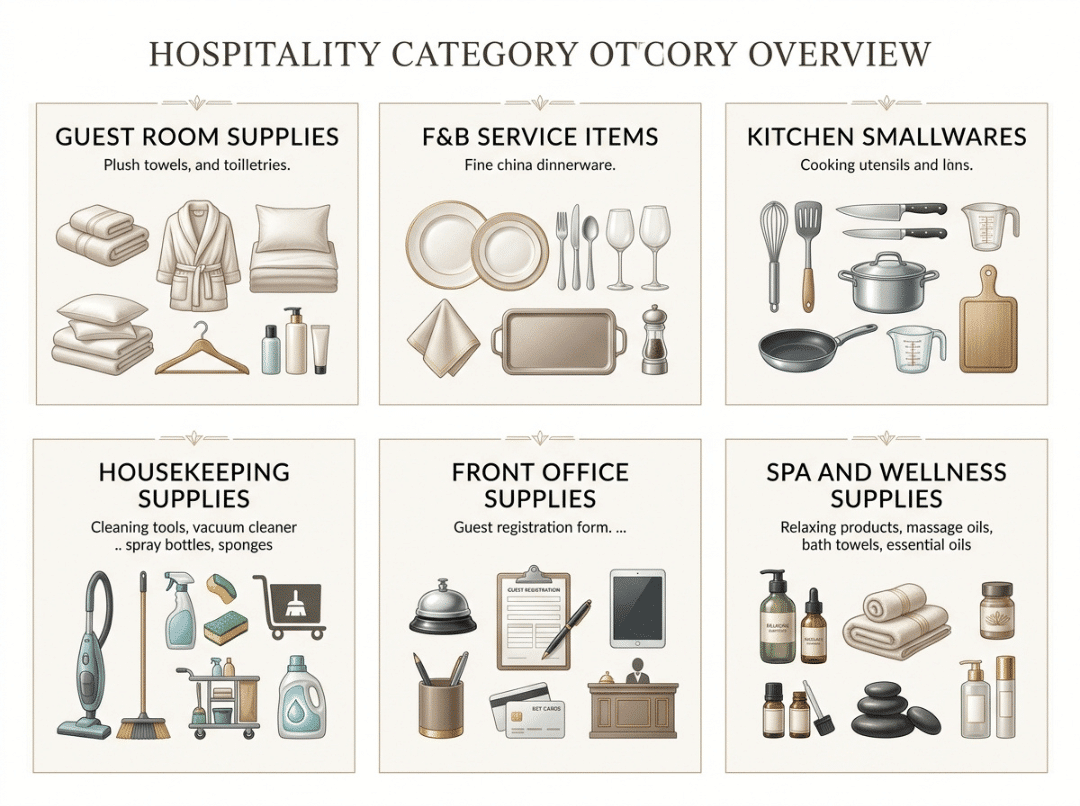
Guest Room Supplies
These shape the guest’s first impression and daily comfort.
- Bed linens, duvets, pillows, and protectors
- Bath towels, hand towels, and bath mats
- Toiletries, amenity kits, and dispensers
- Hangers, laundry bags, slippers, and in-room stationery
Why it matters: guests notice quality here instantly. Common risk: underbuying linens, which forces same-day laundry turnaround and shortens fabric life.
Food & Beverage (F&B) Service Items
Front-of-house dining lives or dies on presentation and consistency.
- Glassware, flatware, and chinaware
- Buffetware, trays, and serving platters
- Table linens, napkins, and menu holders
Why it matters: mismatched or chipped tableware cheapens a premium setting. Common risk: not ordering enough backup stock for breakage, which is constant in F&B.
Kitchen Smallwares and Equipment
Back-of-house needs functional, hygienic, hardworking tools.
- Pots, pans, and cooking utensils
- Knives, cutting boards, and prep containers
- Measuring tools, storage bins, and small appliances
Why it matters: kitchen flow depends on having the right tool at each station. Common risk: buying generic smallwares that fail hygiene standards or wear out under commercial use.
Housekeeping Supplies
Housekeeping runs on reliable, well-stocked consumables.
- Cleaning agents, detergents, and disinfectants
- Vacuums, mops, buckets, and carts
- Microfiber cloths, trash liners, and gloves
Why it matters: clean rooms drive reviews and repeat bookings. Common risk: running out of fast-moving consumables because reorder points were never set.
Front Office Supplies
The reception area needs items that keep check-in seamless.
- Stationery, pens, and registration forms
- Key cards, cardholders, and luggage tags
- Bell carts, printers, and receipt rolls
Why it matters: the front desk sets the tone for the whole stay. Common risk: forgetting low-cost consumables (key cards, receipt rolls) until they run dry.
Spa and Wellness Supplies
If your property has a spa, comfort and hygiene lead.
- Towels, robes, and slippers
- Massage oils, lotions, and disposables
- Treatment linens and headrest covers
Why it matters: spa guests expect a premium, spotless experience. Common risk: treating spa supplies as an afterthought instead of a distinct par-level category.
Now that you know what to buy, the next step is avoiding the errors that quietly drain budgets.
The Biggest Mistakes Hotels Make When Buying OS&E
Even seasoned teams repeat the same costly errors. Here are the five that hurt most, and what to do instead.

1. Buying Only on Price
The cheapest linen or flatware usually fails first. Thin towels fray, budget glassware chips, and low-grade chemicals underperform. You end up reordering sooner, so your “cheap” choice costs more over a year.
Do this instead: compare total cost, including durability, replacement frequency, and guest impact, not just unit price.
2. Ignoring Par Levels
Par level is the minimum stock you keep on hand for each item. Without it, you either run short mid-service or overbuy and clog your storeroom.
Do this instead: set par levels per item based on occupancy and turnaround, then tie reorders to them.
3. Not Standardizing Specifications
When each outlet or property orders slightly different versions of the same plate, you lose bulk pricing and create replacement chaos. Multi-property groups feel this fastest.
Do this instead: lock standard specs (size, material, finish, SKU) before you buy at scale.
4. Underestimating Lead Times
Custom items, imported goods, and branded amenities take longer than teams expect. A missed lead time can delay an opening or leave a department unstocked.
Do this instead: map lead times per category early, and place long-lead orders first.
5. Separating Procurement from Operations
When buyers order without input from housekeeping, F&B, and kitchen heads, quantities and specs miss the mark. The people using the items know what actually works.
Do this instead: get department heads to sign off on specs and quantities before purchase.
Avoid these five, and your budget and operations both stabilize. Next, let’s turn this into a working checklist.
How to Build a Practical Hotel OS&E Checklist
A useful checklist isn’t a random list of items. It’s built from your property’s real numbers. Here’s the method.
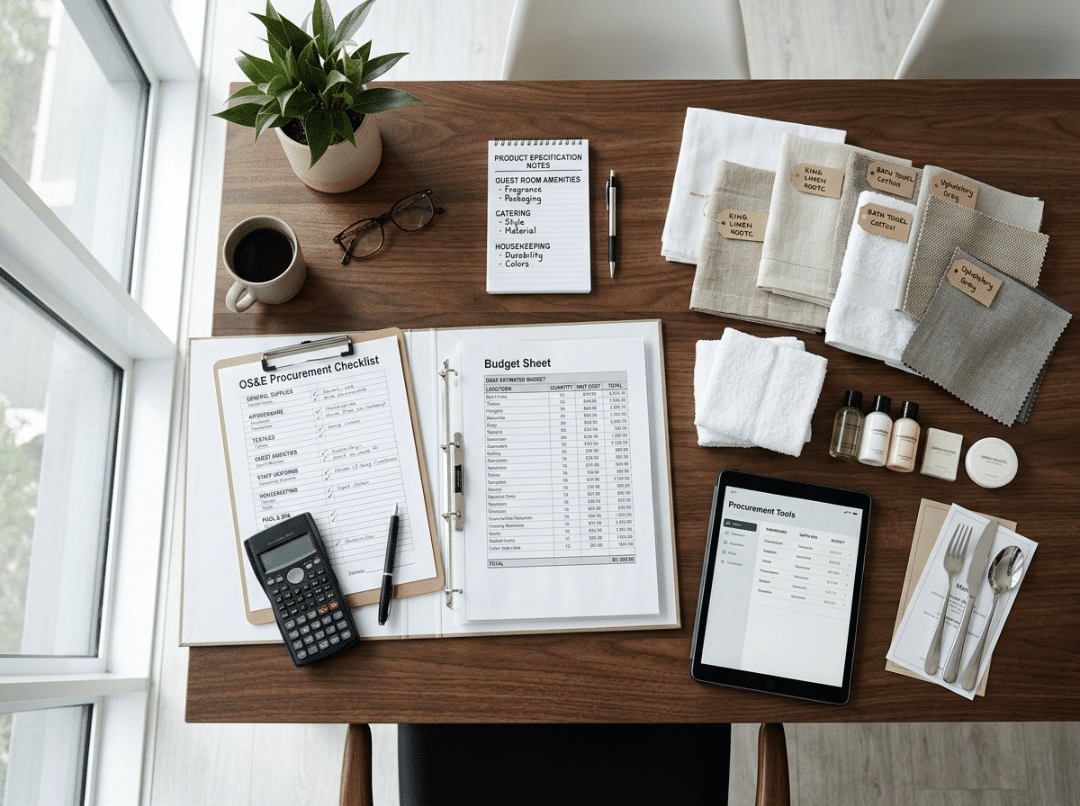
Step 1: Start From Your Core Numbers
Base every quantity on facts, not guesses:
- Room count drives guest room supplies
- Restaurant covers and seating drive F&B items
- Number of outlets (restaurants, bars, spa, banquet) multiplies your categories
Step 2: Define Par Levels
For each item, decide how many sets you need in rotation. A common linen rule is three par: one in use, one in the wash, one in reserve. Adjust for occupancy and laundry speed.
Step 3: Separate Opening Stock From Replenishment
These are two different budgets:
- Opening stock: the full quantity you need to launch, bought once
- Replenishment: the recurring reorders that replace worn or used items
Planning them together leads to overspending or shortages. Keep them apart.
Step 4: Flag Critical vs Replaceable Items
Not everything carries equal risk:
- Critical items (linens, key F&B pieces, cleaning chemicals) stop service if they run out — keep buffer stock
- Replaceable items (generic stationery, common utensils) can be reordered fast — hold less
Sort your list this way and you’ll protect the things that actually matter.
With a checklist in hand, you can now build a budget that holds up.
How to Budget for Hotel OS&E
OS&E budgeting works differently for a new opening than for a running property. Treat them the same and you’ll misforecast.
Pre-Opening Budget
You buy everything at once, so upfront costs are large and timelines are tight.
- Order for full room count plus par levels
- Phase deliveries to match construction and setup
- Build buffer stock for the first 60–90 days
- Align with FF&E installation so items arrive in the right order
Ongoing Replenishment Budget
For an operating hotel, OS&E becomes a recurring OpEx line focused on replacement.
- Track consumption to predict reorder points
- Set reorder triggers for fast-moving items
- Adjust par levels for seasonal occupancy
Don’t Forget the Hidden Costs
These quietly inflate budgets and catch teams off guard:
- Freight and shipping, especially for imported or bulky goods
- Breakage reserve for glassware and chinaware, which break constantly
- Custom packaging and branding, which adds cost and lead time
- MOQ tradeoffs, where low minimums cost more per unit but high minimums tie up cash
- Storage for surplus and buffer stock
Cost-Saving Without Cutting Quality
You don’t have to choose between price and quality:
- Consolidate categories with fewer suppliers for better rates
- Standardize specs to unlock bulk pricing
- Prioritize durability on high-use items to lower replacement cost
- Order long-lead items early to avoid rush freight
A realistic budget only works if your supplier delivers. That’s the next decision.
How to Choose the Right Hotel OS&E Supplier
Your supplier choice affects stock flow, quality consistency, and cost predictability for years. Skip the generic “good quality, fair price” checklist and evaluate against real criteria.
|
Criteria |
What to Check |
Why It Matters |
|---|---|---|
|
Category range |
Can they cover multiple departments? |
Fewer suppliers means simpler coordination and better pricing |
|
Customization ability |
Do they offer OEM/ODM, branding, custom sizing? |
Premium and branded properties need tailored items |
|
Hospitality experience |
Have they supplied hotels before? |
Industry knowledge means fewer spec errors |
|
Lead time reliability |
Can they hit deadlines and hold backup stock? |
Late deliveries delay openings and disrupt service |
|
MOQ flexibility |
Are minimums realistic for your scale? |
Avoids overbuying or being locked out of custom items |
|
Export readiness |
Do they handle compliance, packing, logistics? |
Critical for overseas and cross-border projects |
|
Communication |
Are they responsive and clear? |
Slow replies turn small issues into big delays |
Practical tip: always request samples before committing at scale. A sample reveals quality and consistency that a spec sheet never will.
When a supplier scores well across these criteria, procurement gets far simpler. That leads to the next question: how much should you consolidate?
When a One-Stop Hotel Supplies Partner Makes Sense
Managing a dozen suppliers across linens, glassware, kitchen, and amenities creates delays, mismatched specs, and endless coordination. A one-stop hotel supplies partner solves that in specific situations.
Consider consolidating with a single partner when you face any of these:
- New hotel openings, where dozens of categories must arrive on schedule and in sync
- Multi-category sourcing, where one partner replaces many vendors and reduces communication gaps
- Custom design needs, where OEM/ODM capability turns your brand concept into finished, cohesive supplies
- Overseas procurement coordination, where export readiness, compliance, and reliable logistics decide whether your project stays on time
This is where wonhosp.com fits. Operating from China’s Greater Bay Area, we combine one-stop sourcing, OEM/ODM manufacturing, and custom hospitality supply into a single coordinated service, so hotel and cultural tourism projects avoid the friction of juggling multiple vendors. For opening teams and buyers managing complex, multi-category projects, that consolidation protects both your timeline and your specs.
FAQ
What is hotel OS&E?
Hotel OS&E stands for Operating Supplies and Equipment. It covers the consumable and reusable items a hotel uses daily across every department, including linens, glassware, cutlery, toiletries, cleaning supplies, and front-office stationery.
What is the difference between OS&E and FF&E?
OS&E covers short-life, consumable items you replace often, like linens and glassware. FF&E covers durable, long-life assets like furniture and lighting. OS&E is usually an operating expense; FF&E is usually a capital expense.
How many par levels should a hotel keep?
It depends on occupancy and laundry turnaround, but a common rule for linens is three par: one in use, one in the wash, and one in reserve. Set par levels per item so critical supplies never run out.
How do hotels choose OS&E suppliers?
Evaluate suppliers on category range, customization ability, hospitality experience, lead time reliability, MOQ flexibility, export readiness, and communication. Request samples before committing to confirm quality and consistency.
What is the biggest OS&E procurement mistake?
Buying only on price. Cheap items wear out faster, forcing earlier reorders that raise your total spend and hurt the guest experience. Compare total cost and durability, not just unit price.
Is OS&E CapEx or OpEx?
OS&E is usually treated as an operating expense (OpEx), because items are consumed and replaced regularly. FF&E, by contrast, is typically a capital expense (CapEx). Confirm treatment with your finance team, as classification can vary.