
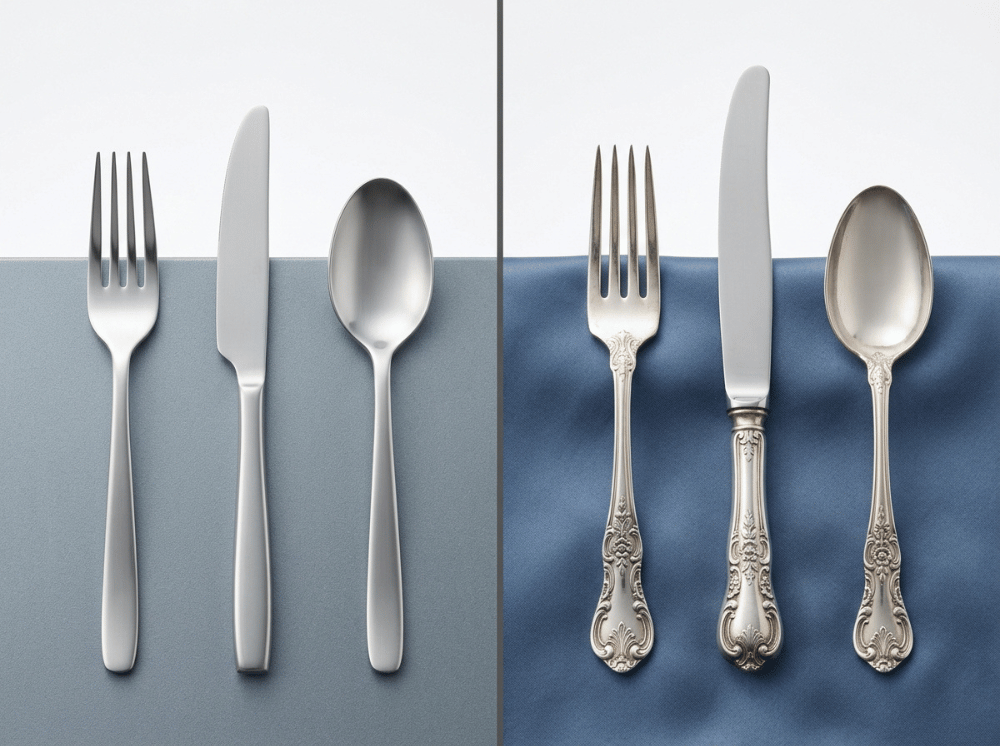
Flatware refers to dining utensils—forks, knives, and spoons—typically made from stainless steel. Silverware technically refers to utensils made from sterling silver or silver-plated metal. For commercial use in restaurants, hotels, and catering operations, stainless steel flatware is the standard choice due to its durability, dishwasher compatibility, and significantly lower cost of ownership.
If you’re sourcing tableware for a restaurant, hotel, or catering operation, you’ve likely seen both terms used interchangeably. They’re not the same thing—and that distinction matters when you’re making a procurement decision that affects daily service, maintenance costs, and guest experience.
This guide breaks down what separates flatware from silverware, what’s inside each stainless steel grade, and how to match the right choice to your operation. Whether you’re fitting out a fine dining room or stocking a high-volume banquet kitchen, the information below will help you buy with clarity and confidence.
Flatware vs. Silverware: What’s the Core Difference?
The simplest way to separate the two is that flatware is a category defined by function, and silverware is a category defined by material.
Flatware is the broad term for the dining utensils used in a table setting—forks, knives, and spoons for eating and serving. Most commercial flatware is made from stainless steel, which offers a practical balance of durability, affordability, and ease of care.
Silverware, in the strictest sense, refers to utensils made from sterling silver or coated with a silver layer over a base metal. The term carries a legacy of luxury—historically, silver utensils were a marker of status—but in casual American English, “silverware” is often used as a catch-all synonym for flatware, regardless of what material it’s actually made from.
For hospitality buyers, the material difference is what matters most. Silverware requires specialized maintenance, cannot be safely run through commercial dishwashers, and carries a significantly higher price tag. Stainless steel flatware, by contrast, is built for the volume, speed, and repeat washing cycles that commercial service demands.
Flatware vs. Silverware: Quick Comparison
|
Feature |
Stainless Steel Flatware |
Sterling Silver / Silver-Plated |
|---|---|---|
|
Primary material |
Stainless steel (chromium + nickel alloy) |
Pure silver (92.5%) or silver over base metal |
|
Best use |
Restaurants, hotels, catering, and institutional |
Fine dining (limited), private events, display |
|
Dishwasher safe |
Yes |
No—handwash only |
|
Maintenance level |
Low |
High—prone to tarnishing |
|
Upfront cost |
Low to moderate |
High |
|
Long-term cost |
Low (high durability, low replacement rate) |
High (polishing, handwashing labor, higher breakage risk) |
|
Commercial viability |
Strong |
Not recommended for commercial use |
What Does Flatware Include?
Flatware covers every utensil used at the table for eating and serving. In a commercial context, that typically means:
- Spoons: Teaspoons, soup spoons, dessert spoons, tablespoons, demitasse spoons (for espresso service), bouillon spoons, and iced tea spoons.
- Forks: Dinner, salad, dessert, cocktail or oyster, and European dinner for formal place settings.
- Knives: Dinner knives, butter knives, butter spreaders, and European dinner knives for upscale service.
Most commercial operations build their inventory around a core set—dinner fork, dinner knife, teaspoon, salad fork, and soup spoon—and expand from there based on menu and concept. Specialty pieces like demitasse spoons or oyster forks are added where the menu calls for them.
What Does Silverware Actually Mean?
True silverware falls into two categories:
Sterling silver is marked “.925” or “STERLING” on the piece itself. This indicates the metal is at least 92.5% pure silver, alloyed with copper or other metals for added strength. Sterling silver has an unmistakable warm luster, but it tarnishes with exposure to air, moisture, and food acids. In commercial settings, the maintenance burden—polishing, careful handwashing, controlled storage—makes it impractical for daily service.
Silver-plated flatware is a base metal (typically brass, nickel, or steel) with a thin silver coating applied over it. The plating can wear through with repeated use and harsh dishwashing cycles. Silver-plated pieces marked “IS” (International Silver) or “EPNS” (Electroplated Nickel Silver) are not sterling, though they can look similar to untrained eyes.
Both sterling silver and silver-plated options are better suited to boutique private dining, specialty events, or decorative use—situations where volume and washing frequency are low.
Stainless Steel Flatware Grades Explained
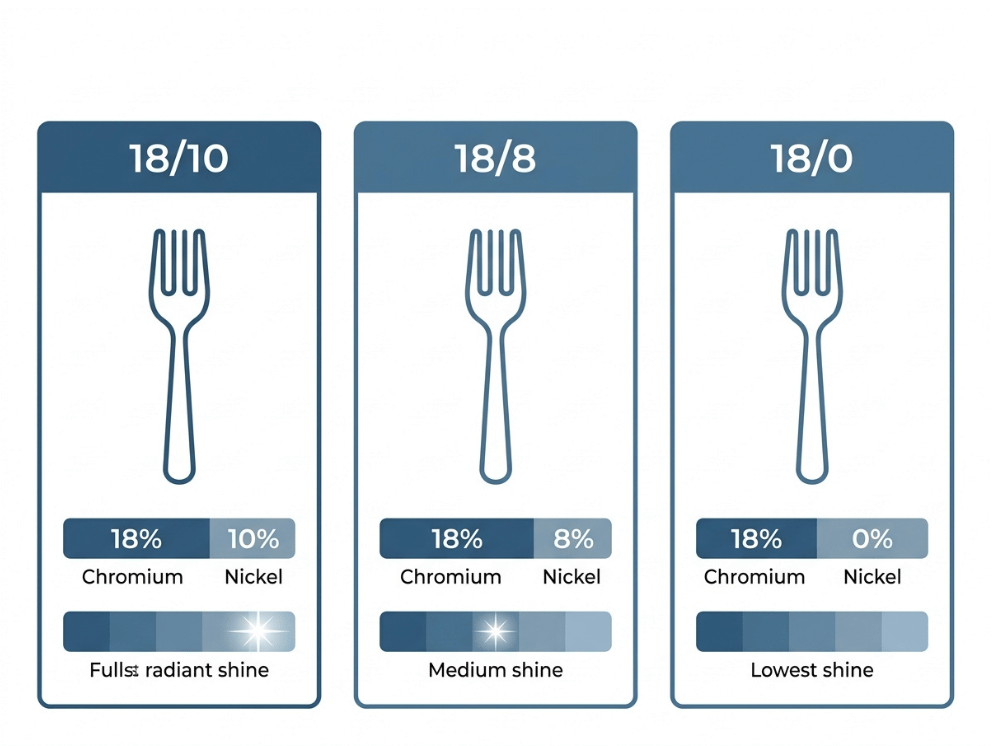
For commercial operations, the real decision is which stainless steel grade fits your concept. Flatware grades are expressed as two numbers representing the percentages of chromium and nickel in the alloy.
Chromium provides corrosion resistance and protects the surface from rust. Nickel adds luster, shine, and additional durability. The higher the nickel content, the more resistant and polished the flatware will appear over time.
What Is 18/10 Stainless Steel Flatware?
18/10 flatware contains 18% chromium and 10% nickel. It’s the premium commercial standard—the most corrosion-resistant, most reflective, and most durable among the common grades. 18/10 flatware holds its shine through repeated high-temperature dishwashing cycles and is far more resistant to bending than lower-grade alternatives.
Fine dining restaurants, upscale hotel outlets, and luxury banquet programs typically default to 18/10, particularly in extra-heavy or forged weights. The higher upfront cost is offset by a low replacement rate—many operators running 18/10 budget for just 2% to 5% annual replacement (according to commercial hospitality sourcing guides).
What Is 18/8 Stainless Steel Flatware?
18/8 flatware contains 18% chromium and 8% nickel—the same chromium content as 18/10, with slightly less nickel. It’s also commonly listed as Grade 304 stainless steel in supplier specifications. Performance is close to 18/10 in most day-to-day conditions, with a modest difference in long-term luster retention.
18/8 is the practical choice for upscale casual restaurants, boutique hotels, and catering operations that want strong durability and a polished table appearance without the premium cost of 18/10. Annual replacement rates typically run 5% to 10%.
What Is 18/0 Stainless Steel Flatware?
18/0 flatware contains 18% chromium and no nickel. It’s more affordable, performs well in high-turnover settings, and has one practical commercial advantage: because it contains no nickel, 18/0 flatware is magnetic, making it compatible with magnetic flatware retrievers used in busy dish areas to reduce loss.
The trade-off is reduced corrosion resistance and a less lustrous finish over time. For cafeterias, staff dining, fast-casual concepts, or any operation where flatware loss and rapid replacement are built into the budget, 18/0 is a sensible pick. Annual replacement rates can range from 15% to 25% in high-volume settings.
What About 13/0 Stainless Steel?
13/0 steel (13% chromium, 0% nickel) is not a flatware grade you’d choose deliberately—it’s the alloy used specifically for the blades of dinner and dessert knives. The lower chromium content makes it easier to forge a sharp, durable cutting edge while still maintaining adequate rust resistance.
Flatware vs. Cutlery vs. Silverware: What’s the Terminology Difference?
Procurement buyers sourcing from international suppliers occasionally encounter all three terms:
- Flatware is the standard American English term for dining utensils. It’s the terminology you’ll see most consistently in US-based commercial supply catalogs and hospitality contexts.
- Silverware is used interchangeably with flatware in American English, even when the pieces are made from stainless steel—a legacy of the era when silver was the dominant material.
- Cutlery is the preferred term in British English and is widely used across the UK, Australia, and parts of Europe. Historically, cutlery referred specifically to knives (from the word “cutter”), but modern usage encompasses all dining utensils. When sourcing from European or international suppliers, expect to see this term in product listings.
For SEO purposes and when specifying to suppliers, flatware and silverware are effectively synonymous in the US market; cutlery maps to the same product category in the UK and international markets.
Which Is Better for Restaurants, Hotels, and Catering?
Stainless steel flatware is the commercial standard across the hospitality industry. Silverware—whether sterling or silver-plated—is not recommended for commercial use due to its maintenance requirements and cost burden.
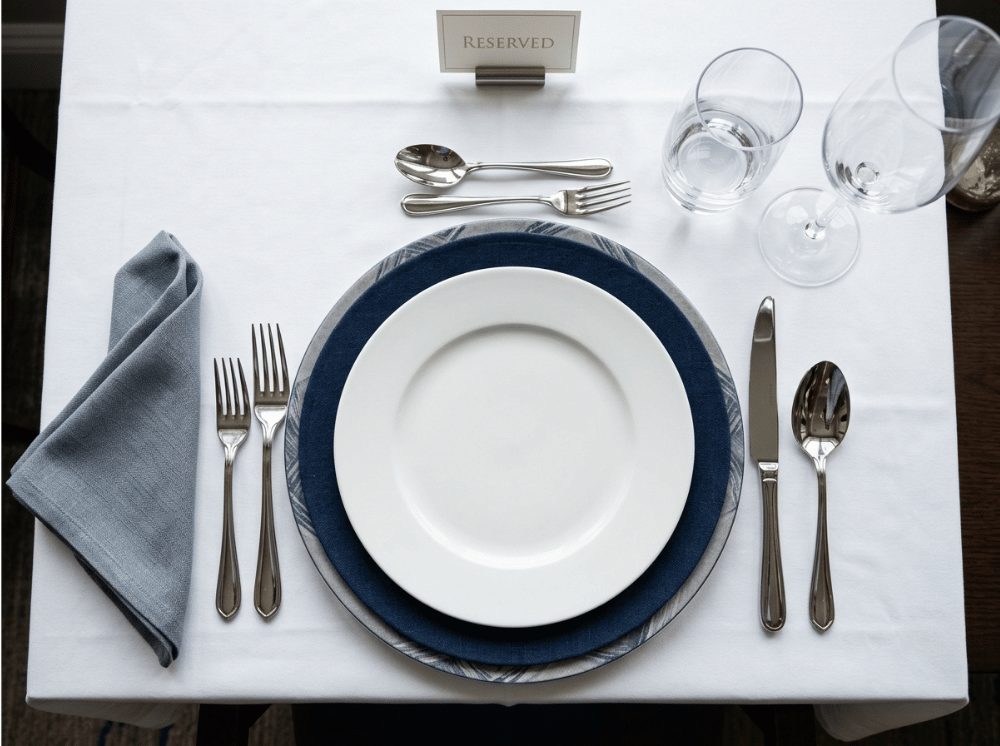
Within stainless steel, the right grade and weight depend on your concept:
- Fine dining restaurants and luxury hotels should specify 18/10 flatware in extra-heavy (60–80 grams) or forged (70–90 grams) weights. Forged construction—formed from a solid steel bar rather than stamped from a flat sheet—delivers maximum resistance to bending and a handle detail that holds up through years of service. A mirror finish suits formal table settings and photographs well.
- Research cited by TigerChef found that diners are willing to pay up to 15% more for a meal served with high-quality flatware. A University of Oxford study found that heavier cutlery causes diners to rate the perceived value of a meal as higher. At the fine dining level, flatware is not a minor detail—it’s part of the product.
- Upscale casual restaurants and boutique hotels land well with 18/8 flatware in heavyweight (55–70 grams), stamped construction. This hits the right balance between guest-facing quality and procurement budget control. Both mirror and matte satin finishes work depending on the room style.
- Fast-casual, mid-level dining, and institutional settings can work effectively with 18/0 or 18/8 in heavy or medium-heavy weights. Loss and replacement are more predictable expenses at this tier, and the magnetic properties of 18/0 make inventory management easier in high-volume dish areas.
- Catering and banquet programs typically use 18/0 to 18/8 in medium-to-heavy weights with mirror finishes. Quantity planning for catering should include a 25% buffer above average event headcount, plus an additional 10–15% in reserve stock for busy seasons.
How to Choose the Right Flatware for Your Operation
Match your flatware decision to three operational factors:
1. Concept and guest expectation. The flatware weight and finish contribute to perceived quality. A guest at a hotel’s fine-dining outlet expects something substantial in the hand. A guest at a fast-casual counter has no such expectation. Specify accordingly.
2. Volume and washing frequency. Higher-nickel grades (18/10, 18/8) hold up better through repeated commercial dishwashing cycles. If your operation runs multiple wash cycles per service, the corrosion resistance and shine retention of 18/10 stainless steel pay dividends over a two- to three-year cycle.
3. Inventory math. A practical formula: multiply your seated capacity by 1.5 to 2.5 to determine how many pieces you need in rotation. A 100-seat dining room at a 2.5 multiplier requires 250 dinner forks in active rotation. Track replacement rates by grade to keep reorders ahead of shortages.
Flatware Maintenance and Care in Commercial Settings
Stainless steel flatware is significantly easier to maintain than silverware, but high-volume commercial washing introduces specific stressors:
- Remove food residue promptly. Prolonged contact with acidic foods and high-chloride detergents degrades the chromium oxide layer that protects the steel.
- Pre-soak flatware for approximately 20 minutes before running it through a commercial dishwasher.
- Mix fork, spoon, and knife types when loading flatware cylinders to prevent nesting, which reduces the effectiveness of the wash cycle.
- Rinse at the correct temperature and change the soaking solution regularly to prevent chemical and food-particle buildup.
- Polish immediately after washing with a microfiber cloth to eliminate water spots and restore surface luster.
- Avoid detergents with high chloride content. These accelerate surface pitting over time, especially on lower-grade stainless.
For silver-plated pieces used at specialty events, handwashing is non-negotiable. Harsh commercial detergents and high-heat cycles quickly strip the plating.
Cost and Long-Term Value: What the Numbers Look Like
The lower price tag of 18/0 flatware is real—but so is the total cost of ownership over 24 to 36 months.
|
Grade |
Annual Replacement Rate |
Typical Application |
|---|---|---|
|
18/10 |
2%–5% |
Fine dining, luxury hotels |
|
18/8 |
5%–10% |
Upscale casual, boutique hotels |
|
18/0 |
15%–25% |
Fast-casual, institutional, catering |
A restaurant purchasing 500 dinner forks at the 18/10 grade will replace 10–25 pieces per year. At 18/0, that same 500-fork inventory could require 75–125 replacements annually. The math shifts depending on your loss rates, volume, and wash cycle intensity—but higher-grade stainless almost always delivers lower total cost in full-service settings.
Sterling silver does not belong in this cost comparison for commercial operators. The maintenance labor alone—regular polishing, careful handwashing, controlled storage—makes it economically unfeasible outside of private clubs or boutique events.
Frequently Asked Questions
What is the difference between flatware and silverware?
Flatware refers to dining utensils—forks, knives, and spoons—most commonly made from stainless steel. Silverware technically refers to utensils made from sterling silver or silver-plated metal. In everyday American English, the two terms are often used interchangeably, but in commercial and procurement contexts, flatware almost always means stainless steel.
Is silverware or stainless steel flatware better for restaurants?
Stainless steel flatware is better for restaurants in virtually all cases. Sterling silver and silver-plated flatware are not dishwasher-safe, require hand polishing, tarnish with regular use, and incur much higher upfront and maintenance costs. Commercial operations run on volume and efficiency—stainless steel is built for exactly that environment.
What does 18/10 mean on flatware, and is it the best choice for hotels?
18/10 means the stainless steel contains 18% chromium and 10% nickel. It is the highest quality commercial stainless steel grade available, offering the best corrosion resistance, the most reflective finish, and the greatest durability. For hotel fine dining outlets and upscale restaurant programs, 18/10 is generally the recommended specification.
What is the difference between flatware and cutlery?
Flatware is the standard American English term. Cutlery is the preferred term in British English and is widely used internationally. Both refer to the same category of products—forks, knives, and spoons used for dining. When sourcing from European suppliers, expect to see “cutlery” in product listings where a US supplier would say “flatware.”
How much flatware do I need for a restaurant or hotel?
A standard commercial estimate is 1.5 to 2.5 pieces per seat per utensil type, depending on table turnover rate and dish cycle speed. A 100-seat restaurant using a 2.5 multiplier needs approximately 250 dinner forks in active rotation. Add a 10–25% reserve buffer to account for loss, breakage, and busy-period demand.
Can you put silverware in a commercial dishwasher?
Stainless steel flatware is fully dishwasher-safe and designed for commercial high-temperature washing cycles. Sterling silver and silver-plated flatware should not be placed in a commercial dishwasher—the heat, water pressure, and detergents will strip the plating and accelerate tarnishing.
How do I identify sterling silver vs. silver-plated flatware?
Sterling silver pieces are typically marked “.925” or “STERLING” on the back of the handle. Silver-plated pieces may be marked “IS” (International Silver), “EPNS” (Electroplated Nickel Silver), or other plating designations. If no marking is visible, the piece is likely stainless steel or silver-plated rather than sterling.
The Bottom Line: Flatware Built for Commercial Service
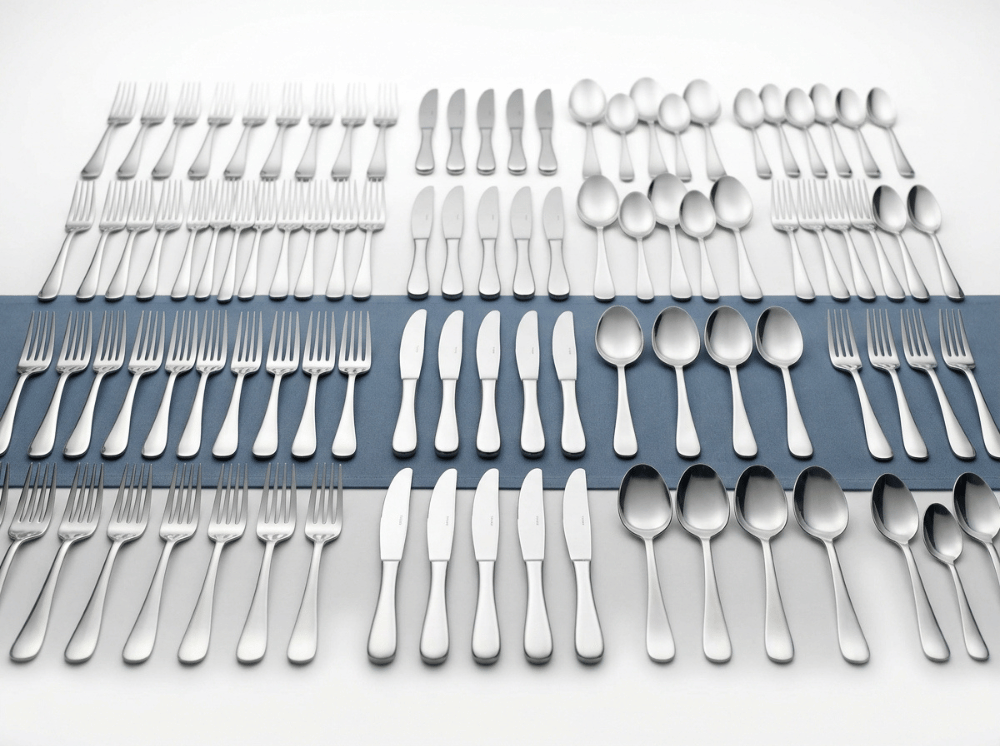
For restaurant owners, hotel buyers, and catering professionals, the flatware vs. silverware question has a clear commercial answer: stainless steel flatware—specified by grade, weight, and finish to match your concept—is the right choice for any operation running at volume.
18/10 for fine dining and luxury hospitality. 18/8 for upscale casual and boutique programs. 18/0 for high-turnover, high-loss environments where cost per piece matters more than longevity.
Browse our full range of commercial flatware at wonhosp.com and filter by grade, weight, and pattern to find the right fit for your operation. Need help specifying for a new opening or a full restocking? Our team is available to help you build a flatware program that aligns with your concept, accommodates your seat count, and fits your procurement budget.