
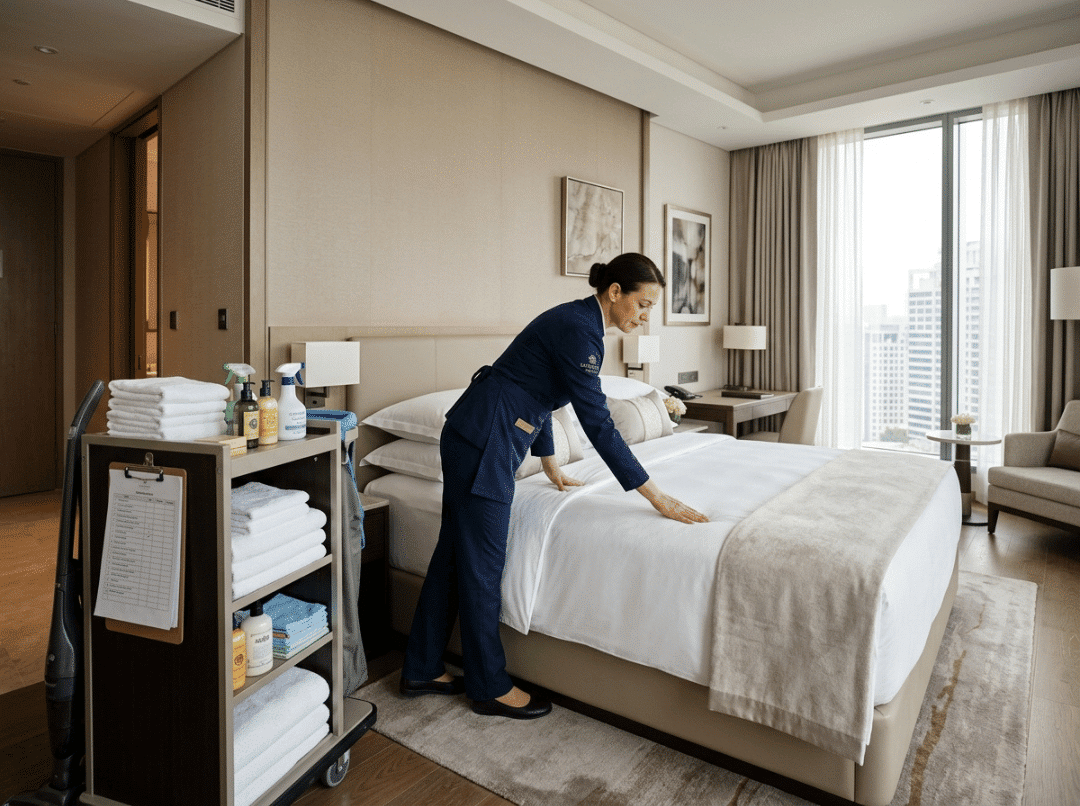
Clean, well-turned rooms do more than look nice. They drive review scores, repeat bookings, and the daily revenue you can actually count on. And how a hotel splits and runs its housekeeping directly shapes that outcome. Get the structure right, and every room feels ready; get it wrong, and small gaps show up in guest reviews within days.
This guide answers three things about the types of housekeeping in hotels: what the main types are, who handles each one, and the standards that separate a well-run department from a merely busy one. You will see how each type fits a different part of the property, why hotels split the work the way they do, and what “good” actually looks like in practice.
The key idea to hold onto is simple. Housekeeping is not a single job. It is an operational system of specialized teams, each with its own scope, pace, and quality bar. Once you see it that way, staffing decisions, supply planning, and quality control all get easier to reason about. Let’s start with a clear definition, then move through the types, the roles behind them, and the standards that hold the whole thing together.
What Is Housekeeping in the Hotel Industry?
Housekeeping is the hotel department responsible for cleanliness, hygiene, and guest-room readiness across the entire property — not just the bedrooms.
Its scope covers guest rooms, public spaces, linen and laundry, and back-of-house areas. Each of these touch points feeds directly into how a guest rates their stay. When housekeeping runs well, it protects three things at once: guest satisfaction, brand reputation, and hygiene compliance. When it slips, all three take the hit fast.
Why Different Types of Housekeeping Matter in Hotels
Hotels split housekeeping into types because each area has different tasks, different frequencies, and different standards. Treat them all the same, and gaps open up.
Think about the difference between a lobby and a checkout room. A lobby needs continuous upkeep — high-touch points wiped through the day, floors kept clear during peak arrivals. A checkout room needs a full, one-time turnover: strip, deep-clean the bathroom, restock, inspect. Linen sits in a third category entirely, where the real work is stock control and quality rotation, not surface cleaning.
Now picture what happens when a hotel runs public areas on a “clean it once in the morning” routine borrowed from room servicing. By mid-afternoon, elevator buttons, door handles, and restroom counters have seen hundreds of hands, and no one is scheduled to touch them until tomorrow. The property looks fine at 9 a.m. and grimy by 4 p.m. That is the cost of ignoring the categories.
Splitting housekeeping into types lets each team run on the routine its area actually needs. That is why the breakdown below matters — it is the foundation for staffing, scheduling, and standards.
Main Types of Housekeeping in Hotels
Hotel housekeeping breaks into distinct service types, each with its own scope, duties, and standards. The table below gives you a quick reference before we dig into each one.
|
Housekeeping Type |
Main Focus |
Typical Frequency |
Where It Matters Most |
|---|---|---|---|
|
Guest Room |
Cleaning and preparing rooms to standard |
Daily servicing + checkout turnover |
Every property — the most guest-judged type |
|
Public Area |
Lobbies, corridors, elevators, restrooms |
Continuous / all-day |
High-traffic and large properties |
|
Linen & Laundry |
Washing, ironing, folding, stock rotation |
Daily, high volume |
Any hotel running tight turnovers |
|
Floor |
Managing specific floors or wings |
Per shift, ongoing |
Larger hotels and multi-wing properties |
|
Exterior |
Entrances, façades, windows, walkways |
Weekly + daily spot checks |
Properties where first impressions count |
|
Specialized / VIP |
Turndown, personalized and suite prep |
Evening / on request |
Luxury and suite-heavy hotels |
Guest Room Housekeeping
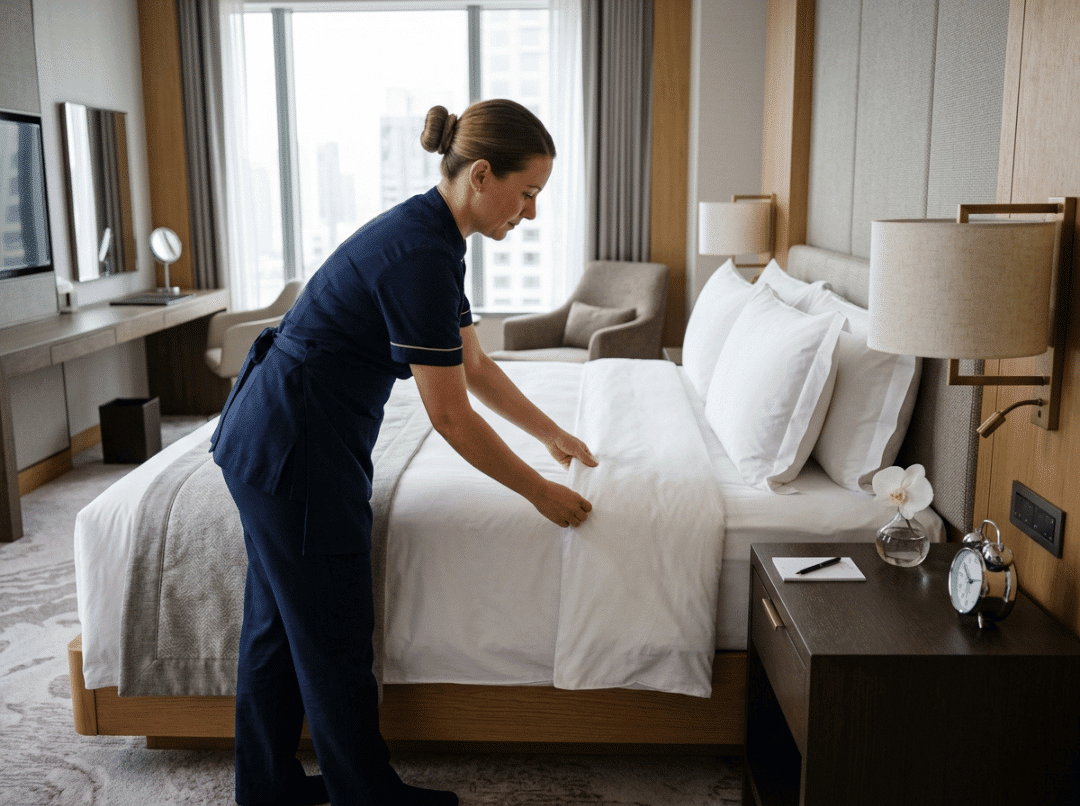
Guest room housekeeping is the work of cleaning and preparing rooms to a consistent standard, every time a guest arrives or stays over.
Core duties include making beds with fresh linens, sanitizing the bathroom, dusting and vacuuming, emptying bins, restocking amenities, and doing a final inspection before the room is released. The work runs on two tracks: a lighter daily service for occupied rooms, and a full turnover after checkout.
This is where it matters most because it is the type of service guests judge most directly. Nobody reviews your laundry room, but everybody notices a hair in the bathtub. The checkout turnover carries the highest stakes — it is the room the next guest sees first.
The operational focus is turnover time balanced against consistency. Push attendants too fast and quality drops; too slow and you cannot sell the room in time for check-in. The right guest room supplies and amenities make that balance easier — well-organized in-room items mean less time hunting and restocking.
Public Area Housekeeping
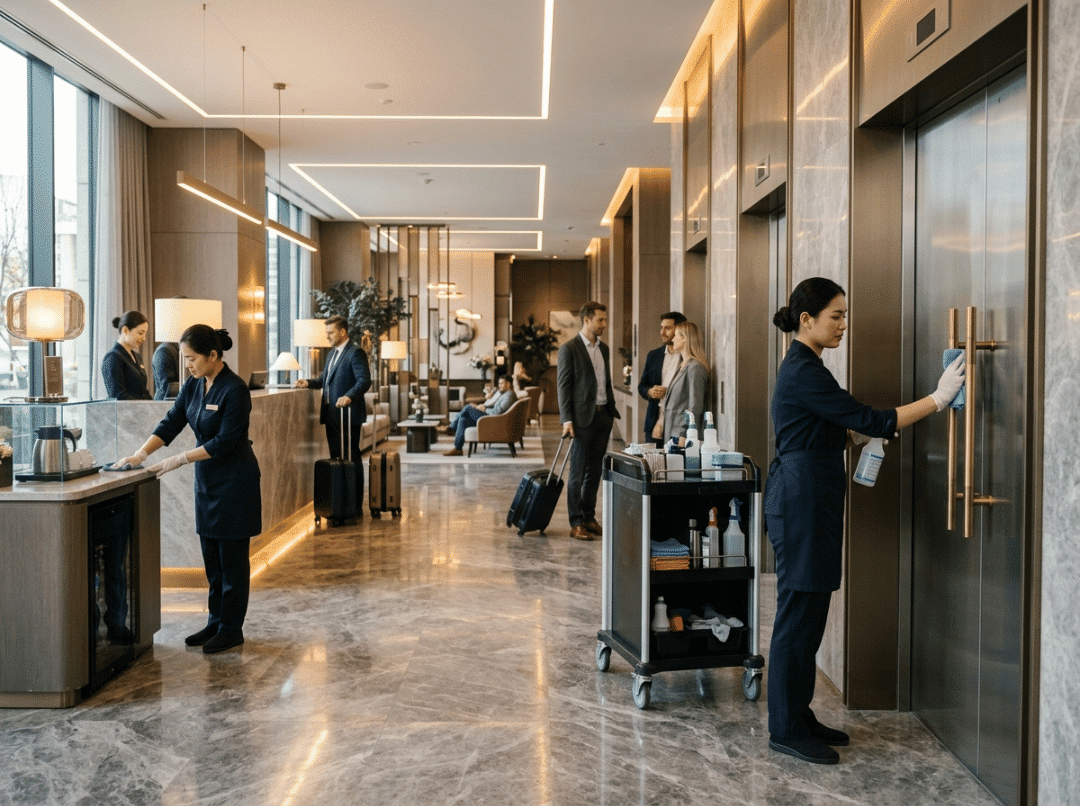
Public area housekeeping covers every shared space: lobbies, corridors, elevators, restaurants, gyms, and public restrooms.
Duties center on high-touch points, restroom upkeep, and the continuous cleaning of floors and common areas. Unlike room servicing, this work never really finishes — it cycles through the day.
It matters most in high-traffic properties, where cleanliness has to hold from the first arrival to the last. A single morning clean cannot carry a busy lobby through peak check-out, lunch service, and evening arrivals.
The operational focus here is response time. How fast can a team clear a spill, refresh a restroom, or handle a complaint in a public zone? Slow response is both a guest-impression problem and a liability risk.
Linen and Laundry Housekeeping
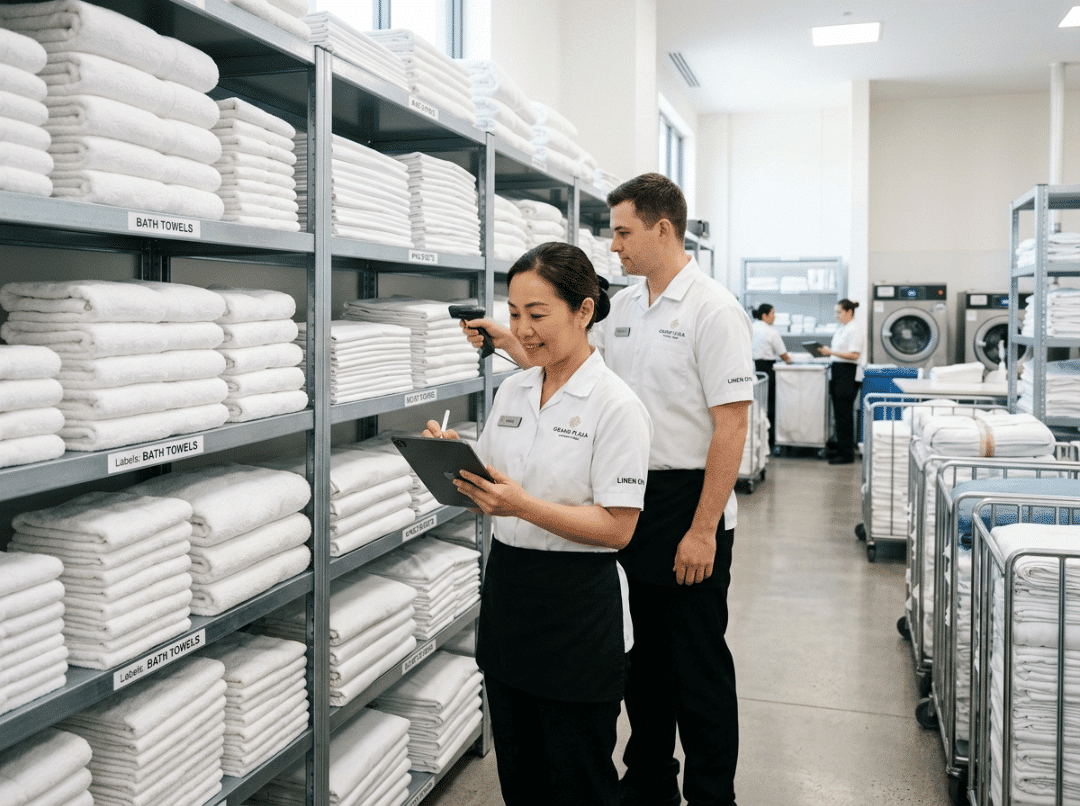
Linen and laundry housekeeping keeps the whole property supplied with clean textiles — washing, drying, ironing, folding, and rotating stock so nothing runs short.
The real duty here is not just washing; it is inventory management. Most hotels run on a par-stock system, typically three sets of linen per bed: one in use, one in the wash, one on the shelf.
This matters most at any property running tight turnovers. When linen runs short mid-afternoon, clean rooms sit unsellable simply because there are no fresh sheets to finish them. The whole turnover chain stalls behind a laundry gap.
The operational focus is par-stock control and linen quality. Even rotation extends linen life and prevents shortages, while consistent quality — crisp sheets, plush towels — carries an outsized share of perceived value. Reliable linen and towel sourcing is what keeps par levels realistic.
Floor Housekeeping
Floor housekeeping assigns teams to specific floors or wings, so each attendant owns a defined set of rooms.
Duties include servicing all rooms on the floor, monitoring pantry stock, coordinating turnovers with the front office, and flagging maintenance issues quickly. Teams often update room status in real time by radio or app.
This matters most in larger hotels. Picture a 400-room property run from one central list — when check-in traffic spikes, no one can tell which rooms are truly ready and which attendant is falling behind. Break it into floors, and accountability becomes obvious. Each floor has an owner, and problems trace back to a single point fast.
The operational focus is accountability per floor and turnover speed during check-in windows. When one person owns a floor, quality issues are easier to catch and fix before they reach a guest.
Exterior Housekeeping
Exterior housekeeping covers the parts of the property guests see before they walk in: entrances, façades, windows, and walkways.
Duties include pressure-washing paths, cleaning glass and entry doors, clearing litter, and keeping the entrance welcoming and hazard-free. Deep tasks usually run weekly, with daily spot checks on high-visibility zones.
It matters most because first impressions are formed outside. A stained walkway or a smudged glass door quietly undercuts every spotless room waiting inside. Guests decide what kind of hotel they have arrived at before they reach the front desk.
The operational focus is consistency at the entrance and other high-visibility points. This is the type most easily neglected, precisely because no one is standing in the lobby to complain about the exterior.
Specialized and VIP Housekeeping
Specialized and VIP housekeeping adds a layer of personal service for suites, high-value guests, and luxury properties.
The best-known duty is turndown service — preparing the room for the evening with refreshed linens, a tidy bathroom, dimmed lights, and small touches. VIP prep can go further: arranging flowers, setting out preferred amenities, or fulfilling specific requests noted at booking.
This matters most in luxury and suite-heavy hotels competing on experience rather than price. Here, the details are the product, and a thoughtful evening setup or a well-presented in-room welcome is what guests remember.
The operational focus is loyalty and premium-rate justification. Small, consistent touches turn a satisfied guest into a returning one — and the quality of those touches, from amenities to tableware, shapes the impression.
One newer category worth a mention is wellness and air-quality housekeeping — HEPA filtration, allergen control, and cleaner indoor air for health-conscious guests. It is an emerging trend rather than a core type, but it is worth watching as guest expectations shift.
Housekeeping Roles and Responsibilities
A working housekeeping department depends on clearly defined roles, from the executive housekeeper down to frontline staff. Clear reporting lines are what keep quality consistent when the property is full and the pressure is on. Here is the hierarchy from top to bottom.
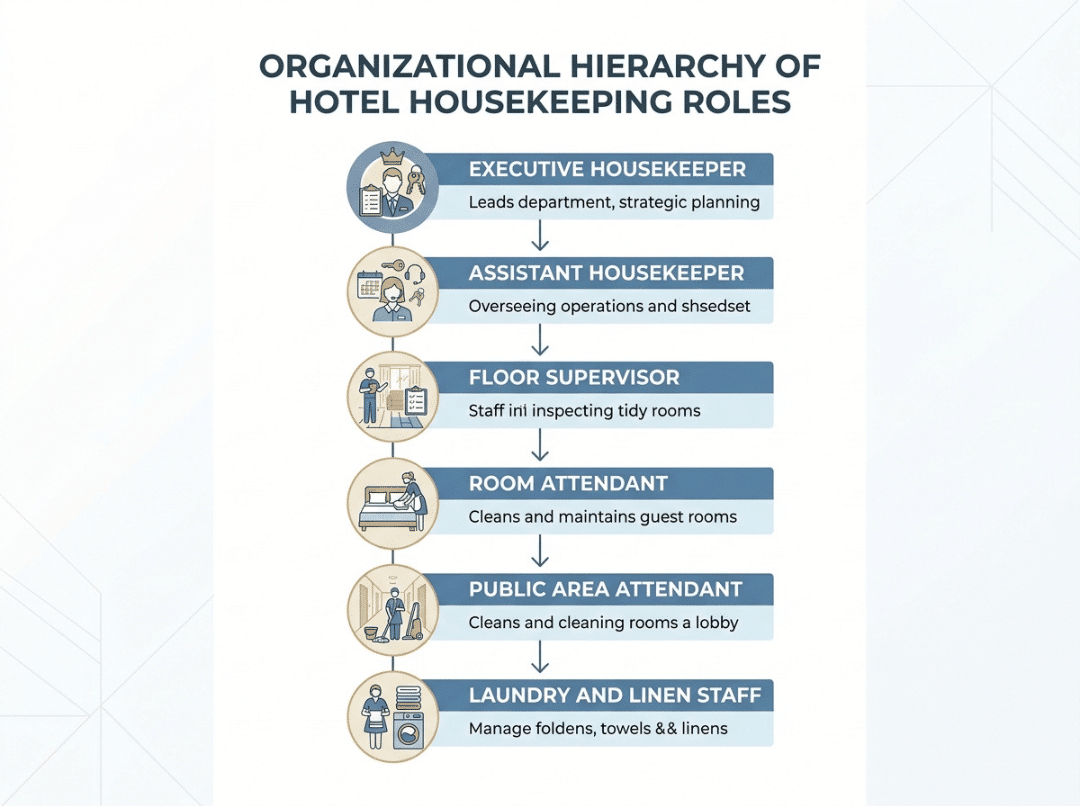
Executive Housekeeper and Assistant Housekeeper
The executive housekeeper leads the department. They own budgeting, staffing, scheduling, supplier relationships, and the standards everyone else follows. When linen costs creep up or inspection scores slip across a whole wing, this is the person who spots the pattern and fixes the system behind it.
The assistant housekeeper runs the day-to-day — covering shifts, supporting training, and stepping into inspections so the executive can stay focused on planning and standards.
Floor Supervisor and Team Leaders
Floor supervisors are the bridge between management and frontline staff, and their most important job is inspection. A supervisor’s check is the quality gate a room passes through before it goes back on sale. If a bathroom was rushed, this is where it should be caught — not by the next guest.
They also allocate workloads, manage supply pars on their floors, and escalate maintenance or guest issues. Inspection pass rate is often the department’s single most-watched quality number.
Room Attendants
Room attendants do the frontline cleaning guests actually see. They service assigned rooms to standard, restock amenities, report maintenance problems, and interact with guests politely when paths cross.
Their challenge is real: hit the required quality on every room while keeping pace with the turnover schedule. A strong attendant clears rooms quickly without leaving the small misses — a smudged mirror, a missing coffee pod — that trigger complaints.
Public Area Attendants
Public area attendants keep shared spaces clean on a continuous cycle rather than a room-by-room list. Their day is built around high-touch points, restroom checks, and fast spill response.
The scenario that defines this role is the unexpected mess in a busy lobby. A spilled drink near reception during peak arrivals needs to be gone in minutes, not after the morning rounds come back around.
Laundry and Linen Staff
Laundry and linen staff process every textile in the building — sheets, towels, and often uniforms and guest laundry. They run washing cycles, check quality, fold, and rotate stock.
Their quieter but critical duty is inventory control: tracking par levels, pulling worn linen before it embarrasses the brand, and keeping fresh stock flowing so no room ever stalls at turnover for want of clean sheets.
What Good Housekeeping Standards Look Like
Standards are what separate a well-run department from a busy one. Two hotels can put in the same hours and get very different results. Here is what “good” actually looks like, so you can benchmark your own operation.
- Room readiness: A guest-ready room passes a fixed inspection every time — bed correctly made, bathroom sanitized and dry, surfaces dust-free, amenities restocked, and no lingering odor. “Looks clean” is not a standard; a repeatable checklist is.
- Linen control: Par levels are held so turnovers never stall for lack of stock, and linen quality stays consistent, with worn items retired before guests notice fraying or graying.
- Inspection consistency: Every room is checked against the same criteria, regardless of who cleaned it or how busy the day is. Consistency here is what makes quality predictable rather than lucky.
- Response time: Spills, complaints, and special requests are handled quickly — within minutes in public areas, and within a clear window for in-room requests. Speed is a standard, not a favor.
The common thread is measurability. Good standards can be inspected and scored; vague ones cannot. If you cannot check it against a fixed bar, it will drift.
Essential Supplies That Support Housekeeping Operations
Every housekeeping type depends on the right supplies to hit its standards — and supply consistency is often what quietly makes or breaks execution. The point here is not a shopping list. It is that the right supplies, matched to each type of work, are what let teams meet the standards above without improvising.
- Guest room supplies and amenities: Linens, toiletries, and well-chosen in-room items shape perceived value more than almost anything else. When amenities are consistent and well-presented, attendants restock faster, and rooms feel intentional. (Learn More: guest room amenities and tableware on wonhosp.com.)
- Linen and towels: Reliable par stock and consistent quality tiers keep turnovers moving. Run short or mix quality levels, and the whole readiness chain wobbles.
- Public area and dining presentation: Buffet pieces and tableware carry your brand standard into shared spaces. A refined lobby means little if the breakfast buffet looks mismatched. (Learn More: buffet ornaments and tableware.)
- Cleaning consumables and carts: Well-organized carts and reliable consumables keep frontline teams efficient, so time goes into cleaning rather than fetching supplies.
Here is the operational angle worth taking seriously: inconsistent supplies undermine brand-standard execution across every room. When one floor gets one toiletry line, and another floor gets a substitute, “consistent” becomes impossible by definition. This is where one-stop sourcing earns its keep — matched, reliable supplies across every category mean your teams execute the same standard everywhere. If supply consistency is a recurring headache, consolidating sourcing is often the fix, and it is exactly the kind of coordinated supply support wonhosp.com is built to provide.
How Hotels Improve Housekeeping Efficiency and Consistency
Standards rise through a few practical levers, not one big fix. The four below cover most of the gains.
- Staff training: Consistent onboarding and regular refreshers keep quality from drifting as teams turn over. New hires should learn the standard from day one, not pick it up by guessing.
- Clear checklists: Repeatable routines remove guesswork and make inspections objective. When everyone follows the same checklist, “clean” means the same thing on every floor.
- Supply consistency: Reliable sourcing means teams never have to improvise with mismatched products — the quiet enabler behind every other lever.
- Cross-department coordination: Smooth sync with the front office and maintenance keeps turnovers fast and rooms selling. A room stuck “dirty” in the system is a room you cannot sell.
Each of these deserves a deeper playbook of its own, but together they form the practical backbone of a department that stays consistent under pressure.
FAQs
What are the main types of housekeeping in hotels?
The main types are guest room, public area, linen and laundry, floor, exterior, and specialized/VIP housekeeping. Each covers a different part of the property and runs on its own schedule and standard.
What are the main duties of hotel housekeeping staff?
Core duties include cleaning and preparing guest rooms, maintaining public areas, washing and rotating linen, restocking amenities, reporting maintenance issues, and inspecting work against a fixed standard before rooms are released.
What is the difference between a room attendant and a floor supervisor?
A room attendant does the frontline cleaning of assigned rooms. A floor supervisor inspects that work, coordinates staff across a floor or wing, manages supply levels, and acts as the quality gate before rooms go back on sale.
What makes a hotel room “guest-ready”?
A guest-ready room passes a fixed inspection: bed correctly made with fresh linen, bathroom sanitized and dry, surfaces dust-free, amenities restocked, and no lingering odor — clean by a repeatable checklist, not just by appearance.
How do hotels keep housekeeping standards consistent?
Through fixed inspection criteria, clear checklists, consistent training, reliable supply sourcing, and steady coordination with the front office and maintenance. Consistency comes from measurable standards, not effort alone.
Where can hotels source housekeeping and guest room supplies?
Hotels typically source from specialized hospitality suppliers who provide linens, amenities, tableware, and presentation pieces across categories. Consolidated, one-stop sourcing helps keep supplies consistent across the property. (Learn more: hotel supplies and product categories on wonhosp.com.)
Conclusion
Housekeeping is not a single job — it is a layered system where types, roles, and standards work together. The types define what needs cleaning and how often; the roles define who owns each piece and where quality gets checked; the standards define what “done well” actually means. Miss any one layer and the gaps show up in guest reviews.
With this framework, you have a practical way to audit your own operation: are your types matched to your property, your roles clearly owned, and your standards measurable rather than vague? That is where most quality problems trace back to.
One quiet factor ties it all together — supply consistency. Reliable, well-matched supplies are what let teams deliver the same standard in every room, every day. If consistent sourcing across linen, amenities, and presentation is on your list, explore the hotel supplies and one-stop sourcing options at wonhosp.com to give your team the foundation it needs.